
Governing the Sustainability Transformation is Failing. What Now?

By Michael Rose

From both global and national-level perspectives, we are witnessing the widespread failure of the ‘sustainable state’ (Bornemann et al. 2025) or ‘sustainability state’ (Rose 2025) and their aspirations for a governed sustainability transformation. When we look at the 2030 Agenda with its Sustainable Development Goals (SDGs), globally, none of the goals is even close to being on track to be achieved by 2030, and the governance impact of the SDGs is largely confined to the discursive level (Sachs et al. 2026; Biermann et al. 2022). Similarly, the Paris Agreement, and systemic sustainability indicators such as planetary and social boundaries more broadly, are mostly off track (Fanning & Raworth 2025). While international green growth programs seem to fail, niche concepts such as degrowth economies are still being discussed in small activist circles but cannot be expected to be willingly and successfully implemented in any state in the foreseeable future.

Against the background of the polycrisis, the promises of a sustainability transformation are currently shattering against the ‘glass ceiling of transformation’ (Hausknost 2020), in full view of everyone. But instead of doubling down on our joint efforts to break through this glass ceiling, we are seeking exclusionary shelter from the splinters in our nation-states or, in the case of global tech elites, in libertarian visions up in space and private luxury bunkers underground.

Caught Between Greenlash, Resilience and Transformation

At least discursively, resilience is taking precedence over transformation. In light of these developments, the sustainable state is on the defensive, struggling to preserve the little that has been achieved, and falling short of any feasible and broadly appealing democratic vision of a viable, inclusive sustainable future. Its claim to global and intergenerational justice has lost both credibility and appeal and is in serious jeopardy.

Acknowledging these realities does not mean that we should give up on the sustainable state as scientists or citizens, though. Possible alternatives, such as a shift away from multi-level sustainability governance with and beyond the state toward populist, nationalist, authoritarian, or even decentralized tribalist and anarchist approaches, may help us ignore the increasingly severe global sustainability issues in the short term, but seem even less likely to mitigate them in the long term.

For better or worse, we need to take both a resilience and a transformation perspective: working against the short-sighted ‘greenlash’ in governance, policy, politics and society, while developing pragmatic and integrative transformation pathways to a less unsustainable future.

The Special Issue

I originally wrote this text (above) a couple of months ago when I was drafting a contribution to the ‘future perspectives’ section of our editorial for the Special Issue “Toward the Sustainable State: Theoretical and Empirical Perspectives on Sustainability-oriented State Transformations,” edited by Basil Bornemann, Marius Christen, Francesco Laruffa and me. I guess I must have been in a somewhat dark mood. As a benefit of co-authorship, our ‘future perspectives’ now paint a more nuanced picture and offer suggestions for ways forward. But read for yourselves (Bornemann et al. 2026)!

Image: The Green Leviathan.

In our editorial, we summarise and critically reflect on the role of the state in sustainability transformations. Is, can, should, and will there be a Green Leviathan? To explore these questions, we review and comment on the ambiguous relationship between the (democratic) state, the polycrisis and sustainability, develop the heuristic of the ‘sustainable state’, and engage with the contributions to the Special Issue. We start with a short discussion of how the current entangled crises seem to strengthen (expectations of) the role of the state. Next, we briefly review political developments and academic discourses of the last 60 years with regard to environmental and sustainability governance with and beyond the state. We focus on more recent developments and narratives that emphasise the state both as the (perhaps only) actor capable of steering systemic sustainability transformations and as a key agent and structure of persistent unsustainability.

Looking forward, we build the heuristic of the ‘sustainable state’ to structure the state-centred sustainability discourse. We distinguish between the political-ideological, policy, institutional, and structural level of the sustainable state, as well as three complementary approaches of analysis: descriptive-analytical, critical-analytical, and prescriptive. While refraining from an agreed definition, we consider the sustainable (or sustainability) state to move beyond the earlier concept of the environmental state and to engage the full normative and functional implications of the idea of sustainability, integrating ecological concerns with social justice and long-term orientations, and recognizing the need for transformative rather than merely managerial change.

After presenting the articles of our Special Issue, we identify and review cross-cutting issues, i.e., the relationship of the sustainable state to economic growth, democracy, and crisis. We conclude by setting out future perspectives, reflecting on current and future political, social, and technical developments, in particular the recent ‘greenlash’ and possible future collapses, and what it means for the prospects of the sustainable state, our roles as researchers, the sustainability transformation more broadly, and future research.

The Special Issue offers rich empirical, conceptual and critical perspectives on the issues raised above and has just been published open access in Sustainability: Science, Practice and Policy. Authors include, next to us as editors and many others, Doris Fuchs, Marit Hammond, Max Koch and Amanda Machin.

Link to the complete Special Issue: https://www.tandfonline.com/journals/tsus20/collections/towards-the-sustainable-state

References

Biermann, F., T. Hickmann, C. Sénit, M. Beisheim, S. Bernstein, P. Chasek, L. Grob, et al. 2022. “Scientific Evidence on the Political Impact of the Sustainable Development Goals.” Nature Sustainability 5 (9): 795–800. https://doi.org/10.1038/s41893-022-00909-5

Bornemann, B., M. Christen, and P. Burger. 2025. “The Sustainable State: A Meta-Governance Framework.” Environmental Politics 34 (2): 344–366. https://doi.org10.1080/09644016.2024.2369015

Bornemann, B., M. Christen, F. Laruffa, and M. Rose, M. 2026. “Toward the Sustainable State in Times of Crisis?” Sustainability: Science, Practice and Policy, 22 (1): 2740549. https://doi.org/10.1080/15487733.2026.2740549

Fanning, A., and K. Raworth. 2025. “Doughnut of Social and Planetary Boundaries Monitors a World out of Balance.” Nature 646 (8083): 47–56. https://doi.org/10.1038/s41586-025-09385-1

Hausknost, D. 2020. “The Environmental State and the Glass Ceiling of Transformation.” Environmental Politics 29 (1): 17–37. https://doi.org/10.1080/09644016.2019.1680062

Rose, M. 2025. “From the Environmental State to the Sustainability State? Conceptualization, Indicators, and Examples.” Sustainability: Science, Practice and Policy 21 (1): 2463188. https://doi.org/10.1080/15487733.2025.2463188

Sachs, J., G. Lafortune, G. Fuller, and G. Iablonovski. 2026. Implementing Sustainable Development: 2030 and Beyond. Sustainable Development Report 2026. Dublin: Dublin University Press. https://doi.org/10.82163/225

Workshop on “Rethinking the governance of European Water protection” 

By Nadine Schröder

When:  January 8th-9th 2019

Where: Helmholtz Centre for Environmental Research (UFZ) in Leipzig

Organizers:

Nadine Schröder  (Leuphana University Lüneburg)

Barbara Schröter (Leibniz Centre for Agricultural Landscape Research (ZALF))

Frank Hüesker (UFZ Leipzig)

Content:

During this workshop we want to discuss on European Water governance and to address frameworks/ lenses/ concepts/ theories and methods to research water governance: Which factors, levels and scales do they focus on? Which roles play participation, sector integration and basin approaches? We draw conclusions how the governance might be improved in favor of better performance: Which factors may influence local, regional and national success or failure? Are best-practice examples identifiable empirically? Additionally, we critically reflect how the chosen frameworks and methods predetermine the findings of regulating parameters. We aim for joint products as results of the workshop, like e.g. a special issue, a book, joint conference panels, seeding joint projects, work on the science-policy interface, a manifest and so on, which is open to be discussed and depends on the interest of the participants.

You can have a look at the abstract and preliminary program here:

Preliminary Program

Abstract


Report

Now published: Leverage Points for Sustainability Transformation

Joern's avatarIdeas for Sustainability

By Joern Fischer

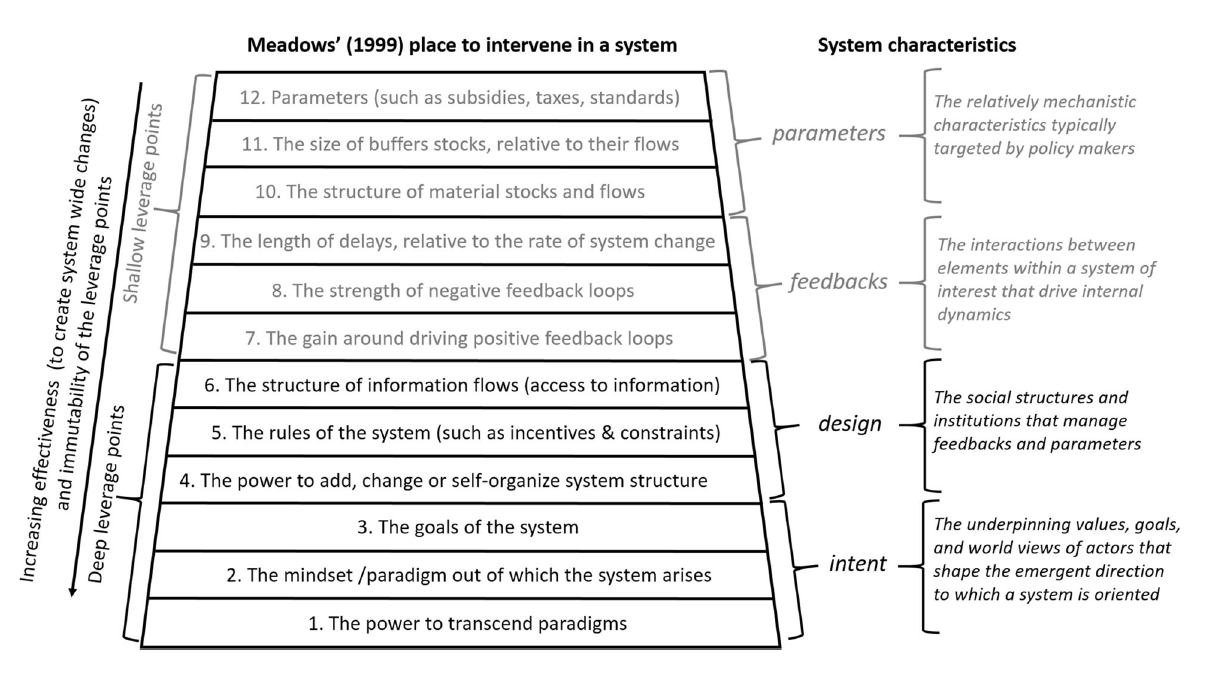
Finally, the first paper is out from our Leverage Points project. It’s led by Dave Abson, and lays out a conceptual framework and research agenda, all around the notion of “deep leverage points”. Please share it through your networks.

Screen Shot 2016-06-28 at 10.31.56.pngThe paper draws on Donella Meadows’ notion of “deep leverage points” – places to intervene in a system where adjustments can make a big difference to the overall outcomes. Arguably, sustainability science desperately needs such leverage points. Despite years of rhetoric on sustainability science bringing about “transformation”, the big picture is still pretty dull: globally at least, there is no indication that we’re starting to turn around the patterns of exponential growth that characterize our era. A potential reason is that much of sustainability science has focused on parameters and feedbacks, rather than system design or “intent” (see above) — when actually, it’s changing a system’s design…

View original post 255 more words

If at first you don’t succeed.. Institutional Failure in the Public Sector

A review of Public Policy and Administration’s special issue on policy failure

By Pim Derwort

In many ways, failure is an inevitable part of life. In many cases, it is also something we would rather not be reminded of and may be hard to accept. Some of the most inspirational movies and stories teach us how to accept or ‘let go’ and ‘move on’ from failure, or to learn from our mistakes on a personal level and generally become better persons for it. But what happens when failure occurs in the public sector?

In the public sector, ‘getting it wrong’ can have significant (and damaging) consequences for those affected. It can significantly damage the public’s trust in the political system, damage individual’s careers and, in extreme cases, may even lead to injury or loss of life. While failure may be just as inevitable, it is all the more important to prevent or learn from mistakes. Yet, in the public policy realm, plenty of examples remain of cases where important lessons remain unlearned, mistakes are buried, responsibility is deflected and the causes of the original failure continue unchallenged. Often, the same – or at least similar – mistakes are repeated time and again.

So what exactly do we understand by ‘failure’? Failure is often defined as the “lack of success”, or alternatively, as a “lack or deficiency of a desirable quality”. Judged by this definition, ‘failure’ is a negative concept, defined largely by the absence of concepts with more positive associations like ‘success’ or ‘quality’. As with general definitions of ‘failure’, definitions of ‘policy failure’ vary, and there have been considerable conceptual difficulties in providing a commonly accepted definition of ‘policy failure’. In its simplest form, failure has been defined as the ‘mirror image of success’ (McConnell, 2010). The difference between success and failure is, however, not always clear-cut. In many cases policies are not an outright success or outright failure, and may succeed in some respects while failing in others. There are many reasons why a policy may fail. A policy may be poorly designed and fail to tackle the problem it was intended to solve or largely be symbolic (e.g. Newig, 2007). Alternatively, a well-designed policy may unexpectedly fail due to unforeseen circumstances or simply not have the effect intended.

Failure can be measured in different ways, and is often subject to interpretation. Disagreement over whether a policy actually should be considered to have failed may arise depending on who is asked (see e.g. Bovens & ‘t Hart, 2011). Policy failures, inevitable or not, are not necessarily problematic. If it is possible to identify the causes of the failure, it may also be possible to adapt the policy or to replace it with one that is better suited. More problematic, however, are persistent policy failures, in which the same type of failure is repeated over time

In July 2015, Public Policy and Administration dedicated a special issue to the topic of ‘policy failure’. In this issue, the authors argue that, despite the volume of literature on policy success and failure, much of it has so far focused on conceptualisations of (different types of) failure, with considerably less attention for the sources of the problems leading to recurrent failures (Howlett, Ramesh & Wu, 2015, p.209). In addition, it is argued that a great deal of the research only examines the causes and characteristics of failed policies in individual cases, rather than looking at the broader political or socio-economic environment in which these policies are embedded (Peters, 2015, p.261), thus limiting our ability to learn from past mistakes. Therefore, the goal of this special issue is to improve our understanding of recurring failures by “examining a wide range of factors both within and beyond a policy subsystem” (Howlett, Ramesh & Wu, 2015, p.209).

Some of the contributions in this issue help improve our understanding of ‘policy failure’. In an attempt to overcome some of the conceptual difficulties, McConnell develops a ‘working definition of ‘failure’, arguing that “a policy fails, even if it is successful in some minimal respects, if it does not fundamentally achieve the goals that proponents set out to achieve, and opposition is great and/or support is virtually non-existent (2015, p.221). Failure is not only limited to policies and other contributions focus on failure in terms of, e.g. ‘state failure’, ‘governance failure’ and ‘implementation failure’ Importantly, Peters (2015, p.264) argues specific failures may only be “a symptom of a broader failure in governing”, and that, to be able to identify these forms of failure, it is important to look beyond just the proximate causes of observed policy failures per se, instead aiming to identify the more deeply seated roots of failure.

In my opinion, there are two main “lessons” to take away from this special issue:

  • Firstly, future research should continue to build on Peters’ thoughts and look beyond individual categories of failure, instead developing a better understanding of the bigger picture. To this end, I would like to propose that it is important to look at the concept of ‘institutional failure’.
  • Secondly, throughout the special issue, and indeed the wider literature, ‘failure’ largely continues to be regarded as something negative. McConnell is the only author to briefly refer to possible “positive benefits” that might ensue from failure in his contribution (2015, p.227), unfortunately without going into further detail. Further attention should be paid to the ways in which failure can allow us to learn important lessons and act as a driver for positive change.

The concept of ‘institutional failure’ has been interpreted in different ways, depending on the disciplinary perspective adopted. From a neo-classical economics perspective, it has been defined as “private and government sector failure” (Pitelis, 1992). Alternatively, from a sustainability perspective, it has been defined in terms of resource sustainability or the inability to conserve resources (Acheson, 2006). The innovation approach (Woolthuis et al., 2005) divides institutional failure into ‘hard institutional failure’ (failures in the framework of regulation and the legal system) and ‘soft institutional failure’ (failures in social institutions such as political culture and social values). Finally, while not everyone agrees (see e.g. Stacey & Rittberger, 2003), another perspective refers to institutions as organisations, regarding institutions as actors/players in their own right. Following these different definitions, the concept of ‘institutional’ failure is sufficiently broad to capture all of the different concepts mentioned above.

In his work, Newig (2013) identifies these as “productive functions” of failure, in that they may allow for valuable lessons to be learned, can trigger adaptations towards sustainability or purposefully destabilise existing unsustainable structures. Currently, these ideas are not yet sufficiently developed and there appear to be few systematic studies into the lessons that (institutional) failure can provide to scholars and practitioners. Focusing on institutional failure and its productive functions will therefore be at the heart of my PhD project over the next three years.


References:

Acheson, J.M. (2006). ‘Institutional Failure in Resource Management’. Annual Review of Anthropology, 35, pp.117-134.

Bovens, M. and ‘t Hart, P. (2011) Understanding Policy Fiascoes. New Brunswick: Transaction Publishers.

Howlett, M., Ramesh, M. & Wu, X. (2015). ‘Understanding the persistence of policy failures: The role of politics, governance and uncertainty’. Public Policy and Administration,30(3-4), pp. 209-220.

McConnell, A. (2010). Understanding Policy Success: Rethinking Public Policy. Basingstoke: Macmillan.

McConnell, A. (2015). ‘What is policy failure? A primer to help navigate the maze’. Public Policy and Administration,30(3-4), pp.221-242.

Newig, J. (2007). ‘Symbolic Environmental Legislation and Societal Self-Deception’. Environmental Politics, 16(2), pp.279-299.

Newig, J. (2013). ‘Produktive Funktionen von Kollaps und Zerstörung für gesellschaftliche Transformationsprozesse in Richtung Nachhaltigkeit’. In: Rückert-John, J. (Ed.)(2013). Soziale Innovation und Nachhaltigkeit, Innovation und Gesellschaft. Wiesbaden: Springer Fachmedien.

Peters, B.G. (2015). ‘State failure, governance failure and policy failure: Exploring the linkages’. Public Policy and Administration,30(3-4), pp.261-276.

Pitelis, C. (1992). ‘Towards a Neo-classical Theory of Institutional Failure’. Journal of Economic Studies, 19(1), pp.14-29.

Stacey, J. & Rittberger, B. (2003). ‘Dynamics of formal and informal institutional change in the EU’. Journal of European Public Policy, 10(6), pp.858-883.

Woolthuis, R.K., Lankhuizen, M. & Gilsing, V. (2005). ‘A system failure framework for innovation policy design’. Technovation, 25, pp.609-619.