ERC Advanced Grant GAPS – Global Assessment of Public Participation in Sustainability Governance: Performance, Justice and Democracy

The European Research Council (ERC) will fund a five-year Advanced Grant project on the role of public participation in sustainability governance in all world regions. We will soon be recruiting the full team: one postdoctoral and four doctoral researchers (see below under ‘Open positions’).

Public participation has become a standard part of sustainability governance worldwide – from citizens’ assemblies and participatory budgeting to stakeholder consultations, and across democratic and non-democratic systems alike. Participatory decision-making is expected to improve environmental decisions, strengthen democratic legitimacy, and give marginalised groups a voice. However, we lack sound knowledge on whether participation actually delivers on these goals. The evidence is scattered across thousands of individual case studies in different languages, disciplines and outlets, each usually limited to one format, sector or region.

Public participation is now a global phenomenon – well beyond Western democracies where most of it was first studied and theorised. But we do not know whether models developed there travel – or whether political regime, level of development and culture fundamentally change how participation ‘works’. Comparative research has so far mostly stopped at single regions or sectors, leaving the cross-regional patterns, and the prevailing North–South and democratic–authoritarian assumptions, largely untested.

What GAPS will do

The project plans to assemble and analyse virtually all documented cases of public participation in sustainability governance for which scholarly publications are available – from all world regions and across the past fifty years, coded into one common framework. The aim is to find patterns on which forms of participation improve sustainability, strengthen democracy and advance justice – and how this varies across political systems, levels of development and cultures.

GAPS will use the case survey method, which our group has applied and tested in 300+ cases of participatory environmental decision-making in Western democracies (EDGE project), and scale it to thousands of case studies worldwide, supported by Large Language Models (LLMs) for coding, benchmarked against human coding.
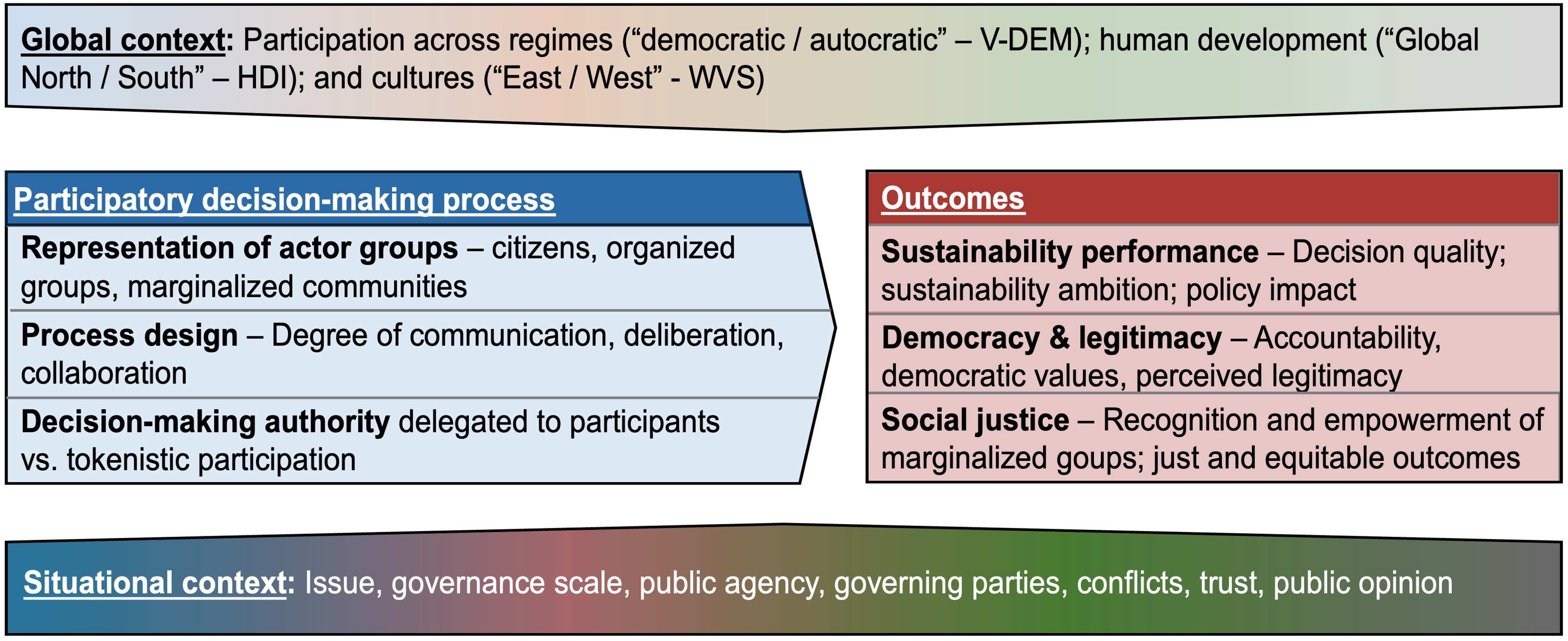
Simplified Conceptual model, including exemplary items to assess.

To address the global challenge, GAPS will pursue a more nuanced approach than is often taken: Instead of assuming a divide between North and South, democratic and authoritarian, or West and East, GAPS treats human development, regimte type and culture as continuous variables and matches each case to country-level data from available global databases on human development (HDI), liberal democracy (V-Dem Liberal Democracy Index), and cultural orientation (World Values Survey).
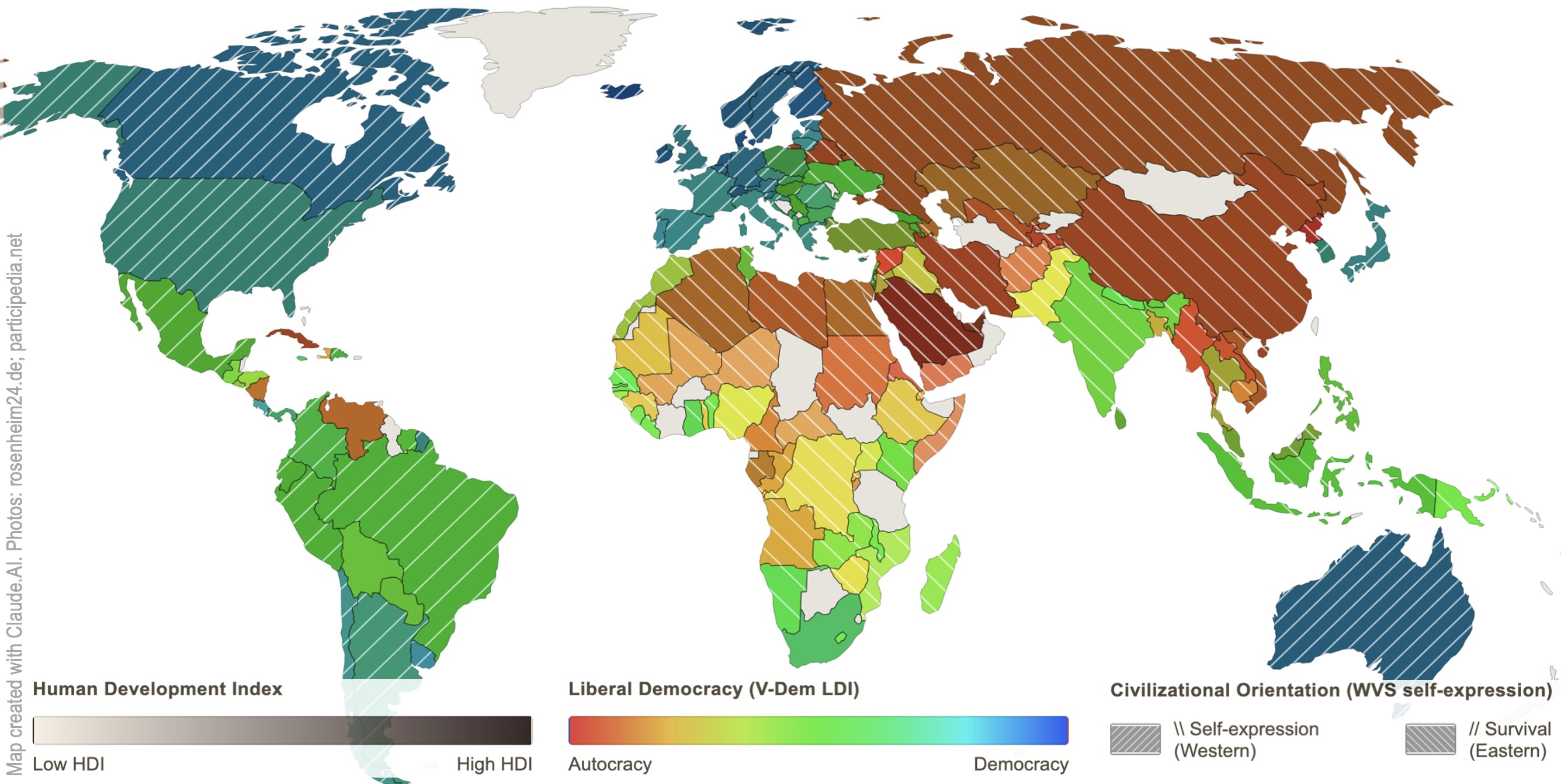
The three context dimensions used to place each case. Shading shows human development (HDI) and liberal democracy (V-Dem LDI); diagonal hatching marks cultural orientation from the World Values Survey, self-expression (“Western”) against survival (“Eastern”) values. Map created with Claude.AI.

To allow for causal analysis, we will combine statistical analysis, including path models to uncover mechanism variables and multi-level models to account for the nested case–country structure, with Large-N Qualitative Comparative Analysis (QCA) and causal process tracing on selected cases.

The research team, based at Leuphana University Lüneburg, will collaborate closely with Prof. Nicolas W. Jager at TU Berlin.

Open positions

We will be hiring one postdoctoral and four doctoral researchers, all at the Institute of Sustainability Governance (one PhD jointly with TU Berlin at Nicolas Jager’s group). Each PhD addresses one component of the overall research programme; the postdoc leads the methodological and synthesis work and helps coordinate the project. All team members will have strong methodological experience.

Postdoc · 100% · 5 years – Participation in sustainability governance and AI-assisted comparison. Co-leads the AI-assisted case database and quality assurance, supports qualitative and quantitative PhD analyses, leads synthesis and theory-building.

PhD · 75% · 4 years –  Participation and sustainability performance. Whether and how participation produces better environmental decisions, across climate, biodiversity, pollution and resource management.

PhD · 75% · 4 years – Participation, democracy and justice. When participation strengthens democracy and legitimacy, and includes marginalised groups in fairer procedures and outcomes.

PhD · 75% · 4 years – Global patterns of participation in sustainability governance. How political, developmental and cultural contexts shape participatory designs and their effects; carries the country-level data and multi-level analysis.

PhD · 75% · 4 years · with TU Berlin – Participation in environmental impact assessments. Comparing more and less participatory environmental impact assessments worldwide. Co-supervised by Prof. Nicolas W. Jager, working in Berlin and Lüneburg.

Macro-Level Datasets for Sustainability Governance

By Michael Rose

Comparative politics scholars love macro data. To comparatively analyze all kinds of nation states and institutions, they build datasets on their characteristics. For example, there are several datasets and indices that help to assess and eventually measure democracies and autocracies worldwide, such as the Freedom House Index, Varieties of Democracy, The Economist’s Democracy Index, or the Polity Project. But data are systematically collected and made available to the research community far beyond democracy indices (see below).

In sustainability governance research, though, these kinds of databases are rarely used or developed. This is a pity, as comparative (macro) data could help to conduct mid- and large-n studies, account for important parts of context variance in comparative case studies, and thereby facilitate relating and cumulating knowledge.

The following list offers a selection of open access datasets used in political science that can be of great benefit for sustainability governance scholars. Feel free to post additional datasets in the comment section!

The Comparative Constitutions Project codes the world’s constitutions, including variables on the states’ polity (branches of government, formal institutions, election rules, federalism) and the constitutions’ issue areas, e.g. if and how the constitution refers to the environment and natural resources. Constitutional changes are tracked on a yearly basis (Elkins et al. 2019).

Polity IV accounts for democratic and authoritative regimes, including variables such as the central state authority, executive constraints, political participation, and transitions (Center for Systemic Peace 2019).

ParlGov provides data on parties, elections and cabinets for 37 western democracies (Döring and Manow 2019).

The Party Manifesto Project codes, inter alia, the party family of ecological parties and statements regarding environmental protection and sustainability in party manifestos (electoral programs) (Volkens et al. 2019).

World Values Survey and European Values Study include aggregatable information on the interviewee’s membership in environmental organizations, attitudes towards environmental care, participation in demonstrations for the environment, donating behavior towards ecological organizations, confidence in the environmental protection movement, and satisfaction with issues such as air quality, public transport, or water quality (Inglehart et al. 2019; European Value System Study Group et al. 2019).

The Sustainable Governance Indicators analyze the policy performance and governance capacities in EU and OECD countries. This includes environmental policies and outcomes (such as waste and GHG emissions), the participation in multilateral environmental agreements and evidence-based instruments such as sustainability checks (Bertelsmann Stiftung 2018; Schraad-Tischler et al. 2018).

The Environmental Performance Index analyses 24 performance indicators for 180 countries (Wendling et al. 2018).

And, of course, the statistics departments of international organizations such as the World Bank and the OECD provide many additional time-series data on key economic, social, environmental, government and development indicators (World Bank 2019; OECD 2019).

Moreover, in their Sustainable Development Report, the Bertelsmann Foundation and the Sustainable Development Solutions Network jointly track the SDG achievements of most of the world’s nations statistically (Sachs et al. 2019).

Cited literature

Bertelsmann Stiftung (2018): Sustainable Governance Indicators. Gütersloh. Available online at http://www.sgi-network.org.

Center for Systemic Peace (2019): Polity IV Project. Vienna (Virginia). Available online at https://www.systemicpeace.org/polityproject.html, checked on 8/14/2019.

Döring, Holger; Manow, Philip (2019): Parliaments and governments database (ParlGov). Information on parties, elections and cabinets in modern democracies. Available online at parlgov.org, checked on 8/13/2019.

Elkins, Zachary; Ginsburg, Tom; Melton, James (2019): Comparative Constitutions Project. Informing constitutional design. Available online at https://comparativeconstitutionsproject.org.

European Value System Study Group; Tilburg University; GESIS (2019): European Values Study. Tilburg, Mannheim. Available online at https://europeanvaluesstudy.eu, checked on 8/13/2019.

Inglehart, R.; Haerpfer, C.; Moreno, A.; Welzel, C.; Kizilova, K.; Diez-Medrano, J. et al. (2019): World Values Survey. Edited by JD Systems Institute. Madrid. Available online at http://www.worldvaluessurvey.org, checked on 8/13/2019.

OECD (2019): OECD.Stat. Paris. Available online at https://stats.oecd.org/.

Sachs, J.; Schmidt-Traub, G.; Kroll, C.; Lafortune, G.; Fuller, G. (2019): Sustainable Development Report 2019. Transformations to achieve the Sustainable Development Goals. Edited by Bertelsmann Stiftung, Sustainable Development Solutions Network (SDSN). New York. Available online at https://sustainabledevelopment.report.

Schraad-Tischler, Daniel; Schiller, Christof; Hellmann, Thorsten; Lopes, Elisabeth Faria (2018): Policy Performance and Governance Capacities in the OECD and EU. Sustainable Governance Indicators 2018. Edited by Bertelsmann Stiftung. Gütersloh. Available online at https://www.sgi-network.org/docs/2018/basics/SGI2018_Overview.pdf, checked on 8/2/2019.

Volkens, Andrea; Krause, Werner; Lehmann, Pola; Matthieß, Theres; Merz, Nicolas; Regel, Sven; Weßels, Bernhard (2019): The Manifesto Data Collection. Manifesto Project (MRG/CMP/MARPOR). Edited by Wissenschaftszentrum Berlin für Sozialforschung (WZB). Berlin. Available online at https://manifesto-project.wzb.eu, checked on 8/13/2019.

Wendling, Z. A.; Emerson, J. W.; Esty, D. C.; Levy, M. A.; Sherbinin, A. de; et al. (2018): 2018 Environmental Performance Index. Edited by Yale Center for Environmental Law and Policy. New Haven. Available online at https://epi.yale.edu.

World Bank (2019): World Bank Open Data. Free and open access to global development data. Available online at https://data.worldbank.org/.