ERC Advanced Grant GAPS – Global Assessment of Public Participation in Sustainability Governance: Performance, Justice and Democracy

The European Research Council (ERC) will fund a five-year Advanced Grant project on the role of public participation in sustainability governance in all world regions. We are now recruiting the full team: one postdoctoral and four doctoral researchers (see below under ‘Open positions’).

Public participation has become a standard part of sustainability governance worldwide – from citizens’ assemblies and participatory budgeting to stakeholder consultations, and across democratic and non-democratic systems alike. Participatory decision-making is expected to improve environmental decisions, strengthen democratic legitimacy, and give marginalised groups a voice. However, we lack sound knowledge on whether participation actually delivers on these goals. The evidence is scattered across thousands of individual case studies in different languages, disciplines and outlets, each usually limited to one format, sector or region.

Public participation is now a global phenomenon – well beyond Western democracies where most of it was first studied and theorised. But we do not know whether models developed there travel – or whether political regime, level of development and culture fundamentally change how participation ‘works’. Comparative research has so far mostly stopped at single regions or sectors, leaving the cross-regional patterns, and the prevailing North–South and democratic–authoritarian assumptions, largely untested.

What GAPS will do

The project plans to assemble and analyse virtually all documented cases of public participation in sustainability governance for which scholarly publications are available – from all world regions and across the past fifty years, coded into one common framework. The aim is to find patterns on which forms of participation improve sustainability, strengthen democracy and advance justice – and how this varies across political systems, levels of development and cultures.

GAPS will use the case survey method, which our group has applied and tested in 300+ cases of participatory environmental decision-making in Western democracies (EDGE project), and scale it to thousands of case studies worldwide, supported by Large Language Models (LLMs) for coding, benchmarked against human coding.
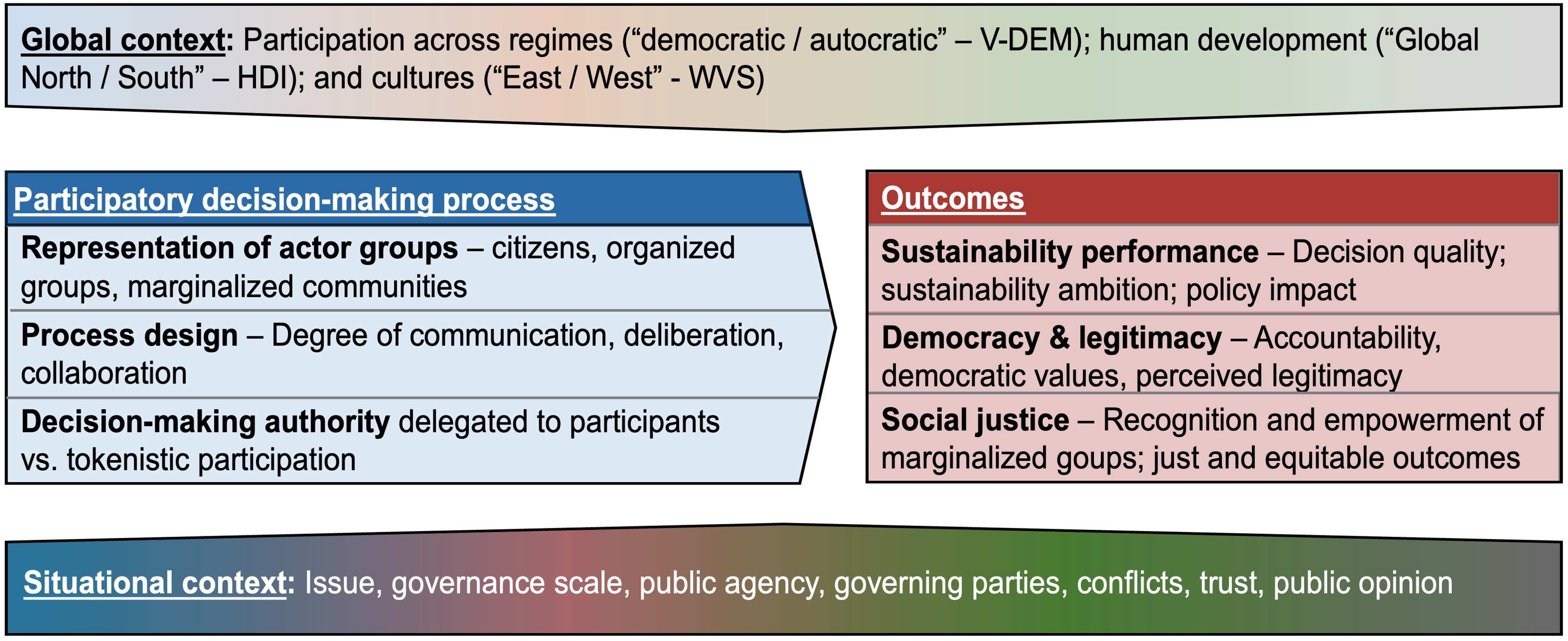
Simplified Conceptual model, including exemplary items to assess.

To address the global challenge, GAPS will pursue a more nuanced approach than is often taken: Instead of assuming a divide between North and South, democratic and authoritarian, or West and East, GAPS treats human development, regimte type and culture as continuous variables and matches each case to country-level data from available global databases on human development (HDI), liberal democracy (V-Dem Liberal Democracy Index), and cultural orientation (World Values Survey).
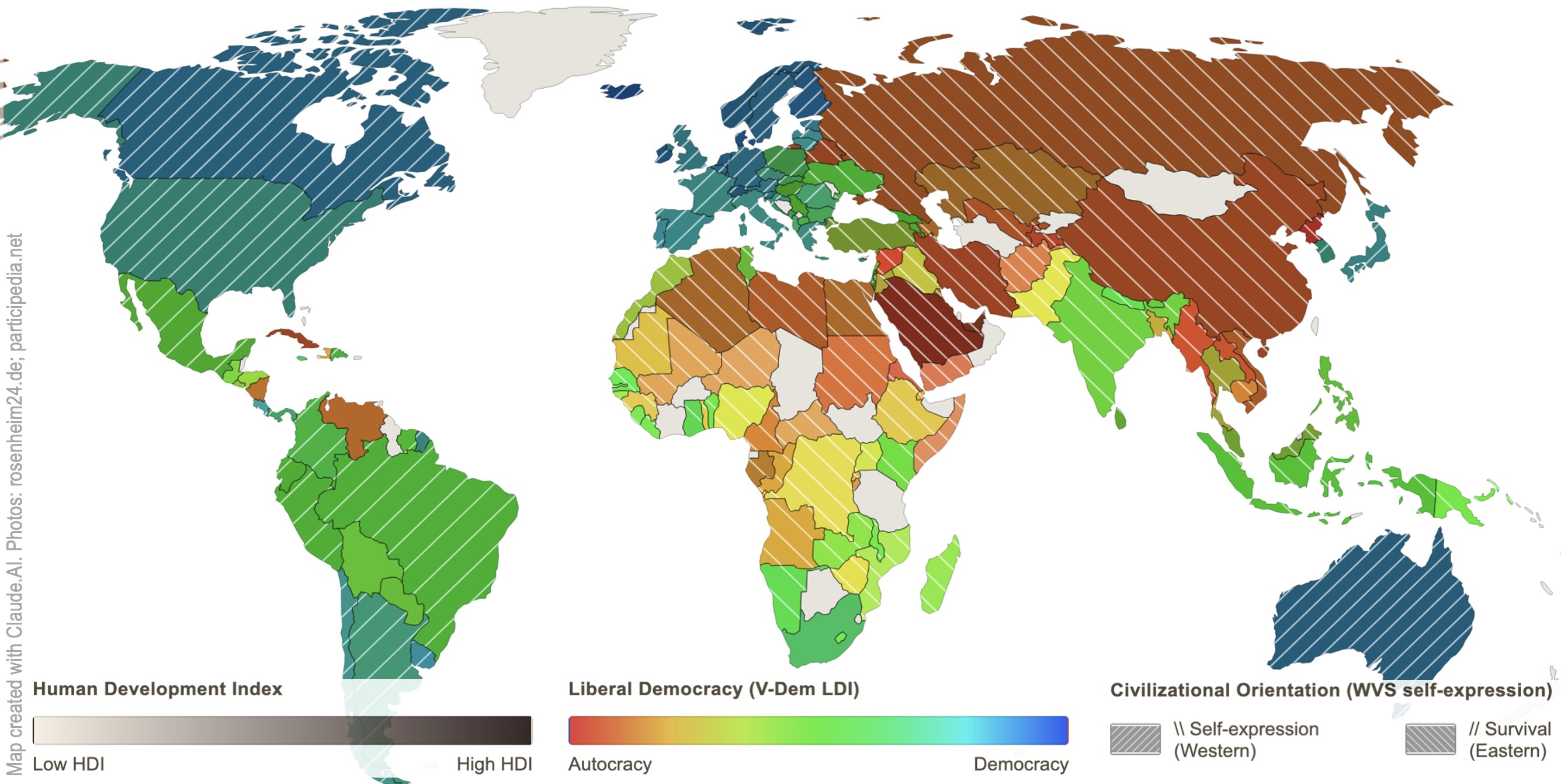
The three context dimensions used to place each case. Shading shows human development (HDI) and liberal democracy (V-Dem LDI); diagonal hatching marks cultural orientation from the World Values Survey, self-expression (“Western”) against survival (“Eastern”) values. Map created with Claude.AI.

To allow for causal analysis, we will combine statistical analysis, including path models to uncover mechanism variables and multi-level models to account for the nested case–country structure, with Large-N Qualitative Comparative Analysis (QCA) and causal process tracing on selected cases.

The research team, based at Leuphana University Lüneburg, will collaborate closely with Prof. Nicolas W. Jager at TU Berlin.

Open positions

We will be hiring one postdoctoral and four doctoral researchers, all at the Institute of Sustainability Governance (one PhD jointly with TU Berlin at Nicolas Jager’s group). Each PhD addresses one component of the overall research programme; the postdoc leads the methodological and synthesis work and helps coordinate the project. All team members will have strong methodological experience.

Postdoc · 100% · 5 years – Participation in sustainability governance and AI-assisted comparison. Co-leads the AI-assisted case database and quality assurance, supports qualitative and quantitative PhD analyses, leads synthesis and theory-building.

PhD · 75% · 4 years –  Participation and sustainability performance. Whether and how participation produces better environmental decisions, across climate, biodiversity, pollution and resource management.

PhD · 75% · 4 years – Participation, democracy and justice. When participation strengthens democracy and legitimacy, and includes marginalised groups in fairer procedures and outcomes.

PhD · 75% · 4 years – Global patterns of participation in sustainability governance. How political, developmental and cultural contexts shape participatory designs and their effects; carries the country-level data and multi-level analysis.

PhD · 75% · 4 years · with TU Berlin – Participation in environmental impact assessments. Comparing more and less participatory environmental impact assessments worldwide. Co-supervised by Prof. Nicolas W. Jager, working in Berlin and Lüneburg.

How I handled missing data in a meta-analysis of case studies

By Shahana Bilalova

As researchers, we frequently find ourselves delving deeply into the body of scientific literature in an effort to find the answers to the questions we have. Recently, I conducted a case survey, which is a kind of meta-analysis that synthesizes qualitative case narratives in published literature. During this process, coping with missing data became both a challenging and insightful journey, which led me to take a strategic approach.

With an aim of understanding how well water governance systems function in addressing various water-related issues, my goal was very clear: to compile data from empirical studies in our sample. I was using cases that we identified systematically at the beginning of our project. These cases were from one of the two problem contexts (in our paper termed problématiques), namely “groundwater exploitation in agriculture” and “surface water pollution”. While in our previous studies, we had clustered cases into five problématiques, I selected the mentioned two problématiques, as they combined a large share of cases and represented diverse natures of problem contexts.

My initial plan was straightforward: to extract data for each case from the original articles in our sample. However, it did not go as planned, and I ran into a problem that all researchers face: incomplete data. Only 12% of cases (10 out of 86 cases) provided complete data. Before addressing the missing data, with careful consideration, I strategically chose 20 cases for each problématiques—40 being the minimum number necessary for QCA in our study—selecting those with the most complete data. Considering the amount of time and resources needed to complete the missing data, this stage was necessary. I then looked into other innovative ways to filling these gaps.

(1) Tapping into expert insight: the first strategy

My first idea was to get in touch with the main authors of the articles, considering their knowledge of the case. This approach was successful in some cases, so I gathered data for another 10 out of 40 cases (33% of the missing information). Authors shared their expert knowledge through surveys, helping with the missing information. Yet, some authors did not respond at all, and with articles published decades ago, authors often struggled to recall details about the cases. Additionally, one of the cases for which we received an author survey still had one missing piece of information.

(2) The hunt for alternative sources: grey or academic literature

As a response to the situation, I delved into the literature, both grey and academic, searching for alternative sources to to fill the remaining missing information. The goal was to identify further publications on the given cases that could help with the missing data. I included either literature published within +/- 5 years of the original article’s publishing date or publications that studied governance within the timeframe of the original article. Although this step required a close look, it was often successful in finding the information I was looking for. As a result, I was able to fill in 69% of the missing information (completing information for 16 cases).

(3) The third strategy: replacement cases

However, all these steps still left some cases with missing data. As a last step, I took a pragmatic approach—replacing those remaining 5 cases with still incomplete data with others from our sample that shared the same problématique and contained more complete data compared to the cases in the whole sample. After replacing the cases, I filled in the missing information for these new cases using the alternative sources.

In conclusion…

Working with the missing information in a case survey demands flexibility, creativity, and perseverance. Although reaching out to authors, looking into alternative sources, and using replacement cases aren’t guaranteed solutions, they are effective ways to get around the problems caused by gaps in the data. During this process, I have come to appreciate research’s dynamic nature, where adaptability is just as important as the data itself. Of course, the important thing is that we are transparent with it. Even though handling missing data might be challenging and difficult at times, we should remember that each missing piece presents an opportunity to improve our problem-solving abilities.

Introducing ParticipationCaseScout – a tool to explore 305 coded cases of public environmental governance

By Jens Newig and Michael Rose

We are proud and happy to announce the launch of ParticipationCaseScout: a new web-based tool to explore and analyse a database of public environmental decision processes, with a focus on participatory and collaborative governance in Western democratic states (project ‘EDGE’).

With the goal of integrating and cumulating fragmented case-based knowledge, ‘EDGE’ has produced a database of 305 coded cases of public environmental governance, mainly to test the relationship between different forms of participatory and collaborative decision-making and environmental outcomes (for results, see e.g. Jager et al. 2020 and Newig et al. 2019). Funded by the European Research Council (ERC), ‘EDGE’ was led by Jens Newig, with Ed Challies, Nicolas Jager and Elisa Kochskämper as collaborators. The map below shows all locations of ‘EDGE’ cases.

To facilitate knowledge transfer, we developed the idea for ParticipationCaseScout in two undergraduate research seminars at Leuphana University Lüneburg in 2019 and 2020. When students were conducting expert interviews, they learned that professionals in public administration and consulting would appreciate a web-based tool that allows them to browse case studies in settings similar to their own work.

After two years of work, ParticipationCaseScout (available in English and German) not only serves to browse, explore and compare existing case studies (with many options for searching and filtering). It also allows to calculate governance-related ‘success’ factors for achieving desired environmental or social outcomes via specifically tailored regression analyses.

We are grateful to our many collaborators: our student assistants, Marlene Rimmert, Anita Vollmer, Inga Melchior and Lana Wesemann; the participants of the two undergraduate seminars; the many experts in public administration and consulting who commented on earlier versions of ParticipationCaseScout and to Mathias Jesussek from DataTab for technical implementation of the interactive tool.

We hope that ParticipationCaseScout will inspire practitioners in the evidence-informed design of participatory decision-making processes, and provide researchers an easy access to a cumulative knowledge base for further comparative inquiry – qualitative and quantitative.