
Understanding power dynamics in stakeholder participation – integrating theory and practice for effective biodiversity conservation
Duration: since 2021
Funded by the French Foundation for Research on Biodiversity (FRB) through its Centre for the Synthesis and Analysis of Biodiversity (CESAB)
Biodiversity conservation increasingly relies on stakeholder participation to reduce conflict, build trust, foster learning and improve outcomes. Yet participatory processes do not unfold on neutral ground: power shapes who takes part, whose knowledge and interests count, and how decisions are made. While power is often invoked in conservation research, it is usually treated as one-dimensional – as “power over” others or as the degree of power delegated to participants – and rarely linked systematically to conservation outcomes. PowerBiodiv addresses this gap by asking how a multidimensional understanding of power can help explain the context, design and outcomes of participatory processes, which strategies exist to address power-related challenges, and what roles researchers, institutional actors and practitioners can play.
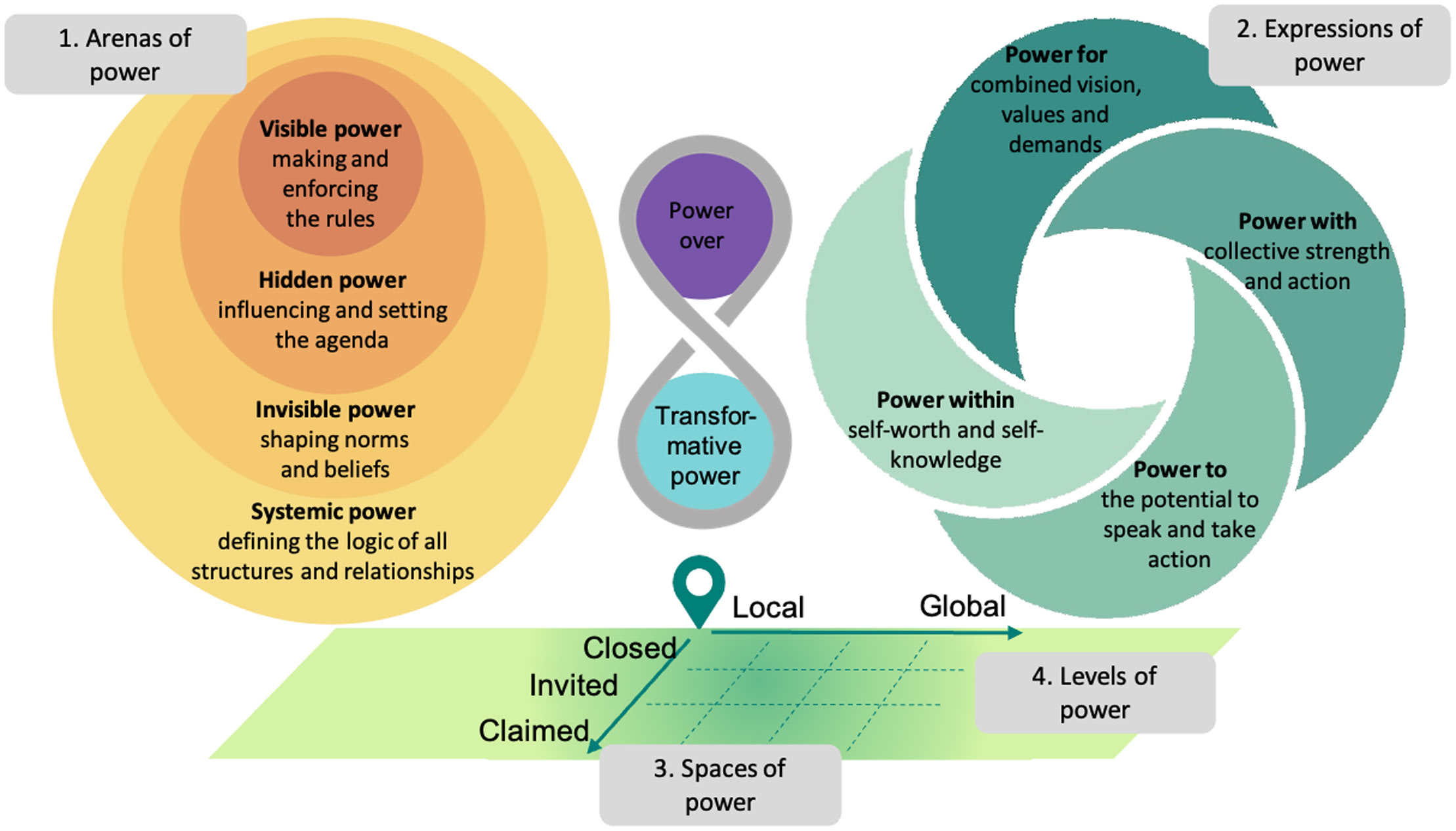
Multiple dimensions of power framework. Graph: Lécuyer et al. (2024), People and Nature, CC BY-NC-ND 4.0; adapted from JASS (2023), Gaventa (2006) and the Power Cube.
The collaborative project
PowerBiodiv is a transdisciplinary synthesis project selected in the 2020 call of the FRB-CESAB programme. It brings together researchers from ecology, geography and the political and social sciences with professional facilitators and representatives of conservation and development institutions, who have met in five workshops since 2021. The project combines three strands of work:
- A multidimensional framework of power. Drawing on work by gender activists and development scholars, the group adapted a framework that distinguishes arenas of power (visible, hidden, invisible, systemic), expressions of power (power to, with, within and for), and spaces and levels of power, and tested it on six participatory processes from Europe and the Asia-Pacific in which members had been involved.
- A systematic review. A systematic review of empirical case studies of participatory biodiversity conservation, which examines how different dimensions of power relate to the outcomes of these processes (see below).
- Resources for practice. For practitioners, facilitators and policymakers, the group has produced a “Tool for Thought” on navigating power in participatory processes and a collection of case narratives, “Staying in the Room”, together with a webinar.
The systematic review
The review follows a protocol published in PROCEED and the guidelines of the Collaboration for Environmental Evidence. Searches in Scopus and Web of Science yielded some 8,350 records. After title, abstract and full-text screening, 87 articles describing 82 distinct participatory processes worldwide were included. Each case was coded on more than 140 variables using a codebook that adapted the SCAPE scheme for the comparative analysis of public environmental decision-making to the analysis of power, complemented by variables from the literature and from three scoping workshops with researchers and practitioners. The coding follows each process from its context through design and implementation to its outputs and outcomes. On this basis, the evidence is being analysed in several complementary ways:
- a systematic map of how, and how deeply, different dimensions of power are documented across the stages of participatory processes;
- a quantitative synthesis that condenses the coded variables into latent dimensions of power through exploratory factor analysis and models their effects on environmental, social and institutional outcomes with random forests;
- a qualitative synthesis that uses a hybrid deductive–inductive thematic analysis to examine how power is described, interpreted or left implicit in published accounts;
- a citation network analysis that explores the theoretical traditions on which this literature draws.
Results of the review are currently being prepared for publication.
Key findings so far
Applying the framework to six participatory processes – Hatfield Forest in England, a contested airport project in western France, large carnivore platforms in the French and Italian Alps, seascape planning in Papua New Guinea and national park negotiations in northern Thailand – showed that the dimensions of power are not separate but intertwined. Visible decision-making power, hidden agenda-setting and invisible norms interact, and “power over” and transformative power can be at work in the same process. Facilitators, too, shape these dynamics. Two challenges stand out for biodiversity in particular: how to represent “beyond-human” voices, and how to integrate multiple knowledge systems when participatory processes tend to privilege scientific data. Integrating power into biodiversity conservation therefore means questioning established discourses centred on the most powerful actors and on scientific knowledge alone, and creating new narratives and practices that give room to a wider diversity of voices (Lécuyer et al. 2024).
Our research group’s contribution
Jens Newig is a member of the PowerBiodiv working group, contributing expertise on participatory environmental governance and research synthesis. The codebook for the systematic review was built on the SCAPE scheme developed in our group, and the review draws on methods and findings from our earlier case survey meta-analyses on participation and environmental outcomes. Jens contributes methodological guidance on the review, co-authored the framework paper and the review protocol, and is a co-author of the forthcoming papers reporting the review results.
Project team
Principal investigators: Juliette Young (INRAE, France) and James Butler (Cawthron Institute, New Zealand; formerly CSIRO, Australia); postdoc: Lou Lécuyer (FRB-CESAB)
Working group: Estelle Balian (FEAL – Facilitation for Environmental Action and Learning, France), Cécile Barnaud (INRAE, Toulouse), Gianetta Butler (independent researcher, New Zealand), Simon Calla (Université Marie et Louis Pasteur, Besançon), Bruno Locatelli (CIRAD, Montpellier), Jens Newig (Leuphana University Lüneburg), Jethro Pettit (Institute of Development Studies, University of Sussex), Diana Pound (Dialogue Matters, UK), Fabien Quétier (Rewilding Europe), Valeria Salvatori (Istituto di Ecologia Applicata, Rome), Yorck von Korff (Flow-ing, France)
Further contributors to the systematic review: Adriana R. Aguilar-Melo, Camille Coux, Joseph Langridge, Sandra Piña-Romero
For details, see the PowerBiodiv page at FRB-CESAB.

