
Sustainability Governance of Global Value Chains
Duration: 08 / 2024 – 07 / 2028
Funded by the VolkswagenFoundation and the Lower Saxony Ministry of Science and Culture under the programme “Wissenschaftsräume”, with a volume of € 2,967,000
Global demand for agricultural commodities and minerals has long been linked to poor working conditions and environmental damage, especially in producing countries of the Global South. For a long time, efforts to address this relied mostly on voluntary certification and auditing. Since the mid-2010s, binding due diligence laws have followed – among them the French Loi de Vigilance (2017), the German Supply Chain Due Diligence Act (LkSG, 2023) and the EU Corporate Sustainability Due Diligence Directive (CSDDD, 2024). How these laws are implemented, and what they change along global value chains (GVCs), is still largely unexplored. GO-Chains therefore asks: what are the actual and potential effects of supply chain laws and related governance initiatives in transforming GVCs towards sustainability?
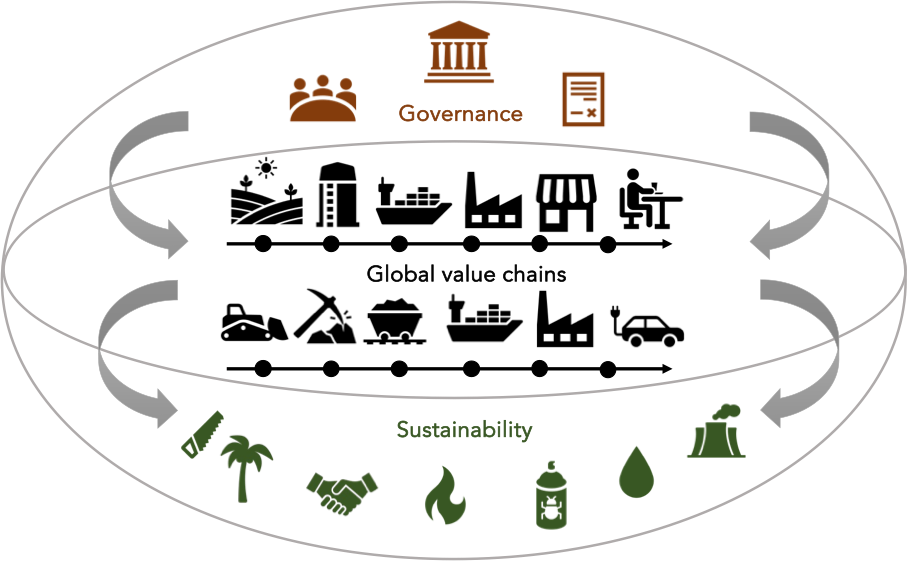
Graph: Johanna Coenen
The collaborative project
GO-Chains is an interdisciplinary collaborative project led by Leuphana University Lüneburg, with Osnabrück University as co-lead, the University of Oldenburg, and the German Institute for Global and Area Studies (GIGA) in Hamburg. It brings together political science, law, business studies, information systems, economics and geography. GVCs are studied from three perspectives, each forming a research cluster, with shared case studies and field work:
- Public governance: the design, administrative implementation and enforcement of due diligence laws and their interplay with trade law, private standards and civil society. At Leuphana, this includes our research group’s work on the effects of due diligence laws (see below) and legal research on regulatory approaches across national, EU and international law; in Osnabrück, work on the advocacy coalitions shaping EU human rights and environmental due diligence policy.
- Corporate and chain governance: how companies and their networks respond to the new rules. At Leuphana, researchers study sustainability reporting and accounting, corporate transformation management and the design of sustainable supply networks; in Oldenburg, the team studies multi-tier supply chains and the role of intermediaries; in Osnabrück, AI-based approaches to sustainability governance.
- Regional perspectives, especially the Global South: the intended and unintended effects of supply chain regulation in producing countries. At GIGA in Hamburg, researchers analyse the effects on producers and producing countries; in Osnabrück, regulatory risks in global production networks are investigated through fieldwork in agricultural supply chains. Work at Leuphana on resource governance in producing countries (see below) links to this perspective.
Results will be shared with companies, authorities and civil society through public-facing conferences and policy briefs, and will feed into teaching, e.g. via a summer school.
Our research group’s contribution: public governance
Our research group works mainly in the public governance cluster.
Franca Angela Bülow (postdoc, project coordinator) studies how due diligence legislation shapes the public and corporate governance of global value chains. With colleagues from the public governance cluster, she conducts a case-based meta-analysis of the empirical literature on the implementation and effects of mandatory supply chain regulation. Early results suggest that research concentrates on legal and corporate implementation in the Global North, while administrative implementation, enforcement and impacts in the Global South remain understudied. With colleagues from the corporate governance cluster, she analyses more than 30,000 GRI-based sustainability reports (2013 to 2024), combining LLM-assisted topic extraction with embedding, clustering and topic modelling to examine how firms construct materiality and how reporting templates converge and persist. She also examines how mandatory human rights and environmental due diligence regulation, such as the EU CSDDD, the German LkSG and the EUDR, redistributes regulatory authority across states, corporations and supply chain actors. This work develops a typology of sovereignty regimes and a normative benchmark of shared responsibility sovereignty to assess whether such reconfigurations are legitimate.
Alongside her research, she coordinates the project, managing its website and LinkedIn channel, organising its monthly webinars, consortium meetings and other events, and project reporting.
Jelto Makris (PhD researcher) examines how human rights and environmental due diligence (HREDD) laws play out in producing countries, focusing on resource-based sectors in Latin America such as fisheries in Ecuador and Peru and cocoa production. Starting from a meta-analysis of HREDD impacts, he investigates how these laws interact with local natural resource governance, voluntary standards and other EU rules such as the Deforestation Regulation, and how relations between companies, public authorities, resource users and NGOs shape their effects. He also explores alternative approaches, such as jurisdictional governance, to address enforcement gaps.
Project consortium
Lead: Prof. Dr. Jens Newig; co-lead: Prof. Dr. Andrea Lenschow (Osnabrück); coordination: Dr. Franca Angela Bülow
Leuphana University Lüneburg: Prof. Dr. Jens Newig, Prof. Dr. Jelena Bäumler, Prof. Dr. Alexander Schall, Prof. Dr. Dr. h.c. Stefan Schaltegger, Prof. Dr. Elke Schüßler, Prof. Dr. Patrick Velte; Finn Bongert, Dr. Franca Angela Bülow, Barbara Ehbauer, Kathleen Evers, Nora Große, Jelto Makris
Osnabrück University: Prof. Dr. Andrea Lenschow, Prof. Dr. Martin Franz, Prof. Dr. Frank Teuteberg; Henrike Jost, Frederik Kamphues, Sofiya Pohurskyy, Dr. Philip Verfürth
University of Oldenburg: Prof. Dr. Christian Busse; Dr. Satwant Dahiya, Jia Zuo
GIGA, Hamburg: Prof. Dr. Jann Lay; Dr. Frauke Steglich
The collaborative project is supported by an international advisory board. For details, see go-chains.org.
Publications
Publications will be listed here as they appear.

