
The European Research Council (ERC) will fund a five-year Advanced Grant project on the role of public participation in sustainability governance in all world regions. We are now recruiting the full team: one postdoctoral and four doctoral researchers (see below under ‘Open positions’).
Public participation has become a standard part of sustainability governance worldwide – from citizens’ assemblies and participatory budgeting to stakeholder consultations, and across democratic and non-democratic systems alike. Participatory decision-making is expected to improve environmental decisions, strengthen democratic legitimacy, and give marginalised groups a voice. However, we lack sound knowledge on whether participation actually delivers on these goals. The evidence is scattered across thousands of individual case studies in different languages, disciplines and outlets, each usually limited to one format, sector or region.
Public participation is now a global phenomenon – well beyond Western democracies where most of it was first studied and theorised. But we do not know whether models developed there travel – or whether political regime, level of development and culture fundamentally change how participation ‘works’. Comparative research has so far mostly stopped at single regions or sectors, leaving the cross-regional patterns, and the prevailing North–South and democratic–authoritarian assumptions, largely untested.
What GAPS will do
The project plans to assemble and analyse virtually all documented cases of public participation in sustainability governance for which scholarly publications are available – from all world regions and across the past fifty years, coded into one common framework. The aim is to find patterns on which forms of participation improve sustainability, strengthen democracy and advance justice – and how this varies across political systems, levels of development and cultures.
GAPS will use the case survey method, which our group has applied and tested in 300+ cases of participatory environmental decision-making in Western democracies (EDGE project), and scale it to thousands of case studies worldwide, supported by Large Language Models (LLMs) for coding, benchmarked against human coding.
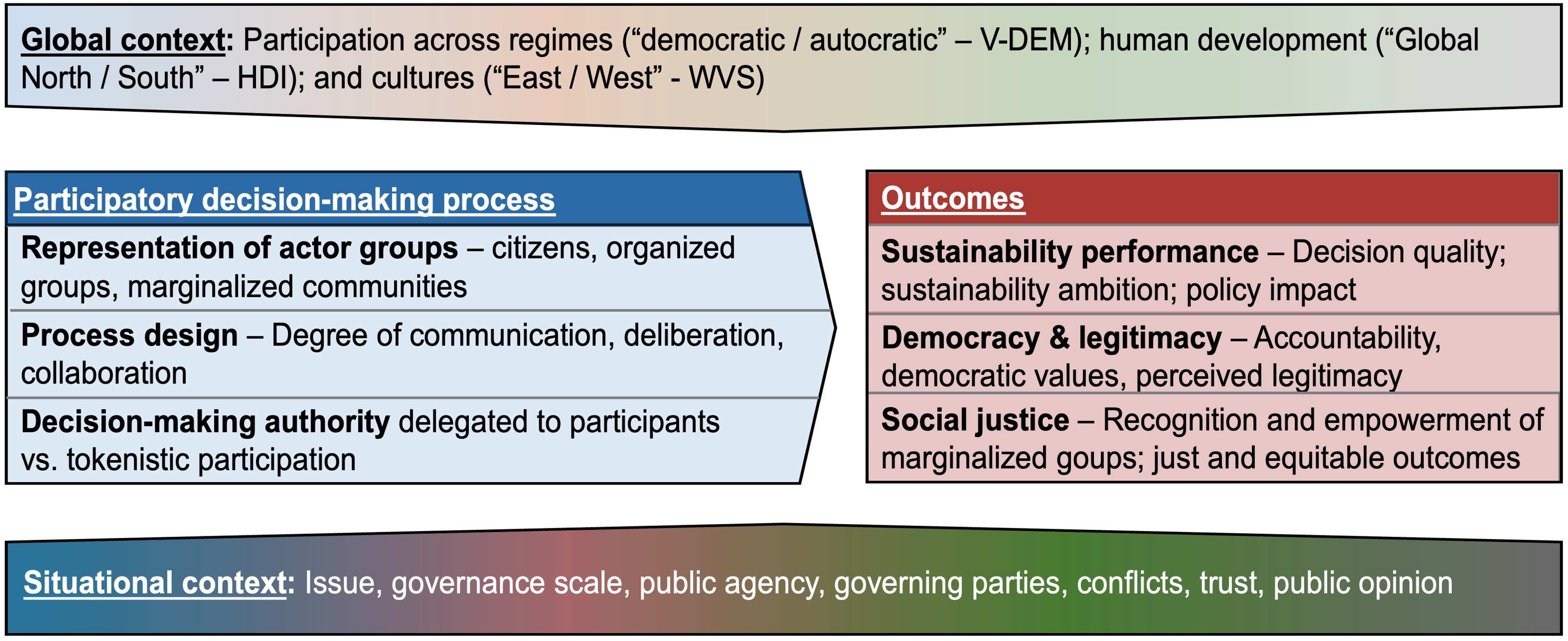
Simplified Conceptual model, including exemplary items to assess.
To address the global challenge, GAPS will pursue a more nuanced approach than is often taken: Instead of assuming a divide between North and South, democratic and authoritarian, or West and East, GAPS treats human development, regimte type and culture as continuous variables and matches each case to country-level data from available global databases on human development (HDI), liberal democracy (V-Dem Liberal Democracy Index), and cultural orientation (World Values Survey).
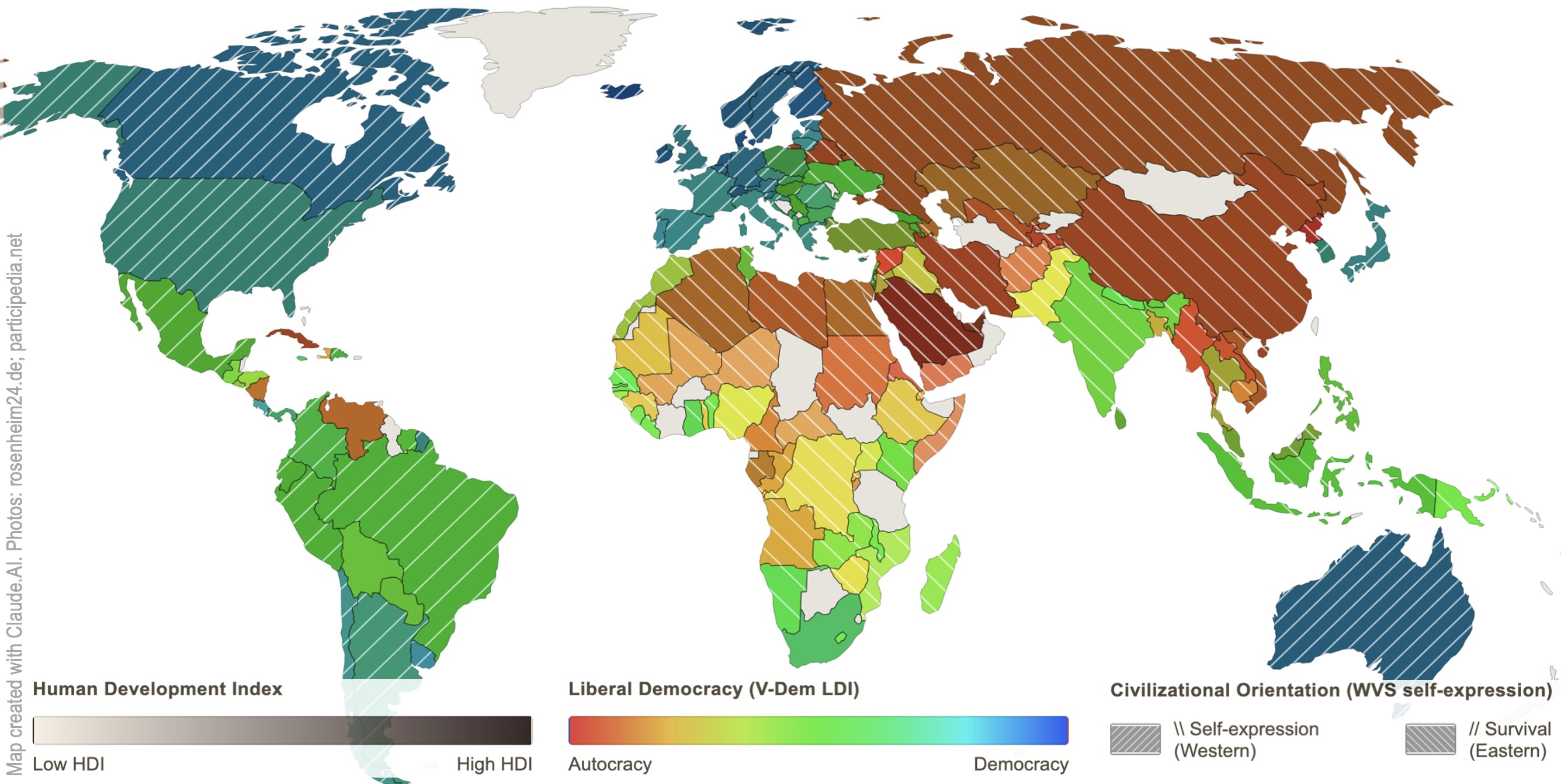
The three context dimensions used to place each case. Shading shows human development (HDI) and liberal democracy (V-Dem LDI); diagonal hatching marks cultural orientation from the World Values Survey, self-expression (“Western”) against survival (“Eastern”) values. Map created with Claude.AI.
To allow for causal analysis, we will combine statistical analysis, including path models to uncover mechanism variables and multi-level models to account for the nested case–country structure, with Large-N Qualitative Comparative Analysis (QCA) and causal process tracing on selected cases.
The research team, based at Leuphana University Lüneburg, will collaborate closely with Prof. Nicolas W. Jager at TU Berlin.
Open positions
We will be hiring one postdoctoral and four doctoral researchers, all at the Institute of Sustainability Governance (one PhD jointly with TU Berlin at Nicolas Jager’s group). Each PhD addresses one component of the overall research programme; the postdoc leads the methodological and synthesis work and helps coordinate the project. All team members will have strong methodological experience.
Postdoc · 100% · 5 years – Participation in sustainability governance and AI-assisted comparison. Co-leads the AI-assisted case database and quality assurance, supports qualitative and quantitative PhD analyses, leads synthesis and theory-building.
PhD · 75% · 4 years – Participation and sustainability performance. Whether and how participation produces better environmental decisions, across climate, biodiversity, pollution and resource management.
PhD · 75% · 4 years – Participation, democracy and justice. When participation strengthens democracy and legitimacy, and includes marginalised groups in fairer procedures and outcomes.
PhD · 75% · 4 years – Global patterns of participation in sustainability governance. How political, developmental and cultural contexts shape participatory designs and their effects; carries the country-level data and multi-level analysis.
PhD · 75% · 4 years · with TU Berlin – Participation in environmental impact assessments. Comparing more and less participatory environmental impact assessments worldwide. Co-supervised by Prof. Nicolas W. Jager, working in Berlin and Lüneburg.
All positions start 1 October 2026. The application deadline is 10 August 2026, and interviews are expected to take place on 17–21 August 2026, with all decisions finalised by 28 August 2026. The individual calls on Leuphana’s jobs page specify the profile and required documents for every position. For questions about the project and the positions (but not about individual eligibility), please contact jens.newig@leuphana.de.
 SUSTAINABILITY GOVERNANCE