A blessing in disguise? Why Trump’s pull-out of the Paris Agreement may open up a window of opportunity

By Pim Derwort

Following his campaign promise and a period of intense speculation, on Thursday June 1, the President of the United States announced his intention to withdraw from the 2015 Climate Accord previously ratified by his predecessor, Barack Obama, claiming it undermines U.S. competitiveness and jobs, and would have a negligible impact on the world’s climate. Inevitably, the series of events were quickly compared to another defining moment in history, when, in 1997, the newly instated United States Government of George W. Bush failed to ratify the Kyoto Protocol negotiated under the Clinton-Gore presidency.

World leaders were quick to condemn the unilateral decision, with the Secretary General of the United Nations calling it a “major disappointment for global efforts to reduce greenhouse gas emissions and promote global security”, and the leaders of France, Germany and Italy almost immediate issuing a joint statement reaffirming their strong commitment to implement the agreement.

Trump’s decision to withdraw from the Paris Agreement appears to be the latest in a string of failures to protect the (global) environment, including executive orders to roll back the Clean Water Rule (giving the federal government authority to limit pollution in major bodies of water, rivers, streams, and wetlands) and review the Environmental Protection Agency’s (EPA) Clean Power Plan, ending restrictions on coal power plants. Having installed Scott Pruitt, a known climate-sceptic as the head of the EPA, President Trump – famously calling climate change a hoax “created by and for the Chinese in order to make U.S. manufacturing non-competitive – proposed slashing the agency’s budget by 31 per cent (or $2.6 billion) and to get rid of the EPA “in almost every form”.

However, while the U.S. withdrawal will almost certainly affect the effectiveness and realisation of the goals of the Paris Agreement, all may not be doom and gloom. Contrary to popular opinion, I would argue that this latest decision may actually hold an important silver lining, in that it may open up a ‘window of opportunity’.

First of all, Trump’s decision to withdraw from the agreement, and particularly the period of uncertainty leading up to it, has resulted in regular attention for environmental regulation, in a news cycle that so often appears dominated by important issues such as possible Russian meddling in the elections of foreign governments, the refugee crisis, and international terrorism. Under the motto that ‘even bad press is good publicity’, it can be argued that the constant attack on environmental regulation means that the topic remains well and truly on the agenda and in the public eye. The official decision, rather than continued speculation, enables world leaders, business, citizens and the academic community to provide a targeted response. From a political perspective, Trump’s latest action opens up opportunities for other actors who are willing to take environmental action, allowing them to form alternative coalitions and advance changes previously blocked by the U.S. (Grossman, 2015, Saurugger and Terpan, 2016). On a structural level, the disappearance of existing structures and institutions (deinstitutionalisation) may thus be perceived as an opportunity to break with existing patterns of inertia and lock-ins, an important precondition for the development of new alternatives (Boin et al., 2008).

Initial evidence suggests that, rather than weaken the resolve of the international community, Trump’s withdrawal has strengthened the resolve of China and the European Union in particular who, despite being unable to produce a joint statement, have reiterated their intention to accelerate joint efforts to reduce global carbon emissions. Leaders of some of the biggest and most influential technology companies, including Google, Facebook, and Amazon have already expressed their continued support for the Paris Agreement and the effort against climate change. Even Trump’s own Secretary of State, and former head of the oil-giant ExxonMobil, signed an international declaration highlighting the importance of the Agreement. Furthermore, the Democratic Governor of California, Jerry Brown has announced a pact with the governors of Washington and New York to uphold the Agreement even without federal support, as did the mayors of 71 small and large American cities from blue and red states – including cities like Los Angelos, New York, Chicago, Washington and Austin, in an open letter to then president-elect.

There may be a long way, but ultimately, the formal decision may thus backfire on Trump, creating the exact opposite of what he intended – with citizens, business and federal governments increasing their climate efforts, leaving the White House out in the cold.

Pim Derwort is a PhD-student in the Leverage Points project and a member of the research group ‘Governance, Participation and Sustainability’ at Leuphana University. His current research focuses on the productive functions of institutional failure and decline.

References
BOIN, A., MCCONNELL, A. & ‘T HART, P. 2008. Governing after Crisis. The Politics of Investigation, Accountability and Learning, Cambridge, New York, Cambridge University Press.
GROSSMAN, P. Z. 2015. Energy shocks, crises and the policy process: A review of theory and application. Energy Policy, 77, 56-69.
SAURUGGER, S. & TERPAN, F. 2016. Do crises lead to policy change? The multiple streams framework and the European Union’s economic governance instruments. Policy Sciences, 49, 35-53.

New project: Governance of global telecoupling – and two open post-doc positions

By Jens Newig

In recent years, more and more research has been pointing to the importance of distant connections of natural and social processes for issues of global unsustainability. Land-use scientist have labelled this phenomenon, which might entail global commodity chains, migration, or the spread of diseases, “telecoupling”. While there have been substantive advances in describing the flows and the associated implications for environmental sustainability, we know little about how to govern such telecoupled global linkages.

Our new project, which is jointly led by Andrea Lenschow from Osnabrück University, Edward Challies and myself, will investigate how state, private and non-governmental actors have sought to govern the (un)sustainability implications of telecoupling in the past; what (polycentric) policy-networks have emerged in doing so; and, together with key state and non-state actors we will map out scenarios for more effectivley governing global telecoupling for environmental sustainability.

We’ve already published two papers on this (see below), which seek to contribute to a conceptual framework.

For deepening conceptual work and conducting empirical case studies, we will be employing two full-time post-docs for three years. The job ad can be downloaded here.

Funding: German Research Foundation.

> More information on the project GOVERNECT.

Papers

Challies, E., Newig, J., & Lenschow, A. (2014). What role for social-ecological systems research in governing global teleconnections?. Global Environmental Change : Human and Policy Dimensions, 27, 32-40. 10.1016/j.gloenvcha.2014.04.015

Lenschow, A., Newig, J., & Challies, E. (2016). Globalization’s limits to the environmental state? Integrating telecoupling into global environmental governance. Environmental Politics, 25(1), 136-159. doi:10.1080/09644016.2015.1074384. [Free Open Access Content]

Now published: Leverage Points for Sustainability Transformation

Joern's avatarIdeas for Sustainability

By Joern Fischer

Finally, the first paper is out from our Leverage Points project. It’s led by Dave Abson, and lays out a conceptual framework and research agenda, all around the notion of “deep leverage points”. Please share it through your networks.

Screen Shot 2016-06-28 at 10.31.56.pngThe paper draws on Donella Meadows’ notion of “deep leverage points” – places to intervene in a system where adjustments can make a big difference to the overall outcomes. Arguably, sustainability science desperately needs such leverage points. Despite years of rhetoric on sustainability science bringing about “transformation”, the big picture is still pretty dull: globally at least, there is no indication that we’re starting to turn around the patterns of exponential growth that characterize our era. A potential reason is that much of sustainability science has focused on parameters and feedbacks, rather than system design or “intent” (see above) — when actually, it’s changing a system’s design…

View original post 255 more words

New doctoral programme “Democracy under Stress” – 7 PhD positions

Leuphana’s Center for the Study of Democracy has been awarded a major grant for funding a total of 14 PhD scholars. The first 7 scholarships are advertised now.

The doc­to­ral pro­gram in­ves­ti­ga­tes how the new po­li­ti­cal, eco­no­mic, eco­lo­gi­cal, and cultural chal­len­ges (‘stress fac­tors’) that mo­dern de­mo­cra­cies en­coun­ter are per­cei­ved, dealt with, and sol­ved in view of the exis­ting ten­si­on bet­ween po­li­ti­cal le­gi­ti­ma­cy and re­stric­ted per­for­mance. It will fur­ther look into the im­pli­ca­ti­ons that dif­fe­rent mo­des of pro­blem-hand­ling have for the ‘sur­vi­val chan­ces’ of de­mo­cra­cy. This two­fold re­se­arch agen­da will be ana­ly­zed in three fiel­ds of stu­dy that re­pre­sent the core func­tions of de­mo­cra­cies: par­ti­ci­pa­ti­on, re­pre­sen­ta­ti­on, and in­clu­si­on.

The first field of stu­dy is con­cer­ned with how ci­ti­zens in de­mo­cra­tic so­cie­ties per­cei­ve cur­rent so­cie­tal – e.g. environmental or sustainability-related – chal­len­ges in light of in­cre­a­sing ’eman­ci­pa­ti­ve’ va­lue ori­en­ta­ti­ons and how the­se per­cep­ti­ons are trans­la­ted into po­li­ti­cal be­ha­viour (participatory democracy).

In the frame­work of the se­cond field of stu­dy, the re­pre­sen­ta­ti­ve ca­pa­ci­ty of po­li­ti­cal in­ter­me­di­a­ry or­ga­niza­t­i­ons as well as po­li­ti­cal in­sti­tu­ti­ons wi­t­hin and outs­ide the na­ti­on sta­te will be ana­ly­zed (representative democracy).

By me­ans of selec­ted po­li­cy fiel­ds (e. g. en­vi­ron­men­tal, cli­ma­te, sci­ence and me­dia po­li­cy) the third field of stu­dy looks into the is­sue of how new forms of po­li­ti­cal par­ti­ci­pa­ti­on in­ter­act with tra­di­tio­nal in­sti­tu­ti­ons, ac­tors, and pro­ces­ses of re­pre­sen­ta­ti­ve de­mo­cra­cy (inclusive democracy).

Deadline for submission of applications is 12 June, 2016.

For more information, please see http://www.leuphana.de/en/research-centers/zdemo-english/doctoral-program-democracy-under-stress.html

Participation and collaboration for sustainable flood risk management?

By Ed Challies

Floods are the most frequently occurring natural disaster globally, and flood damages are expected to increase drastically over the coming decades due to climate change, demographic trends, and on-going development on flood plains. This will play out differently and pose unique challenges in different regions, and Europe is no exception. Floods in Europe inflict greater economic losses more frequently than any other natural hazard, with trillions of Euros worth of assets and millions of people exposed (see Jongman et al. 2012). A recent study reported by the Europe Joint Research Centre predicts annual damages to rise from EUR 5.6 to 40 billion by 2050, and the number of people affected to rise from 200 thousand to over half a million over the same period.

With projections such as these, it is no wonder that the challenge of better managing (and reducing) flood risk is high on the political agenda in Europe. The recurrence of severe floods, like those on the Elbe and Danube rivers in 2013, and the 2015-16 floods in Britain and Ireland, only serve to heighten the sense of urgency among citizens and officials. In some ways this serves to increase awareness and engagement and provide impetus for action at multiple levels – from households and municipalities right up to member states and the European Union. On the other hand, the high stakes and direct threat that floods pose to human wellbeing, present challenges for flood risk management planning. This is particularly so in light of the current policy shift away from the previously dominant paradigm of flood protection and defence, and towards a more integrated flood risk management approach. Most importantly, this entails the management of risk (as opposed to the management of floods), and implies the negotiation of socially acceptable levels of exposure and risk – an issue that is inevitably sensitive and often controversial.

Flood 2013Photo: Flooding in Passau (Inn/Danube), Germany, 2013. Licence CC BY-SA 2.0; Stefan Penninger.
Flood risk is commonly defined as comprising (1) the magnitude of flood hazard (frequency and severity), (2) the exposure of human activities, and (3) the vulnerability of exposed elements. There are, therefore, multiple points for intervention to address and mitigate flood risk, ranging from information and awareness-raising campaigns and early warning systems, to flood protection measures, land-use planning and ‘ecological’ measures such as wetland restoration and afforestation. In this sense, efforts to confront flooding touch on a wide range of activities, policy fields and stakeholders within river basins. No wonder, then, that flood risk management is typically characterised by high stakes, competing interests, and conflict!

With the aim of improving the effectiveness and legitimacy of flood risk management, participatory and collaborative approaches are increasingly advocated, which should bring stakeholders and the affected public on-board in planning and decision-making. One prominent development in this direction in the European context is the 2007 Floods Directive, which aims to reduce the effects of flooding through an explicitly participatory approach to cyclical planning. Under the Directive, member states are legally obliged to encourage the active involvement of all interested parties in the planning process. Because every country and responsible authority is starting from a different baseline in terms of flood risk management and participatory governance, however, an array of approaches are currently unfolding across the EU. The rationale behind this ‘mandated participatory planning’ approach (Newig & Koontz 2014) is very much an instrumental one: The European Commission expects that it will produce better plans, more widely accepted and implementable measures, and more effective flood risk management.

Precisely because so much stock is put in participatory approaches to deliver improved and effective planning and management, there is a need to examine how participatory public decision-making is playing out in the field of flood risk management, and to consider what potential participation holds. Participatory and collaborative approaches in environmental planning and management more widely have certainly had mixed success in terms of achieving legitimacy and effectiveness. What about the field of flood risk management poses particular challenges for participatory planning and implementation? What potential do participatory approaches hold for fostering sustainable and just flood risk management? These questions motivate a recent special issue of Environmental Science and Policy jointly edited by members of our research group here at Leuphana University, and drawing together twelve contributions from leading scholars in the field. The collection examines, from a variety of disciplinary perspectives, some of the key issues around justice and power, acceptance and legitimacy, social learning, multi-level governance and policy integration, and governance learning in flood risk management.

With climate change and developmental pressures continuing to exacerbate multiple drivers of flood risk, it will be crucial for research to focus on how policy and governance responses perform in mitigating this risk. As authorities like the EU increasingly advocate participatory approaches, but recurring flood events continually trigger calls to revert to expert-led planning and engineered flood protection solutions, researchers must also critically examine collaborative planning. This should ideally be done in partnership with authorities and practitioners in ways that can support transdisciplinary learning and adaptation – not only about effective measures for sustainable flood risk management, but also about how to conduct effective and legitimate participatory planning towards this end.

Special Issue: Check out the special issue in Environmental Science and Policy: Participatory and Collaborative Governance for Sustainable Flood Risk Management: An emerging research agenda (Edited by Ed Challies, Jens Newig, Thomas Thaler, Elisa Kochskämper, and Meike Levin-Keitel).

References

  • Jongman, B., Ward, P. J., & Aerts, J. C. J. H. (2012). Global exposure to river and coastal flooding: Long term trends and changes. Global Environmental Change, 22(4), 823-835.
  • Newig, J., & Koontz, T. M. (2014). Multi-level governance, policy implementation and participation: The EU’s mandated participatory planning approach to implementing environmental policy. Journal of European Public Policy, 21(2), 248-267.

Wind energy conflicts in forested landscapes- Insights from stakeholder interviews in Maine, USA and Rhineland-Palatinate, Germany

Abbildung 1_Blog

By Nataly Jürges

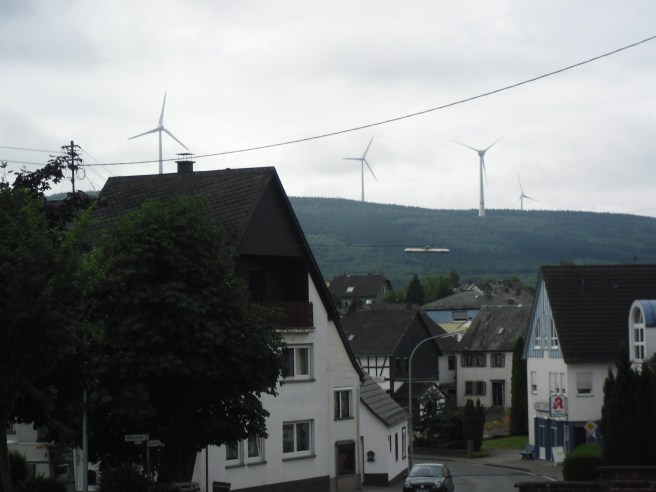
Renewable energy projects are increasingly realized worldwide as part of a global strategy to reduce emissions from fossil fuels and to reduce dependence on imported fossil fuels such as natural gas and oil. However, the transition towards renewable energies is not without problems. For example, wind energy projects in forests are an emotional topic in different parts of the world, and can develop into serious conflicts. Conflicts about renewable energy projects are an important topic from a sustainability governance perspective. The governance of wind energy conflicts is an important issue in the transition towards renewable energies. As part of my PhD project, I examined wind energy conflicts in forested landscapes in Maine, USA and Rhineland-Palatinate, Germany. Between summer 2014 and beginning of 2015 I spent 8 months at the School of Forest Resources at the University of Maine, where I did a case study on wind energy conflicts in forested landscapes as part of my PhD research.

Conflicts over wind energy projects in forests are complex, often involving many stakeholders, such as forest owners, local residents, wind energy companies, nature conservationists and recreationists. Forty-six interviewees from Rhineland-Palatinate and Maine shared their experiences and perspectives on wind energy conflicts with me. Surprisingly, the arguments of involved parties were similar in both regions. Even though differences in the overall governance structure made for some slight differences in decision-making processes in the case study regions, wind energy conflicts turned out to be quite universal (at least in the cases of Maine, USA and Rhineland-Palatinate, Germany).

For example, transparency, or rather a perceived lack of transparency in decision-making, was mentioned in stakeholder interviews in both cases as an important factor in the development of conflicts and controversies around wind energy projects:

“What we’re speaking to is really a sore spot in this town because we would argue and we wouldn’t never back down on that, they kept it secret for a year, they kept it secret for as long as they could to get the ordinance in favor of the developer, and the developer kept it secret to build his alliance and that really matters in terms of how everybody feels about it once they come aware. It would have been much more respectful of the town government to once they were being asked by a developer to consider a huge project, which is way, way out of proportion out of anything that’s ever been going on in [name of the town]. If you’re a small town in Maine and a gigantic development project is coming into town, I feel that they are absolutely obligated to make that as public as possible from the first idea. From the conception of it and they did absolutely the opposite. There was nothing and we are 3,000 feet away from the project. We would be hugely impacted if they went up and they had, they never showed us any respect at all in that regard.”

(Interview quote from an interview with residents near a planned wind energy project)

The most appropriate level or scale for decision-making about wind energy projects was an important aspect in discussions on how to govern wind energy projects most efficiently, effectively, and legitimately. Different perceptions existed in both case study areas as to whether higher or lower administrative governance levels are more appropriate to decide about controversial wind energy projects.

Local decision-making tradition was mentioned as an important argument for the choice of the most appropriate decision-making level, particularly in Maine:

“We’re a state that loves its local control, so, for better or for worse, that’s what we have. You know, there are times when local control is great because those communities understand the needs, wants and desires of their community. Sometimes it can be a draw back if you’re trying to make sort of a systemic change in the way a society operates. So, for example, if you’re trying as a society to move away from fossil fuels and into more clean energy, sometimes local control can be challenging. But that doesn’t mean that we should do away with it.”

(Interview participant from Maine)

However, other interview participants did not share the preference for local decision-making. Consideration of nature conservation interests was seen as being better realized at higher governance levels:

“Everything concerning the protection of species cannot be considered at the local scale. Especially if it is a mobile species, as bats and birds, then you just have to have the greater perspective. Check main occurrence, where are the main migratory lines.”

                (Nature conservationist from Rhineland-Palatinate)

The perception of the most appropriate level or scale for decision-making about wind energy projects was often based on conflicting frames about what wind energy projects are about. For example, some interviewees saw wind energy projects mainly in the context of nature conservation and species protection, while others saw wind energy projects as a topic related to local regional development. These conflicting issue frames quite often resulted in different understandings about the most appropriate decision-making level.

Do we all agree on the importance of learning and knowledge integration for environmental governance?

By Jens Newig

A couple of days ago, I received the report of a symposium I was invited to earlier this year. The symposium, held in May at the Stockholm Environment Institute, was about “Environmental Governance in an Increasingly Complex World: An Interdisciplinary Exchange on Adaptation, Collaborative Learning and Knowledge Integration”, gathering some 25 researchers and practitioners (You can access the website here, and the report here).

Learning and knowledge integration were the key issues discussed by speakers like Ryan Plummer (adaptive co-management), Bernd Siebenhüner (transdisciplinarity), Arjen Wals (social learning in education), Stephen Elstub (deliberation) and myself (governance learning). There certainly was a lot of interesting detail from empirical and conceptual studies. One key insight, however, emerged more implicitly: There seemed a remarkable consensus in the whole group that more learning – either through participation, co-management, or transdisciplinary interaction – would benefit sustainability and environmental governance. To quote from the report, knowledge integration and learning were even seen as “a necessary precondition for transformative change toward more sustainable futures”.

I certainly agree that without learning no major leap forward can be achieved – whether this concerns sustainability or not. I just have this slight unease with the high level of consensus on the issue. Are we still asking the right questions? Are we as reasearchers still learning (sic!) enough when studying learning? Going against the grain, a couple of contributions appeared to indeed question the dominant focus on standard models of learning. Arjen Wals, for example, brought forward the idea of un-learning. While this is not new as such, I believe it would be worth discussing more thoroughly in this community. (In the Leverage Points project – WP 2 “Re-Structure” – we will focus on related topics of de-institutionalisation for the benefit of sustainability). Perhaps it is as important to study what kind of (unsustainable) beliefs, convictions, practices, institutions we need to do away with, as it is essential to examine what new things we need to learn.

New perspectives on a society beyond oil

By Lisa Fischer

Norway is a country with an interesting energy profile. It is known to be rich on oil and gas, which now account for about a quarter of Norway’s GDP and almost half of its exports by value (The Economist, 2015). Despite rich oil and gas reserves, Norway’s domestic energy supply is dominated by hydropower (nearly 40%) (IEA, 2011). In light of a recent encounter with Norwegian energy transition researchers, however, it seems to me that Norwegians are starting to redefine their relationship towards oil. In October 2015 I attended the conference “Beyond oil” in Bergen (http://spacelab.b.uib.no/conference-beyond-oil/). The conference name itself suggests that Norwegians are starting to seriously think about alternatives and ways to realize a transition to a society beyond oil.
Joining the conference, I was especially inspired by three new perspectives that I believe are worth sharing:

1.) Respect for oil workers
I learned that Norwegian professionals in the oil sector, once a highly respected and prestigious workforce, have lost their good reputation. One of the two speakers, who mentioned the current “shaming” of oil workers in Norway, was arguing for showing respect for those employed in the industry. He mentioned the pioneer oil divers, who installed pipelines, took samples etc. – some of whom died in the course of doing their job. The idea of acknowledging work done by oil workers seems rather new in the current energy debate. Could we possibly introduce this way of thinking into the German discussion about energy supply, e.g. in the case of coal workers or workers in the nuclear power sector? The speakers went even further, and explained the idea to create new climate jobs and to address the dilemma of losing traditional jobs along the path to climate neutrality. I do like the idea of acknowledging what has been done by the (oil) workers for us, not only have they worked and sometimes still work under precarious conditions, but by doing so they secure(d) our energy supply and push(ed) economic prosperity. By taking care of them we would possibly enhance the acceptance of renewable energies and counteract resistance as we take a new and more sustainable energy pathway. It might be one way to actually work together and not against each other. It would also demonstrate that we implement the idea of sustainable development more holistically, by also taking care of the social pillar.

2.) Leaving the oil in the ground.
This is a radical and challenging idea. There is no global agreement of regulating or maintaining resources in the ground in individual states. The international community has no legal jurisdiction to decide how e.g. oil and gas discoveries should be regulated. Every state has the right to development (“Declaration on the Right to Development” by the United Nations, 1986). I learned that Kenya has just recently (2012) discovered oil. Companies are still in the exploration phase, so not actually extracting the oil from the ground. While discussing with Kenyans the idea of leaving the oil in the ground, researchers discovered that it is considered a rather absurd idea. Leaving resources in the ground seems quite a radical idea compared to the current way of thinking, but I do think that it is an idea worth discussing, and one which also arises when we think about new methods such as fracking for shale gas or extracting oil from tar sands.

3.) Broadening the discussion for a society “beyond oil”
It seems that in Norway the discussion about a society beyond oil is taking place on a relatively large scale, and taking a holistic view on things. In Germany, in contrast, the debate appears to be narrowed down to a few aspects, with energy supply by renewable energy dominating the public debate. However, speakers and participants at the Bergen conference had an even broader view on the issue of a society beyond oil, also thinking about production and consumption, corruption and justice with respect to energy access, among others. I think that the discussion in Germany could benefit from such a broader perspective on a society beyond oil.

 
References
International Energy Agency (2011) Energy Policies of IEA Countries- Norway 2011 Review, http://www.iea.org/publications/freepublications/publication/Norway2011_web.pdf (accessed 31.10.2015)

The Economist (2015) Norwegian Blues, http://www.economist.com/news/business/21672206-now-easy-times-are-over-norway-must-rediscover-its-viking-spirit-norwegian-blues (accessed 10.10.2015)

United Nations (1986) Declaration on the Right to Development, http://www.un.org/documents/ga/res/41/a41r128.htm (accessed 31.10.2015)