The Importance of Engaging with Values in Policy

This week, a Nature article was brought to my attention. The article was called ‘Australia is ‘free to choose’ economic growth and falling environmental pressures’. The key message of the paper is that Australia can continue to experience economic growth while tackling environmental challenges by pursuing technocratic fixes to these challenges. Over on ideas4sustainability, Joern Fischer has already written a very nice post about the flaws of a technocratic approach. He also outlines why these flaws have lead us to put together the Leverage Points project. To not repeat Joern, and to avoid writing a very long post, I have decided to just highlight my concerns with one specific section of the paper.

The section of the paper is called ‘Policy choices are crucial, not changes in values’. The authors argue that economic growth can be achieved alongside environmental improvements by changing policy. These changes in policy however should sit within existing environmental and social values, allowing existing targets (e.g. emissions reductions) to remain, and keeping in line with public opinion. They argue that we need top-down policies to ensure collective choices towards achieving public goods outcomes. So where individual’s personal interests are not aligned with those of public (collective) interest, top-down policies are needed.

Firstly, I find it odd to assert that this doesn’t involve a change of values. Within the policy framework, values are incorporated into deciding what needs to be tackled, setting goals and targets therein, and in deciding how to achieve them. I find Sabatier’s Advocacy Coalition Framework’s distinction of different types of policy beliefs to be a good way into thinking about this. In this instance, the values being changed are around the way in which policy should be formulated and implemented. Top-down policies incorporate implications on the way in which democracy is exercised. It is a move away from current trends towards participatory forms of policy-making and implementation, which seek to empower people and democratize decision making. It is a change in values in this regard.

Secondly, I just don’t think that top-down policies are effective in securing individual behavior change. Examples from my own research show that where individual beliefs or interests do not align with that in policy, individuals will act against a policy. There is a sizeable environmental policy implementation deficit across the EU (and beyond!), and such mismatched interests contribute to this. Indeed, it is an underlying rationale to the participatory turn in environmental governance; by engaging with individual’s interests, we can increase legitimacy, buy-in and efficacy of policy. Without such commitment from individuals, we instead need some way to strongly enforce top-down policies.

My overall discomfort with the article (and specifically this section) is therefore what is implied by the extension and application of this techno-fix rationale. Do we really want to introduce a dictatorship policy approach with strong enforcement (fines, sanctions)? Or would we rather work with people, and specifically with people’s values? I personally feel that engaging with people’s values would be preferable. A specific value to engage with would be the idea that individual’s income maximisation should take precedence over meeting public interest (and/or that economic growth should be our overall goal!).

Flexibility for flexitarians: thoughts about how to govern a reduction in meat consumption

One issue at the heart of the debate around sustainable consumption is the consumption of meat and other animal products. I recently read an article on the feasibility of the reduction of meat consumption by Dagevos and Voordouw (2013), which lead me to consider this issue from a governance perspective.

Dagevos and Voordouw conducted two representative consumer surveys in the Netherlands and their results suggest that only about a quarter of the surveyed population eat meat at their main meal every day. The rest are flexitarians, who do not eat meat at their main meal at least once per week, and a small group (less than 5%) of vegetarians and vegans, who do not eat meat at all. The authors conclude that while policy-makers are more than hesitant to put the issue of meat consumption on the political agenda, many consumers are already “making progress towards more sustainable foodstyles by reducing their meat-consumption frequency rather than by giving up meat completely” (p. 66). They deem it therefore feasible that policy makers “pursue policies that encourage reductions in meat consumption (an eat less meat approach) without endorsing initiatives to drastically cut or even ban it (a no meat approach)” (p. 66).

Reading this article, the varied initiatives to establish a fixed “veggie day” in all different kinds of canteens – be they in schools, universities, administration, or private companies – came to my mind, as well as the polemic and resistance that such initiatives often meet. It is not as if these initiatives tried to turn everybody into a vegetarian right away; they try to establish only one single meat-free day per week. Thus, they actually pursue an ‘eat less meat’ approach, which was deemed feasible by Dagevos and Voordouw. And if such individual initiatives introduced at lower governance levels (the single canteens) are faced with such opposition, imagine the resistance to a similar ‘eat less meat’ policy introduced by higher governance levels. That is why I wondered: If many consumers already adopt a flexitarian eating style on a voluntary basis, why is there so much resistance to having one meat-free day per week?

I doubt the reason is that the results of Dagevos and Voordouw are specific for the Netherlands or that in other European countries the majority of the people still want meat on their plate every single day. The exact numbers may be different in the different countries but I still think that a substantial part of the people in most of the EU countries already do not eat meat every day. In Germany, for instance, meat consumption has dropped by about three per cent (Vorsamer 2014) and about 11% of the German population are vegetarians or vegans (Vegetarierbund Deutschland Januar 2015) – which is more than in the surveyed population of Dagevos and Voordouw.

Maybe the reason rather lies in the prescriptive nature of such initiatives. The definition of a specific veggie day means a limitation of the freedom of choice and this is something many people react sensibly to – and rightly so. Even if there are many people who are willing to abstain from meat on one or several days per week, probably they themselves want to decide when exactly they want to do so. Therefore, even flexitarians might oppose the introduction of a veggie day in their canteen (and on a broader scale as well, if something like that was ever suggested).

So, apparently top-down prescriptions for reductions in meat consumption do not work very well. But what could the alternatives be? One idea, at least for grassroots-like initiatives in canteens, could be a kind of an incentive system: For example, for each meat-free meal, costumers could earn bonus points and after having earned a certain quantity of bonus points they get a bonus, which could be a (meatless) meal for half the price or a free desert or a free drink etc. This approach would meet the same goals as the introduction of a veggie day – raising awareness about the issue of meat consumption and having the substantive outcome of an effective reduction of the consumption of meat. Yet, it would leave consumers the choice of both whether they want to eat meat-free from time to time at all and when they would like to do so. Whether such an incentive system does not only attract freeriding by vegetarians and vegans (the bonus system would have to be designed to be economically feasible despite freeriding vegetarians and vegans) but also lead meat-eaters to actually reduce their meat consumption would be a matter of trying it out in practice.

However, for higher level policies even such a flexible incentive-based approach could still be too hard a measure. Dagevos and Voordouw hold that “public-policy interest in meat reduction, as well as support for policy measures to reduce meat consumption, are currently scarce in European countries—not to mention other parts of the world” (p. 67). This is why rather an incremental strategy starting with “soft policies of engaging and exemplifying” would be needed before “hard policies of enabling (e.g., laws, rules, nudges) and encouraging (e.g., taxes, subsidies)” (p. 67) become feasible. Yet, the implementation of incentive systems as the one proposed above in a few canteens could serve as best-practice examples. This would be in line with the strategy of exemplifying and thus it could help even the path for ambitious higher level policies aiming at the reduction of the consumption of meat.

References

Dagevos, Hans/Voordouw, Jantine (2013): Sustainability and meat consumption: is reduction realistic? In: Sustainability: Science, Practice, & Policy, 9. Jg. , Heft 2, S. 60–69.

Vegetarierbund Deutschland (Januar 2015): Anzahl der Vegetarier in Deutschland. Unter: https://vebu.de/themen/lifestyle/anzahl-der-vegetarierinnen (Stand: 20.10.2015).

Vorsamer, Barbara (10.01.2014): Ein Hoch auf die Flexitarier. Unter: http://www.sueddeutsche.de/leben/fleischkonsum-ein-hoch-auf-die-flexitarier-1.1859705 (Stand: 20.10.2015).

Joining cutting-edge research on environmental politics and governance: Impressions from the Richard Wesley Conference

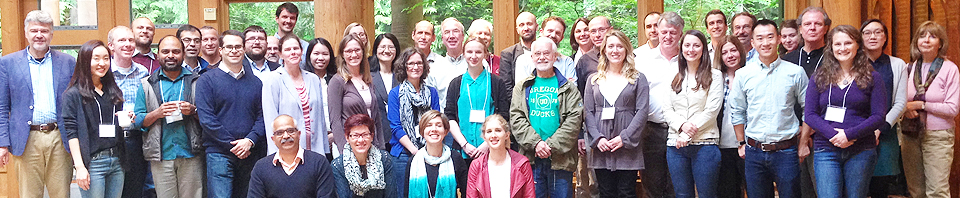
Participants - Foto from official conference website


By Elisa Kochskämper

This May, the Richard Wesley Conference on Environmental Politics and Governance was convened for the first time by the Center for Environmental Politics of the University of Washington, and with the financial aid of Richard B. Wesley and Virginia Sly. This new conference set two ambitious goals: to showcase the best and most innovative scholarship on environmental politics and governance; and start to build a new research community for this research field. The need to better demarcate the field of Environmental Politics and Governance (EPG) stems, according to the conference convenors of the conference, Aseem Prakash and Peter May (University of Washington, Seattle), from a current paradox: although the importance of analyzing present environmental challenges and required solutions is widely recognized by society and academia, EPG remains an understudied area in the social sciences. They identify a ‘silo approach’ as a major reason for this, as EPG scholarship is scattered among various subfields and sub-disciplines without sharing knowledge or results and therefore without building a firm common ground.

With these aims in mind the conference was organized from the 14th to the 16th of May in Seattle. After an initial welcome session on the first evening, eight panels were distributed over the following two days. Furthermore, post-dinner conversations that reflected on the intended community-building process took place every evening. Yet, did this conference meet its aims and differ from other conferences on EPG? It did. Below I offer some reflections on the reasons.


  1. Small group size

A group of 45 scholars was gathered by Aseem and Peter in a small center for environmental education on Bainbridge Island, around 16km from Seattle, amidst the lush forests of Washington State. I mention the location because it was one of the factors that created the exceptional, original and inspiring atmosphere the conference transmitted during its whole course.

The small group size, resulting from a selection process out of 290 abstracts, involving contributions of over 400 scholars from 40 countries, was another factor. We met for breakfast, lunch and dinner, attended all paper presentations, as there were no parallel panels, and participated in all post-dinner conversations. Discussions on current or recent research projects, home university, common difficulties for publications but also on hobbies or personal backgrounds, emerged completely naturally and by the end of the second day, all participants knew each other. Professional – and personal – knowledge exchange and input was therefore high (inside and outside the panels) and extremely valuable. Whether such a small group size would be viable for future conferences was one of the more controversial discussion topics in the post-dinner conversations


  1. High quality of papers

A defining feature of the conference was the consistently high quality of the papers presented. 32 papers addressed topics ranging from global, national and local issues, or analyses of scale (global institutions, networks, and interactions; policy approaches and outcomes: cross-national comparisons; city-level environmental politics and governance), to behavioral aspects and conflicts of distribution (opinions, attitudes, and environmental communication; conflict and cooperation in subnational governance), to pertinent substantive environmental issues (emissions, decarbonization, and climate change; environmental inequalities; corporate environmentalism and greenwashing). Presenters hailed from many of the leading institutes and universities engaging with environmental policy and governance around the world, such as Stanford and Princeton University, University of California, Australian National University, University of Essex, ETH Zürich or the Potsdam Institute.


  1. Interdisciplinarity

The aim to reach out to diverse subfields of EPG and foster interdisciplinarity was also met, albeit to a lesser extent. Regarding disciplines, political science predominated, although this homogeneity was extensively discussed during the post-dinner conversations. Apart from representation of a larger diversity of disciplines from the social sciences, calls were also made to reach out more to natural scientists. For us, coming from a group with the background of geography, environmental law and political science in EDGE, it was rather surprising that papers with more than two authors, which additionally come from different fields, were difficult to find. But this, again, might be due to the strong focus on political science coming from the Anglo-Saxon context. Geographically, representation from other western countries was rather low, let alone representation of developing countries. Finally, regarding group composition and coverage of topics, we were somewhat surprised that the whole resilience and earth-system governance scholarship was not present.


  1. Cutting-edge methods

One effect of the aforementioned Anglo-Saxon political science bias might be the emphasis on quantitative methods – only 4 out of 32 papers worked with qualitative methods. Quantitative methods were highly sophisticated and it was in particular methodologically instructive to see experimental designs on the rise. Yet, the low representation of qualitative approaches and absence of mixed methods seemed to undermine to a certain degree the intention to bring one research field comprehensively together and achieve sound theoretical insights. This, however, was also mentioned in one evening discussion session.


  1. Outlook

Nonetheless, these were rather formal or organizational points, which seem to be quite normal for a first conference, which is intended to mark a starting point for the gradual definition of a potential new or stronger field. The conference is planned to continue in a rotating, self-organizing manner, and the next conference is set to be held in Gerzensee, Switzerland, so many of the points raised above can be easily addressed already in the second Richard Wesley Conference on Environmental Politics and Governance. In case you are now more interested in the conference and emerging research community, you can sign up to the listserver, which was set up to provide information on, and facilitate knowledge sharing within the research community. Abstracts for the second conference are due soon, by November 3, 2015; do not miss the opportunity, we are still amazed by our outstanding stay on Bainbridge Island.

See our presentation in EDGE – Presentations.

Blurred Boundaries between the Terms Agri-Environment Measure, Scheme, and Programme

By Tamara Schaal

Note: The following reflects my experiences as part of the MULTAGRI project with finding the “right” terms to describe agri-environmental management in the federal state of Lower Saxony in Germany. This article does not take into account the latest reform of the Common Agricultural Policy resulting in a separate measure for organic farming, which had often been co-funded by the EU under measure 214 ‘agri-environment payments’ in the 2007-2013 programming period.

In this blog post, I consider the different words people use to describe agri-environmental management under the Common Agricultural Policy (CAP). As part of CAP (pillar 2), which supports the development of rural areas (EP 2015), the European Union (EU) co-funds commitments made by farmers or other land managers to provide environmental services through the European Agricultural Fund for Rural Development (EAFRD) (Council Regulation 1698/2005). Broadly, member states or regional governments develop agri-environmental programmes, which consist of agri-environment schemes, which in turn comprise agri-environment measures (EC 2005; Kleijn & Sutherland 2003). However, when comparing how these terms are used in practice the boundaries between the terms become blurry, and terms seem to be used interchangeably and variably between authors and areas. For example, some authors pertain to (the) agri-environment measure(s) when generally discussing the EU measure under which funding is provided for the agri-environment (Keenleyside et al. 2011; Uthes & Matzdorf 2013). This and other EU-funded measures aim to achieve the different goals or priorities of the rural development policy. To illustrate the inconsistencies in terminology, and to try to add some clarity, I present several examples pointing out the different use of these terms related to the agri-environment.

Agri-environment measure usually refers to the commitment made by the farmer. This might refer to specific prescriptions (Kleijn & Sutherland 2003). Examples are “a reduction in stocking densities or a cessation of fertilizer inputs” (Kleijn & Sutherland 2003: 949). Most commonly, agri-environment measures are understood as individual measures, which usually encompass several prescriptions to farmers (Degenfelder et al. 2005; EC 2005). An example from the federal state of Lower Saxony in Germany in the 2007-2013 programming period is the measure A6 ‘multi-annual flower strips’. However, Keenleyside et al. (2011) who developed a typology of entry-level agri-environment schemes, called these measures different types of management action. This shows that different terms are used to describe these voluntary commitments by farmers.

Moreover, a distinction between the terms agri-environment measure and agri-environment scheme is often absent in the literature (see for example Russi et al. 2014) and the terms are not used consistently in practice. The discussion on result-oriented approaches, whereby farmers receive payments for achieving a certain outcome (Burton & Schwarz 2013), provides an example for these differences regarding terminology. An outcome-based approach has for example been implemented in Lower Saxony (measure B2 “support of species-rich grassland sites based on a payment-by-results approach” (Groth 2010: 14)), which has been classified as a result-oriented agri-environment scheme (EC 2015) but also a result-oriented measure (Russi et al. 2014). Another example, which highlights the inconsistencies regarding terminology is organic farming. It is described as a scheme (Kleijn et al. 2006), a category of measures (EC 2005), and a measure (Degenfelder et al. 2005; Scheper et al. 2013).

Finally, it remains unclear from the literature whether there is a difference between agri-environment programmes and schemes in the German federal states. For example, the Marktentlastungs- und Kulturlandschaftsausgleich (MEKA) in the federal state of Baden-Württemberg is described both as an agri-environment programme (Matzdorf & Lorenz 2010) and an agri-environment scheme (Keenleyside et al. 2011; Troost et al. 2015). Moreover, when discussing the German context, some authors just use the terms agri-environment programme and measure (Degenfelder et al. 2005; Matzdorf & Lorenz 2010). This raises the questions whether the term scheme is applicable in the agri-environment programmes of the German federal states and if so what it pertains to.

Figure: Key areas of ambiguity of agri-environmental terminology
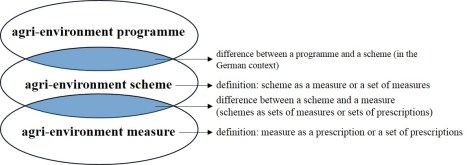
figure Tamara

But how can these inconsistencies regarding terminology be explained? Several authors argue that the design of agri-environment measures and agri-environment programmes and their structure vary significantly across different countries in the EU (see for example Keenleyside et al. 2011) and in some cases even within one country (see e.g. Hartmann et al. 2006). This renders a comparison of agri-environment measures/schemes difficult and possibly also the use of the same terms.

Due to the ambiguities regarding terminology (see figure), it is challenging to know which terms to use and to consistently compare measures/schemes between different locations if the level of comparison is unclear. In my view, it is important to point out what the terms refer to in order to be able to understand differences or similarities between agri-environment programmes, schemes and measures.

In a nutshell

Terminology regarding agri-environmental management under the CAP is fuzzy as the brief overview of literature has shown and often lacking clear demarcations between the terms discussed above. Explaining what the terms agri-environment programme, scheme and measure refer to would provide clarity about the level at which comparisons are made: the level of prescriptions, single measures or sets of measures.

References

Burton, R.J., Schwarz, G. (2013) Result-oriented agri-environmental schemes in Europe and their potential for promoting behavioural change. Land Use Policy 30 (1), 628–641.

Council Regulation (EC) No 1698/2005 of 20 September 2005 on support for rural development by the European Agricultural Fund for Rural Development (EAFRD) [2005] OJ L277/1.

Degenfelder, L., Lösch, S., Seibert, O. (2005) Evaluation des mesures agro-environnementales: Annexe 6: Etude nationale Allemagne. Available from: http://ec.europa.eu/agriculture/eval/reports/measures/annex6.pdf (accessed 26 August 2015).

European Commission (EC) (2015) Maintenance of species rich grassland through results-based agri-environment schemes – Germany, various Länder. Available from: http://ec.europa.eu/environment/nature/rbaps/fiche/maintenance-species-rich-grassland-through-results_en.htm (accessed 18 August 2015).

European Commission (EC) (2005) Agri-environment Measures: Overview on General Principles, Types of Measures, and Applications.

European Parliament (EP) (2015): Fact Sheets on the European Union. Second pillar of the CAP: rural development policy. http://www.europarl.europa.eu/atyourservice/en/displayFtu.html?ftuId=FTU_5.2.6.html (accessed 26 August 2015).

Groth, M. (2010) The use of markets for biodiversity in Germany: where are we and where should we go from here? Available from: http://www.diss.fu-berlin.de/docs/servlets/MCRFileNodeServlet/FUDOCS_derivate_000000001394/Groth-The_use_of_markets_for_biodiversity_in_Germany-116.pdf (accessed 24 August 2015).

Hartmann, E., Schekahn, A., Luick, R., Thomas, F. (2006) Kurzfassungen der Agrarumwelt- und Naturschutzprogramme: Darstellung und Analyse von Maßnahmen der Agrarumwelt- und Naturschutzprogramme in der Bundesrepublik Deutschland. In: Bundesamt für Naturschutz (ed.): BfN-Skripten 161. Bonn.

Keenleyside, C., Allen, B., Hart, K., Menadue, H., Stefanova, V., Prazan, J., Herzon. I., Clement, T., Povellato, A., Maciejczak, M., Boatman, N. (2011) Delivering environmental benefits through entry level agri-environment schemes in the EU. Report Prepared for DG Environment, Project ENV.B.1/ETU/2010/0035. Institute for European Environmental Policy: London.

Kleijn, D., Baquero, R.A., Clough, Y. et al. (2006) Mixed biodiversity benefits of agri-environment schemes in five European countries. Ecology Letters 9(3), 243–254.

Kleijn, D. Sutherland, W.J. (2003) How effective are European agri-environment schemes in conserving and promoting biodiversity? Journal of Applied Ecology 40, 947–969.

Matzdorf, B., Lorenz, J. (2010) How cost-effective are result-oriented agri-environmental measures?—An empirical analysis in Germany. Land Use Policy 27 (2), 535–544.

Russi, D., Margue, H. & Keenleyside, C. (2014) Result-Based Agri-Environment Measures: Market-Based Instruments, Incentives or Rewards? The case of Baden-Württemberg. A case-study report prepared by IEEP with funding from the Invaluable project.

Scheper, J., Holzschuh, A., Kuussaari, M. et al. (2013) Environmental factors driving the effectiveness of European agri-environmental measures in mitigating pollinator loss – a meta-analysis. Ecology Letters 16(7), 912–920.

Troost, C., Walter, T., Berger, T. (2015) Climate, energy and environmental policies in agriculture: Simulating likely farmer responses in Southwest Germany. Land Use Policy 46, 50–64.

Uthes, S., Matzdorf, B. (2013) Studies on agri-environmental measures: a survey of the literature. Environmental Management 51(1), 251–266.
Linking transdisciplinary sustainability research with governance

By Jens Newig

On attending the 2nd International Conference on Public Policy (ICPP 2015) in Milan, I would like to share some thoughts on the relationship of transdisciplinary research and the governance of science-policy interactions.

For those of us working in sustainability and environmental studies, transdisciplinarity (Hirsch Hadorn, Pohl, Scholz, Lang, Bergmann, …) has become an important feature. Some prefer the terms “mode 2 science” (Nowotny, Gibbons) or “post-normal science” (Funtowicz and Ravetz). They all refer essentially to the participation of non-academics in academic processes, aiming to democratise research and to produce better and societally more relevant (“socially robust”) research outputs. Whether we see it as a new mantra, or as a mere necessity to produce knowledge relevant to solving today’s looming environmental sustainability problems – it is virtually impossible to ignore transdisciplinarity when engaging in sustainability-relevant research.

Connecting academia and practice

At the well-attended ICPP 2015 plenary session on “Academics and practitioners, opposed or complementary?”, established scholars and policy-makers discussed different venues through which the academic sphere and that of policy-making are or could be linked.

The following list blends those points raised in the panel discussion, mainly by Leslie A. Pal and Rob Hoppe, with some of my own thoughts that immediately followed this. (For the purposes of simplification, I call those people outside academia who are to some degree influential in what they do “decision-makers”).

So what are those interfaces between academia and practice?

  • Decision-makers have typically themselves gone through a university education, perhaps up to PhD level or beyond.
  • Some decision-makers publish in (academic) journals.
  • Some decision-makers even read academic journals.
  • Countless think tanks, established by policy-makers themselves, consult policy-makers
  • Decision-makers selectively draw on consultants for particular purposes, and those consultants sometimes engage more with the academic sphere than do policy-makers in their day-to-day practice.
  • Some decision-makers attend (academic) conferences and exchange here with academics.
  • ‘Public intellectuals’ publish their ideas in newspapers, bridging academia and public opinion.
  • Boundary workers who, through participation in academia and in practice, facilitate co-production of knowledge.

Why is transdisciplinarity not mentioned?

Surprisingly, to me at least, transdisciplinarity, mode 2, post-normal science – those concepts that appear as the epitome of science-practitioner interaction – none of them were even mentioned in this 90-minute plenary panel.

How can this be? Perhaps most obviously, different academic discourses do not diffuse evenly into scholarly communities. Transdisciplinarity might in comparison still be a niche discourse. This does not mean that it should not be important to other fields of research, too. Exchanging about this is of course why conferences such as ICPP are important.

Another reason could be that the discourse on transdisciplinarity is much focused on (funded) research projects. Projects are limited in scope and time, often short-term, which makes on-going interaction between science and practice more difficult. Hence what Rob Hoppe – one of the plenary speakers – calls the preoccupation of transdisciplinary sustainability scholars with trust-building, whereas classical ‘policy analysts’ in other areas tend to have more stable relationships with decision-making (see http://works.bepress.com/robert_hoppe1/2/).

Third, as someone with experience in leading and studying transdisciplinary projects (→ project MONA), my impression is the following: By calling for an involvement of non-academics into research, and even an empowerment of practitioners (Brandt et al. 2013), transdisciplinary researchers (often implicitly) assume academic research to be on the side of those who are in power to decide. The plenary discussion at ICPP showed, however, that practitioners tend to see things quite differently. For public decision-makers, the point of departure is public decision-making (quite naturally), into which academics can or should be involved (through think-tanks and other mechanisms listed above). In their view, decision-makers have the power to decide, whereas academics just do research. Someone at the panel even mentioned a certain angst on the part of academics of being left out of decision-making.

The final point connects to the previous one. In response to my question of why transdisciplinarity did not figure in the said plenary, one of the panellists (I think it was Rob Hoppe) mentioned the typical normative stance of sustainability researchers in their desire for changing the world for the better, in Germany now hotly discussed under the label of “transformative science”. The general tendency at the panel was, however, to keep academia and policy-making apart (referred to as ‘demarcation’) lest we run into important legitimacy issues if researchers engage in decision-making themselves. Nevertheless, both worlds should of course connect, which is then referred to as ‘coordination’.

What role for governance?

These thoughts might sound awfully critical of transdisciplinary sustainability science. They are not. But perhaps they help us put transdisciplinarity into perspective and remind us that this is just one of many ways in which research and practice can connect. After all, we are still struggling to understand the pathways though which transdisciplinarity actually leads to an effective co-production of knowledge. This is what colleagues and I are trying to find evidence for, comparing 100 completed sustainability-related research projects (→ MONA).

So how does all this concern governance? As sustainability governance scholars, we should be aware of the multiple avenues through which we can interact with practitioners. Transdisciplinary research projects are one important way (with many different facets). Others are listed above. In particular, we might want to engage in boundary work, or connect with boundary organisations such as consultancies.

Regarding public sustainability governance, research funding organisations in particular should likewise take into account the multiplicity of research-practice interactions. While certain environment and sustainability-oriented funding programmes in Germany and Switzerland demand transdisciplinary interactions in projects they fund, the United Kingdom funding bodies are heavily concerned with the practical and societal impact generated through research (see Julia Leventon’s recent blog entry on ideas4.sustainabiliy.org). Both of these approaches appear somewhat one-sided. One could consider, for example, encouraging and funding long-term interactions between research and policy, or creating and funding intermediary organisations that serve as institutionalised bridges between research and decision-making.

Readings

Brandt, P., Ernst, A., Gralla, F., Luederitz, C., Lang, D.J., Newig, J., Reinert, F., Abson, D.J., Von Wehrden, H. (2013) A review of transdisciplinary research in sustainability science. Ecological Economics 92, 1-15.

Funtowicz, S.O., Ravetz, J.R. (1993) Science for the post-normal age. Futures 25, 739-755.

Hirsch Hadorn, G., Hoffmann-Riem, H., Biber-Klemm, S., Grossenbacher-Mansuy, W., Joye, D., Pohl, C., Wiesmann, U., Zemp, E., (2008) Handbook of Transdisciplinary Research. Springer.

Hoppe, R. (2005) Rethinking the Science-Policy Nexus: from Knowledge Utilization and Science Technology Studies to Types of Boundary Arrangements. Poiesis Prax 3, 199-215.

Lang, D.J., Wiek, A., Bergmann, M., Stauffacher, M., Martens, P., Moll, P., Swilling, M., Thomas, C.J. (2012) Transdisciplinary research in sustainability science: practice, principles, and challenges. Sustainability Science 7, 25-43.

Nowotny, H., Scott, P., Gibbons, M. (2004) Re-thinking science. Knowledge and the public in an age of uncertainty. Polity Press, Oxford.

Stauffacher, M., Flüeler, T., Krütli, P., Scholz, R. (2008) Analytic and Dynamic Approach to Collaboration: A Transdisciplinary Case Study on Sustainable Landscape Development in a Swiss Prealpine Region. Systemic Practice and Action Research 21, 409-422.

Governing transformation to sustainability: A new blog on environmental and sustainability governance

By Jens Newig

Climate change; biodiversity loss; depletion of natural resources; air, water and soil pollution… humankind is facing enormous environmental challenges. Given an imperfect human nature, designing the ‘right’ institutions is a vital factor for bringing about the necessary change towards an ecologically more sustainable development.

In this blog, we will share ideas on designing and implementing institutions, policies, and governance processes across the broad area of environmental and sustainability governance. Our group – the Research Group on Governance, Participation and Sustainability, based at Leuphana University Lüneburg – studies polycentric decision-making in the public realm, and in particular the involvement of broader sectors of society in this. Our research is as much about effective steering (achieving substantive change towards sustainability) as it is about fair decision processes and democratic structures. Our perspective is mainly from political science, but blends approaches and insights from other fields such as human geography, sociology and social-ecological systems. While we approach environmental governance issues mostly form a social science perspective, we collaborate with colleagues in the natural sciences and also with non-scientists.

Politics and policy on multiple levels, from the very local to the global, working across scales, and involving a variety of stakeholders and process forms, from top-down policy implementation to processes of social learning in collaborative networks are at the center of our research. We ask whether and how participation and collaboration foster environmental sustainability. How can sustainability transitions be governed? How can we meet the challenges of governing global social-ecological telecoupled systems?

We set up this blog to share our thoughts on exciting new ideas, concepts or findings; but also on critical thoughts on recent books and articles; reflections on conferences; or simply to recommend and spread contributions we find interesting and useful. We understand this blog as an open forum, and invite readers to comment on our posts. We hope readers will find our contributions useful, and by this hope to contribute to the discourse on environmental and sustainability governance.