New Collaborative Project on the Sustainability Governance of Global Value Chains

By Jens Newig

Updated on 4 July 2024.

The global demand for raw materials and agricultural products has led to unsustainable working conditions and environmental impacts, especially in countries of the Global South. Efforts to address these issues have largely relied on voluntary certification and auditing by businesses, but since the mid-2010s, countries have implemented binding regulations such as France’s 2017 Loi de Vigilance, Germany’s 2023 Supply Chain Due Diligence Act, and the EU’s Corporate Sustainability Due Diligence Directive, with their effects still largely unexplored.

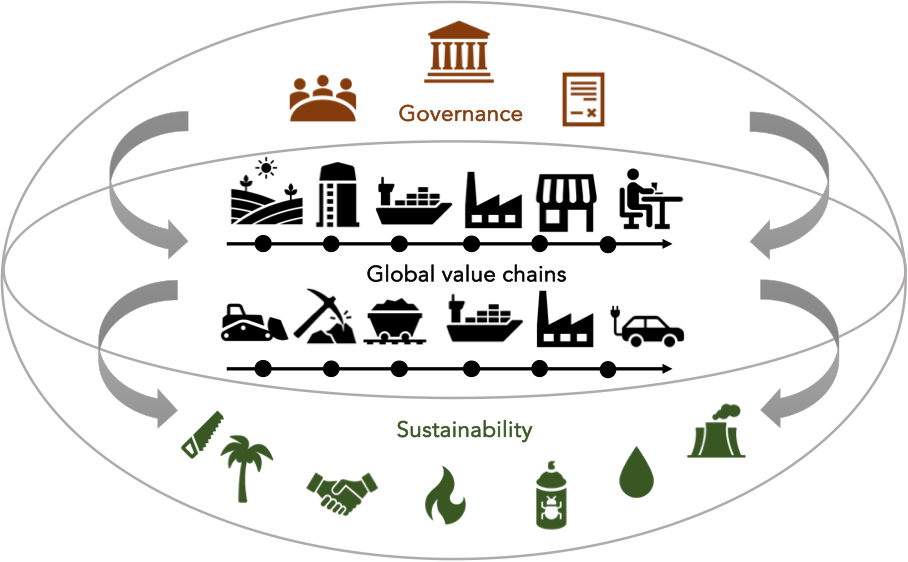
A new collaborative project, funded by the VolkswagenFoundation and the Lower Saxony Ministry of Science and Culture, will explore effects, potentials, and limitations of sustainability governance in global value chains (GVC). Leuphana University Lüneburg (lead) and Osnabrück University (co-lead) are collaborating with Oldenburg University and the German Institute for Global and Area Studies (GIGA).

Existing private and public approaches to the sustainability governance of GVCs face significant challenges. The geographic distance of many GVCs often leads to a lack of knowledge among Global North actors regarding the socio-economic, cultural, and ecological impacts at production sites in the Global South. Additionally, current information management systems fail to provide adequate data for making supply chains more sustainable, and the concept of “telecoupling” highlights the complexity of adapting international regulations to local conditions. Furthermore, GVCs are characterized by divergent interests and power asymmetries, making transparency and traceability essential yet difficult to achieve. Compliance with laws and standards remains challenging, particularly in regions with weak state capacities, necessitating monitoring, verification, sanctions, and capacity-building measures.

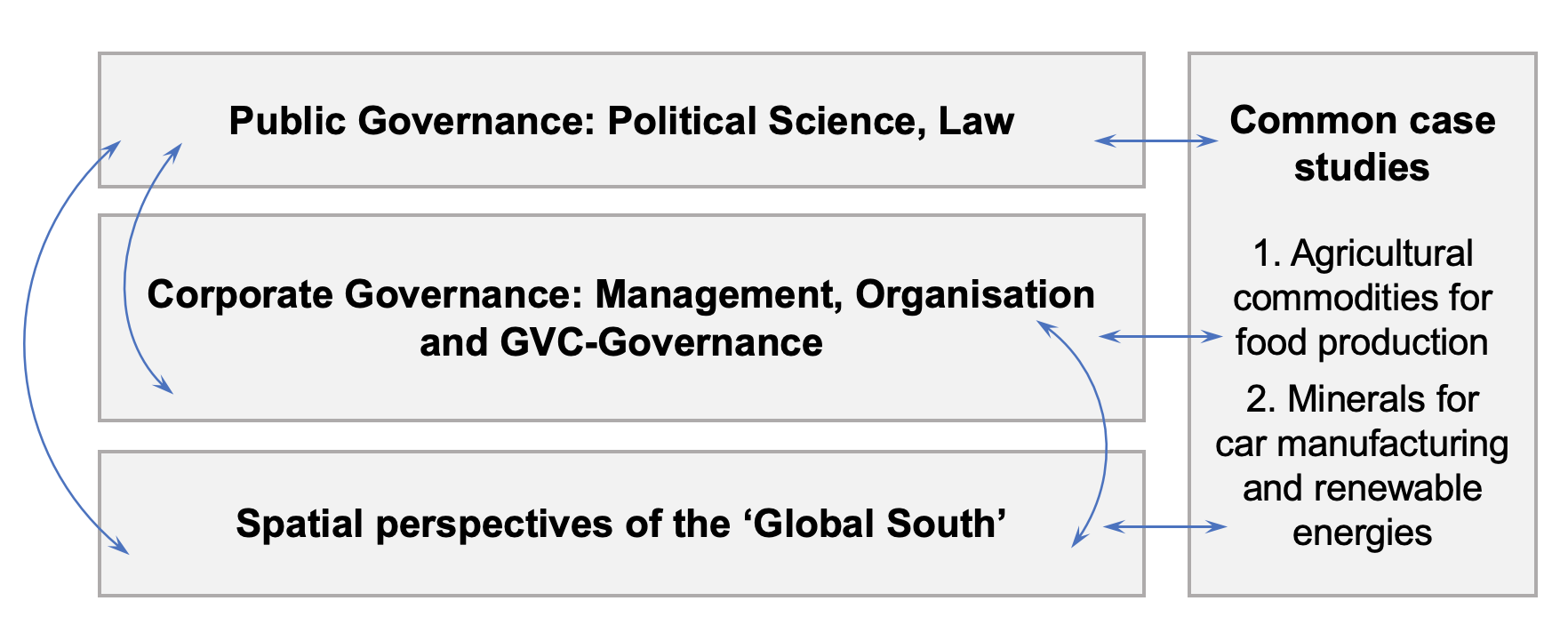
To explore these complex issues, the collaborative project takes a multi-perspective approach encompassing public governance (political and legal aspects), corporate governance (company networks and their practices), and regional perspectives (focusing on the Global South). The project will utilize empirical case studies in sectors crucial to Lower Saxony, such as agricultural raw materials for food production and minerals for automotive manufacturing and renewable energy production.

Key features of the research cluster include:

  1. Interdisciplinary integration of political, legal, economic, socio-technical, and geographical perspectives.
  2. Integration of perspectives from both the Global North and South.
  3. An empirical multi-sector comparison of GVCs relevant to Lower Saxony.

This comprehensive approach seeks to promote a deep understanding of how public regulations, corporate sustainability management, and technological solutions can drive the desired transformations along GVCs, ultimately contributing to sustainable global development.

In the months to come, two post-doc positions and nine PhD positions will be advertised across the collaborative project.

The Independent Guardian, the Advisory/Coordination Body, and the Stakeholder Council

Three Types of Institutional Innovations Show How to Represent Future Generations in Political Decision-Making Today

By Michael Rose

The choices we make in politics today, whether regarding biodiversity loss, climate change, or social security systems, hold significant repercussions for the well-being of future (i.e., yet unborn) generations. The fact that future generations have no voice today may contribute to the governance failures prevalent in these realms and others. From a democratic perspective, the interests of all affected by political decisions should be considered in their formulation. Moreover, the guiding principle of sustainable development asks us to consider the needs of future generations alongside those of the present. But how could we give a voice to people who do not yet exist?

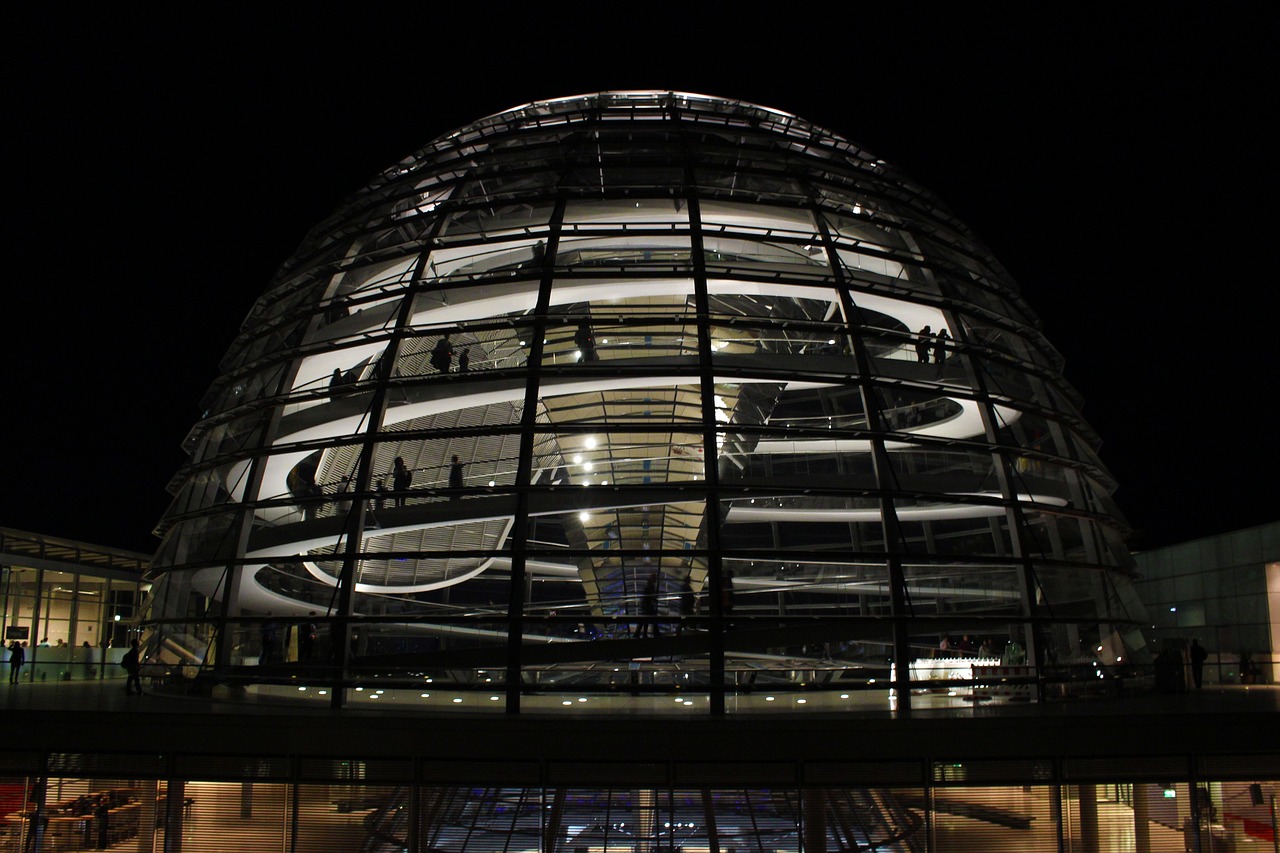
The German Bundestag hosts the Parliamentary Advisory Council on Sustainable Development, a member of the Network of Institutions for Future Generations (Photo: Robert Diam).

Several democracies have responded to this challenge by establishing specialized institutions. For instance, in 1993, the Finnish Parliament formed the Committee for the Future. Shortly thereafter, in 1995, Canada established the Commissioner for Environment and Sustainable Development. Both institutions remain active today. From 2001 to 2005, the Israeli Knesset had a Parliamentary Commissioner for Future Generations. Following suit, in 2008, the Hungarian Parliament introduced an Ombudsman for Future Generations, although this position was later downgraded by the Orbán Government in 2012. Notably, the Future Generations Commissioner for Wales stands out as a prominent example of how democracies evolve their institutional frameworks to consider future generations today.

Twenty-five institutions in 17 democracies

In my article “Institutional Proxy Representatives of Future Generations: A Comparative Analysis of Types and Design Features”, I formulated the notion of institutional proxy representation of future generations to provide a theoretical foundation for these institutional advancements. Furthermore, I applied this concept to build a comprehensive inventory of empirical instances of institutional proxy representation across democracies worldwide. Through this analysis, I identified 25 institutions for future generations – or “proxies” – in 17 democracies.

The proxies are grouped into three types, based on the rationale of selecting their members: The expertise-driven independent guardian (type I), the political or administrative advisory or coordination body (type II), and the sustainability stakeholder council or commission (type III). For each proxy (and proxy type), I assessed how it is designed, and how this translates into its formal capacity to influence political decision-making.

Three types

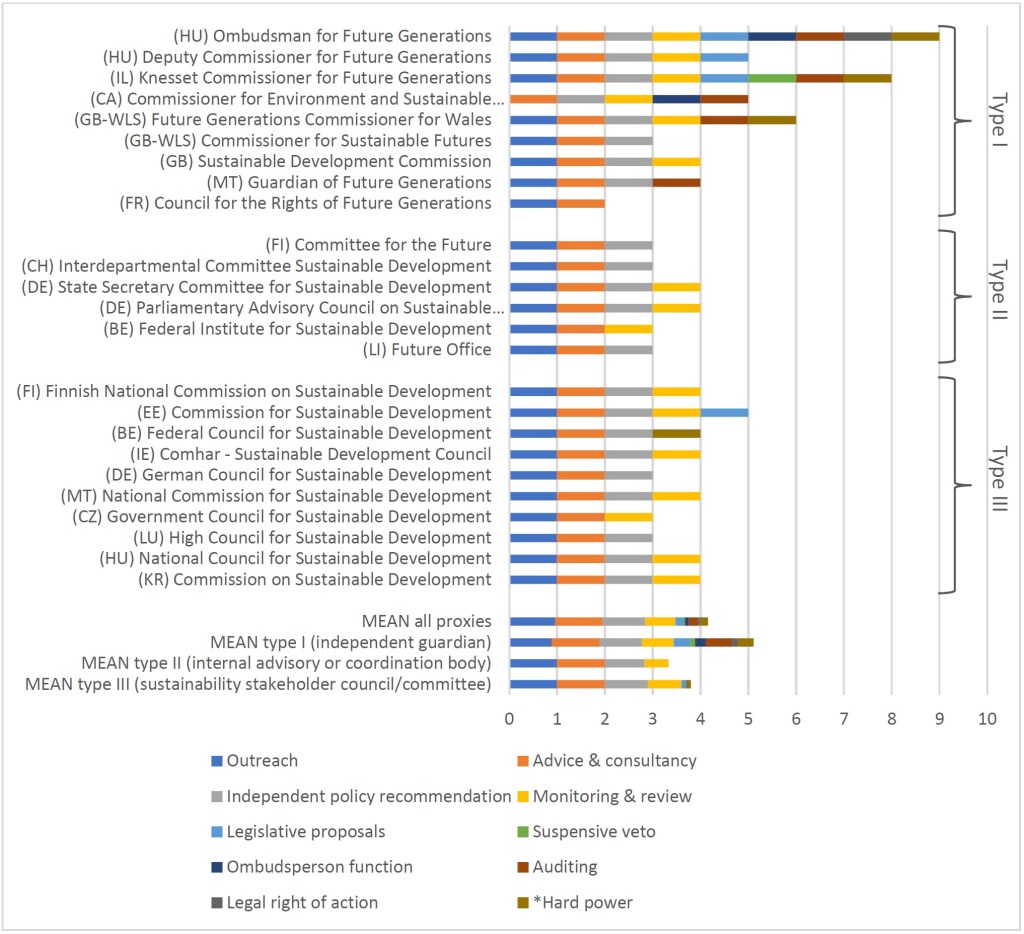
Type I proxies – the independent guardians – typically comprise experts who are not part of government or parliament. This allows them to consider the needs of future generations from a professional point of view with minimal political interference. These proxies often have robust legal foundations and wield specific political instruments usually not found in other proxy types, such, legal rights of action, a suspensive veto, ombudsperson functions, legislative proposals, and auditing, including independent investigation rights. Type I includes all the strongest, but also some of the weakest proxies examined in this study. The strongest ones can not only voice the interests of future generations, but can also make sure they are heard by parliament or government. However, the survival rate of type I proxies is rather low.

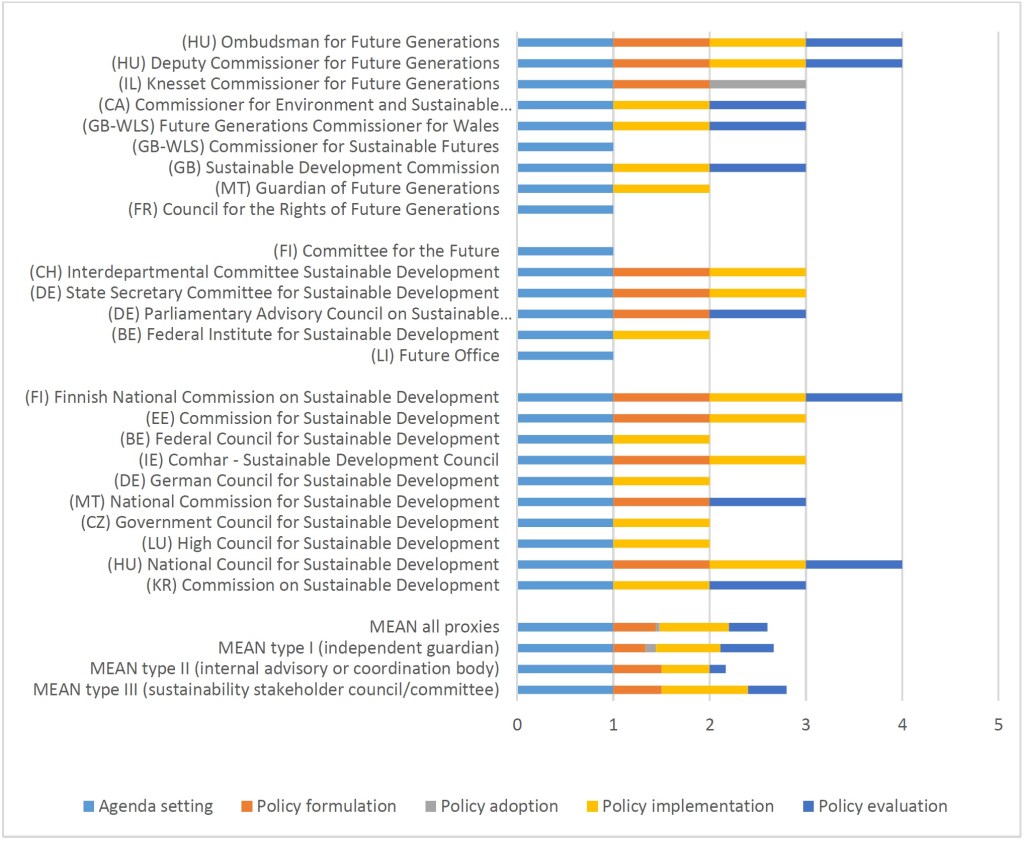
Type II proxies – the political or administrative advisory or coordination bodies – are, to a certain extent, the counter-model to type I. They are not independent, but internal parts of the political system, comprising either Members of Parliament or members of the governmental departments. Operating on a predominantly weak legal footing, they provide internal advisory, coordination, and sometimes monitoring services to enhance political decision-making from within, with a view toward benefitting future generations. They only have limited political instruments at their disposal and can access only few stages of the policy cycle, which makes them heavily reliant on good working relationships with other parts of parliament and government.

Type III proxies – the sustainability stakeholder councils or committees – are designated parts of the sustainability governance architecture of their host countries. Embracing the principles of functional representation and participation, members are appointed from different sectors of society to broaden societal outreach, provide general advice and specific policy recommendations to the government, and oftentimes monitor and review sustainability-related developments. While they lack particularly strong or weak formal capacities to influence political decision-making, they show the highest survival rate among the three types, possibly attributable to their integration across multiple sectors.

Design features

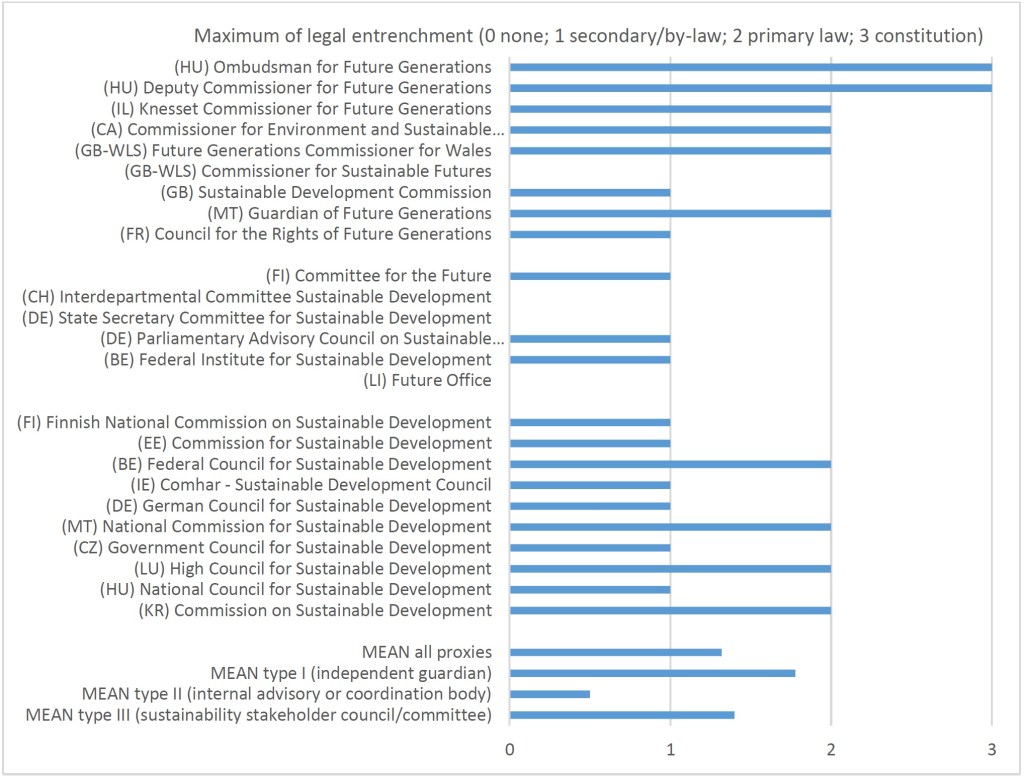
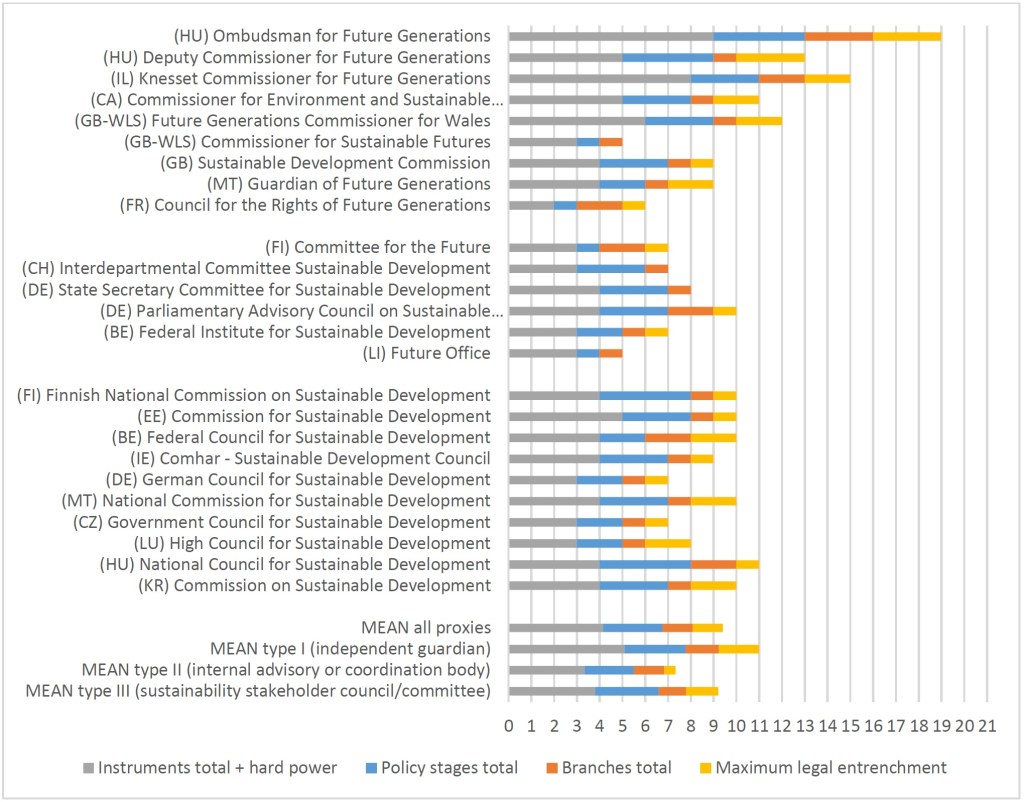
I assessed each proxy to determine the legal basis upon which it was established, the political instruments it was granted, and the branches of government and stages of the policy cycle it could engage with through these instruments. This figure shows the distribution of political instruments across proxies and types. Proxies were created with these instruments to allow them to monitor and influence political decision-making and reach out to society. To learn more about proxies’ access to branches of government and phases of the policy cycle, as well as their legal bases and total formal capacity to influence political decision-making, please scroll through the slideshow.

Political instruments | Access to stages of the policy cycle | Access to branches of government | Legal basis | Total formal capacity to influence political decision-making

A multifaceted landscape of institutionalized voices of future generations

In general, the diverse and dynamic array of proxies, although relatively small in number, provides manifold examples of institutional innovations illustrating how the interests of future generations can be considered in political decision-making. However, while some of these proxies can act as watchdogs with teeth when ignored, many seem to represent rather cosmetic than far-reaching reforms of the democratic decision-making process. Therefore, it is important not to place excessive expectations on these proxies in terms of effecting significant policy changes to the benefit of future generations. For more detailed and inspirational results, download the full study here.

Reference
Rose, Michael (2024): Institutional Proxy Representatives of Future Generations: A Comparative Analysis of Types and Design Features, in: Politics and Governance 12, Art. 7746 (21 pages). DOI: 10.17645/pag.7745

Citizens’ Councils for Promoting the Global Common Good

By Okka Lou Mathis

Prioritise climate protection, promote sustainable food production, increase funds for development cooperation, and create a sustainability ministry: These are just four of the 32 proposals from the citizens’ council on “Germany’s Role in the World”, consisting of 154 randomly selected citizens. The Bundestag will receive the final report on 19 March. The citizens’ council is an instrument of innovative citizen participation that has been used in many countries and at various political levels.

Citizens’ councils promise to reduce disenchantment with politics and to promote courageous solutions to socially controversial issues. The trick is that certain people come together by lot, ideally representing the socio-economic composition of society, in a so-called “mini-public”. The council is therefore much more inclusive and diverse than, for example, the Bundestag. Moreover, the councillors have neither voters, nor a party line, or lobby interests breathing down their necks. The idea is that this allows them to discuss political issues more impartially and at eye level. In addition to learning together, an appreciative, personal and yet fact-oriented exchange of experiences and views can take place according to the principle of “deliberation”: In the end, the best argument for the common good should actually be convincing, not just the loudest voice or the best-organised interest. For this reason alone, citizens’ councils are a useful addition to our democracy. In concrete terms, citizens’ councils can provide valuable impulses in terms of content, as the political recommendations on sustainability from the citizens’ council “Germany’s Role in the World” show.

The citizens examined this broad topic from five perspectives in working groups: sustainable development, peace and security, democracy and the rule of law, economy and trade, and the EU. The topics were selected in advance through a participatory process, and it is gratifying that sustainable development was considered very important. A small drop of bitterness, however, is that sustainable development was not, by its very nature, considered as a cross-cutting basic principle everywhere. Be that as it may, both the agreed guidelines and the concrete recommendations of the sustainable development group showed that the randomly chosen citizens were serious about wanting to anchor sustainability as an overarching guiding principle in German politics. For example, at their final meeting on 20 February, they agreed that Germany should “promote sustainability, climate protection, the right to clean water and the fight against world hunger as a global cross-sectional task (…) and place them at the centre of its political action so that future generations can also live well”. They proposed “enshrining sustainability in the Basic Law” and the “establishment of a sustainability ministry that coordinates, controls and monitors other ministries and ensures transparency”. They also found clear words for prioritising climate protection and for Germany to show “courage to embrace a reorientation towards the common good and end the continuous growth paradigm”. In addition, funds for “development aid” should be increased to 2% of gross national income (currently the rate is 0.6%). In addition, food production should become sustainable worldwide – “even if food prices in Germany rise as a result.”

If we think of the international agreements such as the Paris Climate Agreement and the 2030 Agenda for Sustainable Development, sustainability and the reduction of greenhouse gases are central and overarching political goals, and are not exactly new. What is new and encouraging, however, is that the international community’s existing goals, and their consequences for us in Germany seem to enjoy support among the general population, at least when citizens are given the opportunity to discuss them in an informed way. This could increase both the pressure on politicians for the ambitious implementation of these goals and the social legitimacy of sustainability measures in Germany. Despite all the euphoria, however, questions remain about the citizens’ council as an instrument, for example how to strengthen its political weight and how to attract broader public attention to the discussions and conclusions.

The citizens’ council “Germany’s Role in the World” shows the instrument’s potential for searching for solutions oriented towards the common good – both at national and global level. This makes the format directly relevant for international (development) cooperation, because the global common good is the very rationale behind the climate and sustainability agendas. The institutionalisation of citizens’ councils in Germany, especially on sustainability issues, would therefore be a promising way of exerting pressure for the implementation of these international targets. Incidentally, this is also a recommendation of the panel itself: “Germany should (…) use and account for citizen-based, political forums (e.g., citizens’ assemblies) on a permanent basis”. The next citizens’ council that could work for the global common good is already in the starting blocks – the topic: climate.

This post first appeared as The Current Column (2021), Deutsches Institut für Entwicklungspolitik / German Development Institute (DIE) on 18 March 2021.

What it takes to exercise adaptive planning

By Shirin Malekpour and Jens Newig

This research was a collaboration between Monash Sustainable Development Institute, Monash University (Melbourne, Australia), and the Research Group Governance and Sustainability, Leuphana University (Germany). Dr Shirin Malekpour (Monash) is the recipient of the Green Talents award, which enabled her to undertake a research sabbatical at Leuphana in 2019, conducting this study in collaboration with Prof. Jens Newig.

Adaptive planning is an approach to long-term strategic planning when confronted with significant uncertainties that dwarf any seemingly robust forecast (think Covid-19 pandemic). It is a shift from the conventional ‘predict-and-act’ approach, which assumes that we can anticipate the most likely future scenarios, and optimise our strategies accordingly. When uncertainties are profound and we have no good grasp of what can happen in the future, adaptive planning posits that decision makers should not even dream of an optimal strategy that can work in the long term. Instead, they need to adopt strategies that are flexible, and a planning approach that remains open to adaptation over time, in order to proactively respond to changing circumstances.

In today’s world overwhelmed by unprecedented events and profound shocks, adopting an adaptive approach to long-term strategic planning might sound like a no-brainer. There are, in fact, a range of tools for adaptive planning available to decision makers, such as those developed by the Decision Making Under Deep Uncertainty (DMDU) community. However, reactive planning and over-reliance on narrow projections still appear to prevail.

Some scholars have argued that the poor usage of adaptive planning is not due to a lack of appreciation of adaptive planning, but because of unfavourable governance processes, institutional frameworks and organisational arrangements within which adaptive planning should take place. Some of these issues impacting adaptive planning have been discussed in individual case studies, but there has been no larger scale comparison across various cases to provide a comprehensive picture of what it takes to put adaptive planning into practice.  

In our recent publication, we present a meta-analysis of 40 cases of adaptive planning applications. The cases were from diverse geographies (i.e. all continents), sectors (e.g. water, transport, etc.) and implementation scales (i.e. local to national). We assessed: 1) to what extent those applications adhered to the principles of adaptive planning – in other words, how adaptive were those adaptive planning applications, and 2) what enablers and barriers they faced in the broader governance and institutional arrangements.

So, what did we find?

Figure 1: Adaptive planning in different geographies. The data has been sorted (left to right) based on the number of reported cases of adaptive planning. Check the publication for further details on how we calculated average adaptiveness.

Figure 2: Adaptive planning in different sectors. The data has been sorted (left to right) based on the reported number of cases of adaptive planning. Check the publication for further details on how we calculated average adaptiveness.

We found that in the studied cases, adaptive planning applications are far from ideal. The main challenge is in setting up a monitoring regime that can identify early signals, and a systematic process that can assist with activating contingency plans when needed. The principal barrier to this is the lack of long-term investment strategies that go beyond short-term budgetary cycles for individual projects. There is a need for a redefinition of planning priorities and success indicators, from efficient delivery and implementation (i.e. a quick fix), to long-term outcomes achieved through experimentation, learning and adaptation.

Another challenge has been in using a wide range of future scenarios as the basis for decision making, which is another principle of adaptive planning, in addition to monitoring and keeping options open. The implicit assumption that future conditions could be estimated from existing trends was identified as a significant barrier to using a wide range of scenarios. This confirms earlier observations in the literature that, despite encountering major uncertainties, decision makers still rely on forecasts and a limited number of future scenarios to plan for the future. Another barrier is decision makers’ risk aversion and reluctance to acknowledging that ‘they do not know’. They prefer to squeeze future scenarios into a manageable set that is easier to grasp and communicate with stakeholders and the broader public.

On the other hand, there are a range of enablers that can facilitate adaptive planning. When strategic planning takes place in a transdisciplinary environment through effective and uninterrupted science-policy exchange, it is easier to avoid a reductionist approach to decision making.

Furthermore, adaptive planning is better enabled when there is a dedicated governance body that takes on the coordination role for adaptive planning activities. This would avoid situations where adaptive planning is taken on as an add-on to ongoing activities of a strategy team, with little to no dedicated resources for effective implementation. A coordinating body is not meant to drive all activities in a top-down approach, but rather to broker and negotiate activities across different stakeholders, and to absorb some of the transaction costs for adaptive planning.

The findings of our study shed light on some of the ingredients of a governance framework for enacting adaptive planning. They indicate what enablers should be harnessed, and what barriers should be overcome in an adaptive planning endeavour. Future research could extend the findings of this study to fully articulate how adaptive planning could be operationalised: who should be involved, what structures should be set up, what resources would be needed, and what practices would need to be put in place to successfully exercise adaptive planning.

Malekpour, S. and J. Newig (2020) ‘Putting adaptive planning into practice: A meta-analysis of current applications.’ Cities 106: 102866.

Workshop Invitation: Democracy & Intergenerational Justice – Overcoming Harmful Short-termism Through New Institutions? (8–9 September 2020)

By Michael Rose

Sustainable development requires legitimate and effective governance for the long-term that somehow considers the needs of future generations. As part of the MANCEPT Workshops 2020, an annual conference in political theory at the University of Manchester (this time online), we co-organise a two-day panel to discuss the relationship between democracy and intergenerational justice and the opportunities and challenges of institutional reform.

Date: 8–9 September 2020, from 9 to 18:30 hrs (British Summer Time UTC+1), online

We welcome everyone who is interested in the topic! There is no fee for non-presenters, just send me an e-mail to get the Zoom login data. Let me know if you’d be willing to volunteer as a discussant (not required).

On Tuesday, Axel Gosseries will give a keynote speech “On Why We Should Not Expect Too Much from Intergenerational Legitimacy“ (11:3012:30).

On Wednesday, Simon Caney will deliver a keynote speech on “The Challenges of Governing for the Long-Term: Why the Problem is Deep” (11:0012:00).

Workshop Description

Democracies are commonly diagnosed with a harmful short-sightedness which makes it difficult to recognise and deal with long-term risks and challenges. This bias towards the present arises out of many institutional, cultural, and anthropological factors, among them the election cycle, the influence of special interest groups and the ineptitude of humans to deal with ‘creeping problems.’ In light of this, democracies seem ill-equipped to deal with challenges such as the climate crisis, artificial intelligence or microbial resistance. Thus, the ability of the living generation to take the interests of future people into account and to fulfil its obligations to future people is hampered.

Consequently, several countries have taken measures to facilitate long-term oriented decision-making, e.g. by establishing commissioners for future generations (Hungary, since 2008; Israel, 2001-06; Wales, since 2016) or a parliamentary committee for the future (Finland, since 1993), some of them having considerable capabilities for influence. Furthermore, scholars discuss a wide range of proposals for new future-oriented institutions (F-Institutions). These include the representation of future generations in parliament, ombudspersons for the future, regulatory impact assessments, advisory councils, deliberative mini-publics as well as the enfranchisement of the young, the disenfranchisement of the elderly and many more.

Despite the growing range of proposals for F-Institutions, questions regarding their justification and legitimacy, design, and implementation deserve further discussion. Intergenerational equity, democratic legitimacy, and generational sovereignty all exert their normative pull on the democratic system and consequently on the design of F-Institutions. For example, the ability of each generation to govern itself collectively seems incompatible with the idea of institutionally binding the currently living to ensure that they meet their obligations of intergenerational justice. Further, honouring obligations of intergenerational justice may suggest installing F-Institutions with extensive influence on the political decision-making process, while a concern for democratic legitimacy might foreclose many proposals for F-Institutions.

In sum, this workshop aims to bring together moral, political, and legal theorists and practitioners interested in democracy, intergenerational justice, long-term decision-making and short-termism to discuss the various tensions associated with these concepts on both the theoretical and empirical levels.

Macro-Level Datasets for Sustainability Governance

By Michael Rose

Comparative politics scholars love macro data. To comparatively analyze all kinds of nation states and institutions, they build datasets on their characteristics. For example, there are several datasets and indices that help to assess and eventually measure democracies and autocracies worldwide, such as the Freedom House Index, Varieties of Democracy, The Economist’s Democracy Index, or the Polity Project. But data are systematically collected and made available to the research community far beyond democracy indices (see below).

In sustainability governance research, though, these kinds of databases are rarely used or developed. This is a pity, as comparative (macro) data could help to conduct mid- and large-n studies, account for important parts of context variance in comparative case studies, and thereby facilitate relating and cumulating knowledge.

The following list offers a selection of open access datasets used in political science that can be of great benefit for sustainability governance scholars. Feel free to post additional datasets in the comment section!

The Comparative Constitutions Project codes the world’s constitutions, including variables on the states’ polity (branches of government, formal institutions, election rules, federalism) and the constitutions’ issue areas, e.g. if and how the constitution refers to the environment and natural resources. Constitutional changes are tracked on a yearly basis (Elkins et al. 2019).

Polity IV accounts for democratic and authoritative regimes, including variables such as the central state authority, executive constraints, political participation, and transitions (Center for Systemic Peace 2019).

ParlGov provides data on parties, elections and cabinets for 37 western democracies (Döring and Manow 2019).

The Party Manifesto Project codes, inter alia, the party family of ecological parties and statements regarding environmental protection and sustainability in party manifestos (electoral programs) (Volkens et al. 2019).

World Values Survey and European Values Study include aggregatable information on the interviewee’s membership in environmental organizations, attitudes towards environmental care, participation in demonstrations for the environment, donating behavior towards ecological organizations, confidence in the environmental protection movement, and satisfaction with issues such as air quality, public transport, or water quality (Inglehart et al. 2019; European Value System Study Group et al. 2019).

The Sustainable Governance Indicators analyze the policy performance and governance capacities in EU and OECD countries. This includes environmental policies and outcomes (such as waste and GHG emissions), the participation in multilateral environmental agreements and evidence-based instruments such as sustainability checks (Bertelsmann Stiftung 2018; Schraad-Tischler et al. 2018).

The Environmental Performance Index analyses 24 performance indicators for 180 countries (Wendling et al. 2018).

And, of course, the statistics departments of international organizations such as the World Bank and the OECD provide many additional time-series data on key economic, social, environmental, government and development indicators (World Bank 2019; OECD 2019).

Moreover, in their Sustainable Development Report, the Bertelsmann Foundation and the Sustainable Development Solutions Network jointly track the SDG achievements of most of the world’s nations statistically (Sachs et al. 2019).

Cited literature

Bertelsmann Stiftung (2018): Sustainable Governance Indicators. Gütersloh. Available online at http://www.sgi-network.org.

Center for Systemic Peace (2019): Polity IV Project. Vienna (Virginia). Available online at https://www.systemicpeace.org/polityproject.html, checked on 8/14/2019.

Döring, Holger; Manow, Philip (2019): Parliaments and governments database (ParlGov). Information on parties, elections and cabinets in modern democracies. Available online at parlgov.org, checked on 8/13/2019.

Elkins, Zachary; Ginsburg, Tom; Melton, James (2019): Comparative Constitutions Project. Informing constitutional design. Available online at https://comparativeconstitutionsproject.org.

European Value System Study Group; Tilburg University; GESIS (2019): European Values Study. Tilburg, Mannheim. Available online at https://europeanvaluesstudy.eu, checked on 8/13/2019.

Inglehart, R.; Haerpfer, C.; Moreno, A.; Welzel, C.; Kizilova, K.; Diez-Medrano, J. et al. (2019): World Values Survey. Edited by JD Systems Institute. Madrid. Available online at http://www.worldvaluessurvey.org, checked on 8/13/2019.

OECD (2019): OECD.Stat. Paris. Available online at https://stats.oecd.org/.

Sachs, J.; Schmidt-Traub, G.; Kroll, C.; Lafortune, G.; Fuller, G. (2019): Sustainable Development Report 2019. Transformations to achieve the Sustainable Development Goals. Edited by Bertelsmann Stiftung, Sustainable Development Solutions Network (SDSN). New York. Available online at https://sustainabledevelopment.report.

Schraad-Tischler, Daniel; Schiller, Christof; Hellmann, Thorsten; Lopes, Elisabeth Faria (2018): Policy Performance and Governance Capacities in the OECD and EU. Sustainable Governance Indicators 2018. Edited by Bertelsmann Stiftung. Gütersloh. Available online at https://www.sgi-network.org/docs/2018/basics/SGI2018_Overview.pdf, checked on 8/2/2019.

Volkens, Andrea; Krause, Werner; Lehmann, Pola; Matthieß, Theres; Merz, Nicolas; Regel, Sven; Weßels, Bernhard (2019): The Manifesto Data Collection. Manifesto Project (MRG/CMP/MARPOR). Edited by Wissenschaftszentrum Berlin für Sozialforschung (WZB). Berlin. Available online at https://manifesto-project.wzb.eu, checked on 8/13/2019.

Wendling, Z. A.; Emerson, J. W.; Esty, D. C.; Levy, M. A.; Sherbinin, A. de; et al. (2018): 2018 Environmental Performance Index. Edited by Yale Center for Environmental Law and Policy. New Haven. Available online at https://epi.yale.edu.

World Bank (2019): World Bank Open Data. Free and open access to global development data. Available online at https://data.worldbank.org/.

What is ‘environmental governance’? A working definition

By Edward Challies and Jens Newig

As researchers, we are fully aware that ‘governance’ (like many similar concepts) is multi-facetted, ambiguous and subject to changing interpretation over time. Yet in practice we tend to assume we know what we mean when we employ the term – at least in our research team.

As university teachers, however, we cannot rely on this implicit shared understanding, and need to be more explicit. For teaching purposes, the two of us have therefore developed our own working definition of environmental governance – drawing on previous work by scholars of governance, and of environmental governance in particular.

‘Governance’ has emerged as a prominent topic in disciplines across the social sciences at large. Since the mid-1990s, cross-disciplinary governance research has increasingly grappled with shifting roles of and interactions among societal and political actors engaged in efforts to govern all facets of social life. While the term is ubiquitous, its usage varies and many definitions exist. In the political science tradition, discussion of governance has tended to be rather state-centric, concerned with “change in the pattern and exercise of state authority from government to governance” (Bevir and Rhodes 2011, p. 203). Governance, in this context, refers to a bundle of (new) governing practices and structures characterised increasingly by market mechanisms and network forms, as opposed to primarily by hierarchical state-based modes of governing (see Rhodes 1997; Stoker 1998; Pierre and Peters 2000). The main challenge for states then becomes one of retaining legitimacy and effectiveness in steering relatively ‘autonomous self-governing networks of actors’ (Stoker 1998), or ‘self-organising inter-organisational networks’ (Rhodes 1997).

Despite the importance of various combinations of network and market relations for contemporary governance, and their significant implications for the role and meaning of the state, we adopt here a rather broader conceptualisation of governance (following Kooiman 1993, 2003), which encompasses a wide spectrum of interactions among societal actors (within and across the public and private sectors, civil society and the citizenry) aimed at securing collective interests. According to Kooiman, governance – as ‘social political interaction’ – comprises  “the totality of interactions in which public as well as private actors participate, aimed at solving societal problems or creating societal opportunities; attending to the institutions as contexts for these governing interactions; and establishing a normative foundation for all those activities” (2003, p. 4).

In specifying governance arrangements in the environmental context, Lemos and Agrawal (2006, p. 298) identify as relevant the full range of “regulatory processes, mechanisms and organizations through which political actors influence environmental actions and outcomes”. They stress that while governance is distinct from government, it does encompass the actions of the state, alongside diverse non-state actors (ibid.).

Such definitions allow for consideration of a range of ‘new’ modes of environmental governance (see Driessen et al. 2012), combining aspects of network and market relations without neglecting the (still important) activities of governments, and provide for engagement with the widely invoked ‘shift from government to governance’ (Rhodes 1996; Peters and Pierre 1998) as a contingent tendency rather than a clean break with the past.

On the basis of this perspective on governance, we can define environmental governance as

the totality of interactions among societal actors aimed at coordinating, steering and regulating human access to, use of, and impacts on the environment, through collectively binding decisions. Environmental governance arrangements may be directed towards a range of causes – including conservation and environmental protection, spatial and land use planning, (sustainable) management of natural resources, and the protection of human health – and operate across scales to address local and global environmental problems.

Within this we seek to acknowledge a variety of motives for environmental governance. These may range from rather more ecocentric motivations to conserve and protect the environment for its intrinsic value, to instrumental rationales for the sustainable management of resources for human benefit, to the mitigation of immediate or long-term hazards and risks to human health and wellbeing. We also try to capture the implications of intensifying global interconnectivity, and the way in which this increasingly forces governing actors to confront problems that escape their immediate reach and jurisdiction.

As an analytical field, environmental governance research describes scientific and scholarly endeavour to understand and explain these relationships. As a normative project, environmental governance seeks to achieve some degree of balance between collective social interests and environmental protection. This can be thought of, again following Kooiman (2003), as solving social-environmental problems and/or realising social-environmental opportunities, however these might be defined in a given context.


Cited literature

Bevir, M. and R.A.W. Rhodes (2011) The Stateless State, in The SAGE Handbook of Governance, ed. M. Bevir. London: Sage: 203-17.

Driessen, P.P.J., C. Dieperink, F. van Laerhoven, H.A.C. Runhaar and W.J.V. Vermeulen (2012) ‘Towards a Conceptual Framework for The Study of Shifts in Modes of Environmental Governance – Experiences From The Netherlands.’ Environmental Policy and Governance 22 (3): 143-60.

Kooiman, J. (1993) Social-Political Governance: Introduction, in Modern Governance: New Government-Society Interactions, ed. J. Kooiman. London, Thousand Oaks, New Delhi: Sage: 1-8.

Kooiman, J. (2003) Governing as Governance (London: Sage).

Lemos, M.C. and A. Agrawal (2006) ‘Environmental Governance.’ Annual Review of Environment and Resources 31: 297-325.

Peters, B.G. and J. Pierre (1998) ‘Governance without Government? Rethinking Public Administration.’ Journal of Public Administration Research and Theory 8 (2): 223-43.

Pierre, J. and B.G. Peters (2000) Governance, Politics and the State (New York: St. Martin’s Press).

Rhodes, R.A.W. (1996) ‘The New Governance: Governing without Government.’ Political Studies 44 (4): 652-67.

Rhodes, R.A.W. (1997) Understanding Governance. Policy Networks, Governance, Reflexivity and Accountability (Buckingham: Open University Press).

Stoker, G. (1998) ‘Governance as Theory: Five Propositions.’ International Social Science Journal 50 (155): 17-28.

Workshop on “Rethinking the governance of European Water protection” 

By Nadine Schröder

When:  January 8th-9th 2019

Where: Helmholtz Centre for Environmental Research (UFZ) in Leipzig

Organizers:

Nadine Schröder  (Leuphana University Lüneburg)

Barbara Schröter (Leibniz Centre for Agricultural Landscape Research (ZALF))

Frank Hüesker (UFZ Leipzig)

Content:

During this workshop we want to discuss on European Water governance and to address frameworks/ lenses/ concepts/ theories and methods to research water governance: Which factors, levels and scales do they focus on? Which roles play participation, sector integration and basin approaches? We draw conclusions how the governance might be improved in favor of better performance: Which factors may influence local, regional and national success or failure? Are best-practice examples identifiable empirically? Additionally, we critically reflect how the chosen frameworks and methods predetermine the findings of regulating parameters. We aim for joint products as results of the workshop, like e.g. a special issue, a book, joint conference panels, seeding joint projects, work on the science-policy interface, a manifest and so on, which is open to be discussed and depends on the interest of the participants.

You can have a look at the abstract and preliminary program here:

Preliminary Program

Abstract


Report

New PhD position on governance and policy analysis in globally telecoupled systems

We are now seeking to fill a 100% PhD position on “Governance institutions for sustainability in globally telecoupled systems” within the Marie-Skłodowska-Curie ETN Graduate School ‘COUPLED’, starting 1 July 2018 for a duration of 36 months.

Topic: Globally telecoupled systems such as commodity chains, long-range pollution or distant policy-driven effects present complex new challenges for sustainability governance. These are often beyond the capabilities of individual states and even multilateral institutions to regulate. At the same time, the policy and governance interventions of governments and other actors themselves often have a range of unforeseen consequences and knock-on effects. Taking European Union (EU) environmental policy as its primary vantage point, this research will: (1) identify key institutions, networks of actors and instruments deployed to govern for sustainability in specific case studies of telecoupled systems (e.g. global trade and supply chains and networks), and (2) assess their impacts with particular attention to so-called ‘policy-driven displacement’ effects, policy spillovers and feed-backs (e.g. increased deforestation resulting from EU biofuels policy). On the basis of this analysis, the research will (3) identify governance levers for effective intervention at multiple levels (from multilateral to local) and among different actors (e.g. governmental, private sector, civil society) to address policy-driven displacement effects.

In carrying out this work, the ESR will: (1) Conduct interviews and documentary research to chart networks and key actors and structures associated with EU efforts to govern for sustainability in telecoupled systems (focusing on certain specific cases such as agricultural commodity chains or raw resource flows); (2) analyse and assess the effectiveness (success factors and barriers, social and environmental impacts) of different governance arrangements and their unintended policy-driven displacement effects; and (3) propose potential policy and governance interventions for increased sustainability in telecoupled systems. The ESR will be jointly supervised by Prof. Jens Newig, Dr. Edward Challies and Prof. Patrick Meyfroidt (Earth and Life Institute, Catholic University of Leuven). Potential secondment placements include the German Federal Environmental Ministry in Berlin (Germany) and the Catholic University of Leuven (Belgium).

Location: Leuphana University Lüneburg is a young university, focusing on sustainability, cultural and political science, education, and management and entrepreneurship, and has repeatedly been awarded for innovation. The Research Group on Governance, Participation and Sustainability, led by Prof. Newig, is affiliated both with Leuphana’s Faculty of Sustainability and with its Centre for the Study of Democracy. A multidisciplinary group of senior and early-career social scientists, it focuses on addressing the big challenges of governance in the context of environmental and sustainability politics.

We seek: a candidate with an above-average MSc (or equivalent degree) in Political Science, Human Geography, Sustainability Science or cognate discipline. We expect a strong interest in environmental policy and governance. Excellent written and spoken English is essential, and experience with both qualitative and quantitative methods (e.g. Social Network Analysis) would be advantageous.

Mobility Rule: Please note that at the time of recruitment, candidates must not have resided or carried out their main activity (work, studies, etc.) in Germany for more than 12 months in the last 3 years (in accordance to the funding programme of the ETN). Leuphana University Lüneburg is an equal opportunity employer committed to fostering heterogeneity among its staff. Applications by qualified individuals are strongly encouraged. Disabled applicants with equal qualifications will be given priority consideration.

Contact: Prof. Dr Jens Newig; e-mail: newig@uni.leuphana.de.

Applications including a letter of motivation, full CV, a draft proposal, relevant certificates/transcripts, and contact details for two references shall be submitted via the project website http://coupled-itn.eu/.

Application deadline: 24 November 2017.

New project: Governance of global telecoupling – and two open post-doc positions

By Jens Newig

In recent years, more and more research has been pointing to the importance of distant connections of natural and social processes for issues of global unsustainability. Land-use scientist have labelled this phenomenon, which might entail global commodity chains, migration, or the spread of diseases, “telecoupling”. While there have been substantive advances in describing the flows and the associated implications for environmental sustainability, we know little about how to govern such telecoupled global linkages.

Our new project, which is jointly led by Andrea Lenschow from Osnabrück University, Edward Challies and myself, will investigate how state, private and non-governmental actors have sought to govern the (un)sustainability implications of telecoupling in the past; what (polycentric) policy-networks have emerged in doing so; and, together with key state and non-state actors we will map out scenarios for more effectivley governing global telecoupling for environmental sustainability.

We’ve already published two papers on this (see below), which seek to contribute to a conceptual framework.

For deepening conceptual work and conducting empirical case studies, we will be employing two full-time post-docs for three years. The job ad can be downloaded here.

Funding: German Research Foundation.

> More information on the project GOVERNECT.

Papers

Challies, E., Newig, J., & Lenschow, A. (2014). What role for social-ecological systems research in governing global teleconnections?. Global Environmental Change : Human and Policy Dimensions, 27, 32-40. 10.1016/j.gloenvcha.2014.04.015

Lenschow, A., Newig, J., & Challies, E. (2016). Globalization’s limits to the environmental state? Integrating telecoupling into global environmental governance. Environmental Politics, 25(1), 136-159. doi:10.1080/09644016.2015.1074384. [Free Open Access Content]