
Special Issue on Knowledge Cumulation in Environmental Governance

By Michael Rose and Jens Newig

Over the past years, we’ve watched environmental governance research expand at impressive speed. New case studies, new concepts, new methods — the field is vibrant. Yet one question has kept nagging at us: Are we actually building knowledge, or are we sometimes also talking past each other?

This simple question ultimately motivated a group of scholars from the Earth System Governance taskforce on Knowledge Cumulation to work on a special issues, which is now published with Environmental Policy and Governance.

Environmental governance research is wonderfully diverse, but that diversity also makes it difficult to connect findings across contexts. Too often, insights remain isolated: a promising mechanism here, an interesting participatory process there — but without linking back to previous work, without clarifying whether what we’ve learned travels, under which conditions, and with what implications. If we want the field to mature — and to be genuinely useful for policymakers and practitioners — we need to become more deliberate about how we build on each other’s work.

The contributions in this issue take up this challenge from different angles. Some examine where cumulation is already happening (and where it isn’t). Others propose ways to measure or strengthen cumulation — through comparative designs, transparent data practices, systematic reviews, or conceptual clarification. Still others reflect critically on whether a stronger push for cumulation risks narrowing the field or crowding out diverse ways of knowing. Taken together, they open up a conversation we believe the field has long needed.

Our hope is that this special issue sparks more reflection — and more intentionality — in how we, as a research community, create knowledge that genuinely adds up. Not by forcing uniformity, but by building bridges: across cases, disciplines, methods, and perspectives. We as guest editors – Michael Rose, Jens Newig, Sina Leipold – invite you to explore the issue, engage with its arguments, and join the conversation on what cumulative knowledge in environmental governance could and should look like.

This way to the Special Issue page: https://onlinelibrary.wiley.com/doi/toc/10.1002/(ISSN)1756-9338.knowledge-cumulation-environmental.
New Collaborative Project on the Sustainability Governance of Global Value Chains

By Jens Newig

Updated on 4 July 2024.

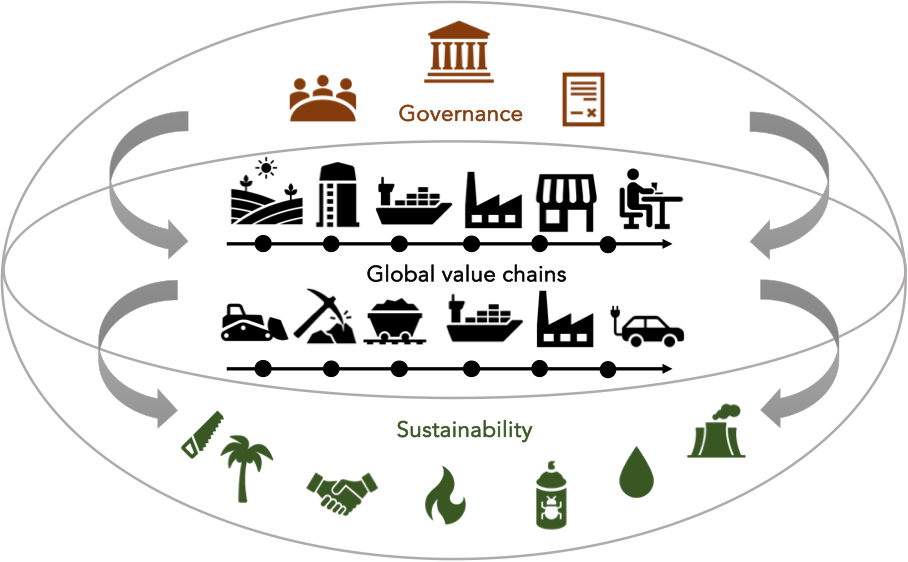
The global demand for raw materials and agricultural products has led to unsustainable working conditions and environmental impacts, especially in countries of the Global South. Efforts to address these issues have largely relied on voluntary certification and auditing by businesses, but since the mid-2010s, countries have implemented binding regulations such as France’s 2017 Loi de Vigilance, Germany’s 2023 Supply Chain Due Diligence Act, and the EU’s Corporate Sustainability Due Diligence Directive, with their effects still largely unexplored.

A new collaborative project, funded by the VolkswagenFoundation and the Lower Saxony Ministry of Science and Culture, will explore effects, potentials, and limitations of sustainability governance in global value chains (GVC). Leuphana University Lüneburg (lead) and Osnabrück University (co-lead) are collaborating with Oldenburg University and the German Institute for Global and Area Studies (GIGA).

Existing private and public approaches to the sustainability governance of GVCs face significant challenges. The geographic distance of many GVCs often leads to a lack of knowledge among Global North actors regarding the socio-economic, cultural, and ecological impacts at production sites in the Global South. Additionally, current information management systems fail to provide adequate data for making supply chains more sustainable, and the concept of “telecoupling” highlights the complexity of adapting international regulations to local conditions. Furthermore, GVCs are characterized by divergent interests and power asymmetries, making transparency and traceability essential yet difficult to achieve. Compliance with laws and standards remains challenging, particularly in regions with weak state capacities, necessitating monitoring, verification, sanctions, and capacity-building measures.

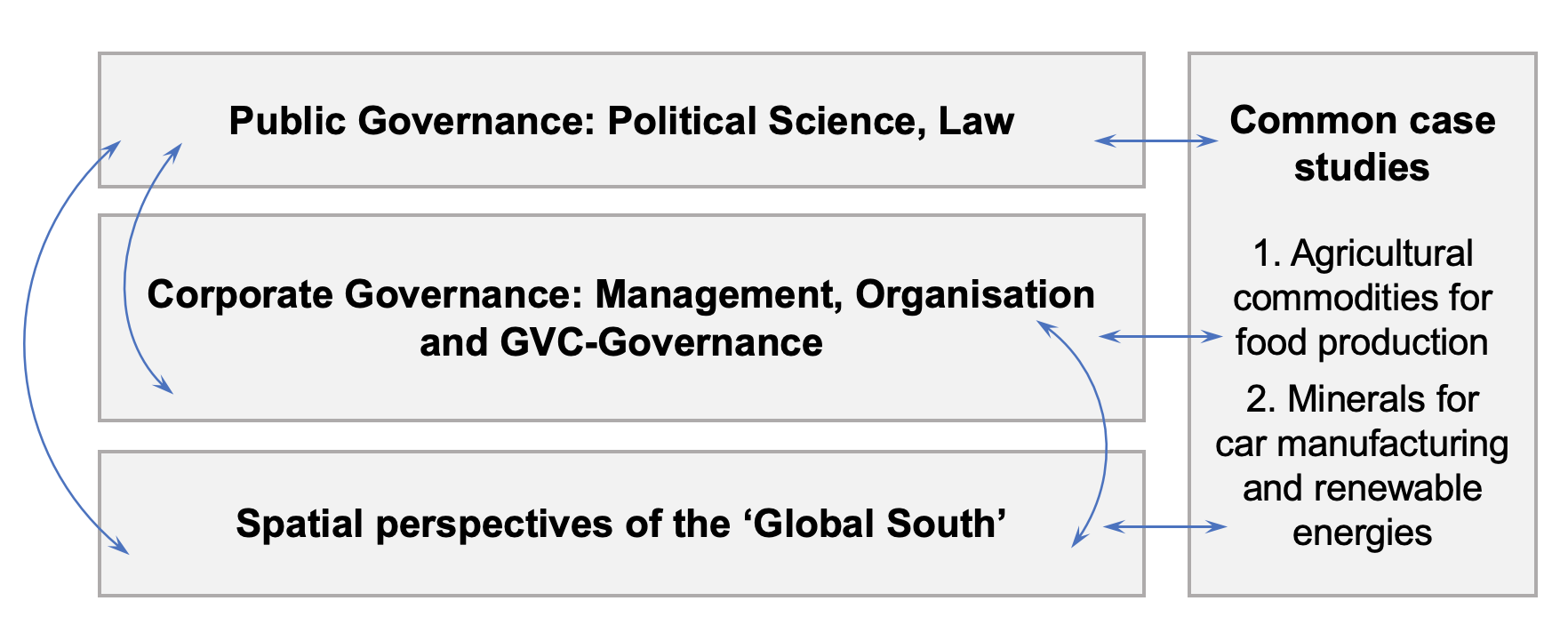
To explore these complex issues, the collaborative project takes a multi-perspective approach encompassing public governance (political and legal aspects), corporate governance (company networks and their practices), and regional perspectives (focusing on the Global South). The project will utilize empirical case studies in sectors crucial to Lower Saxony, such as agricultural raw materials for food production and minerals for automotive manufacturing and renewable energy production.

Key features of the research cluster include:

  1. Interdisciplinary integration of political, legal, economic, socio-technical, and geographical perspectives.
  2. Integration of perspectives from both the Global North and South.
  3. An empirical multi-sector comparison of GVCs relevant to Lower Saxony.

This comprehensive approach seeks to promote a deep understanding of how public regulations, corporate sustainability management, and technological solutions can drive the desired transformations along GVCs, ultimately contributing to sustainable global development.

In the months to come, two post-doc positions and nine PhD positions will be advertised across the collaborative project.