The Independent Guardian, the Advisory/Coordination Body, and the Stakeholder Council

Three Types of Institutional Innovations Show How to Represent Future Generations in Political Decision-Making Today

By Michael Rose

The choices we make in politics today, whether regarding biodiversity loss, climate change, or social security systems, hold significant repercussions for the well-being of future (i.e., yet unborn) generations. The fact that future generations have no voice today may contribute to the governance failures prevalent in these realms and others. From a democratic perspective, the interests of all affected by political decisions should be considered in their formulation. Moreover, the guiding principle of sustainable development asks us to consider the needs of future generations alongside those of the present. But how could we give a voice to people who do not yet exist?

The German Bundestag hosts the Parliamentary Advisory Council on Sustainable Development, a member of the Network of Institutions for Future Generations (Photo: Robert Diam).

Several democracies have responded to this challenge by establishing specialized institutions. For instance, in 1993, the Finnish Parliament formed the Committee for the Future. Shortly thereafter, in 1995, Canada established the Commissioner for Environment and Sustainable Development. Both institutions remain active today. From 2001 to 2005, the Israeli Knesset had a Parliamentary Commissioner for Future Generations. Following suit, in 2008, the Hungarian Parliament introduced an Ombudsman for Future Generations, although this position was later downgraded by the Orbán Government in 2012. Notably, the Future Generations Commissioner for Wales stands out as a prominent example of how democracies evolve their institutional frameworks to consider future generations today.

Twenty-five institutions in 17 democracies

In my article “Institutional Proxy Representatives of Future Generations: A Comparative Analysis of Types and Design Features”, I formulated the notion of institutional proxy representation of future generations to provide a theoretical foundation for these institutional advancements. Furthermore, I applied this concept to build a comprehensive inventory of empirical instances of institutional proxy representation across democracies worldwide. Through this analysis, I identified 25 institutions for future generations – or “proxies” – in 17 democracies.

The proxies are grouped into three types, based on the rationale of selecting their members: The expertise-driven independent guardian (type I), the political or administrative advisory or coordination body (type II), and the sustainability stakeholder council or commission (type III). For each proxy (and proxy type), I assessed how it is designed, and how this translates into its formal capacity to influence political decision-making.

Three types

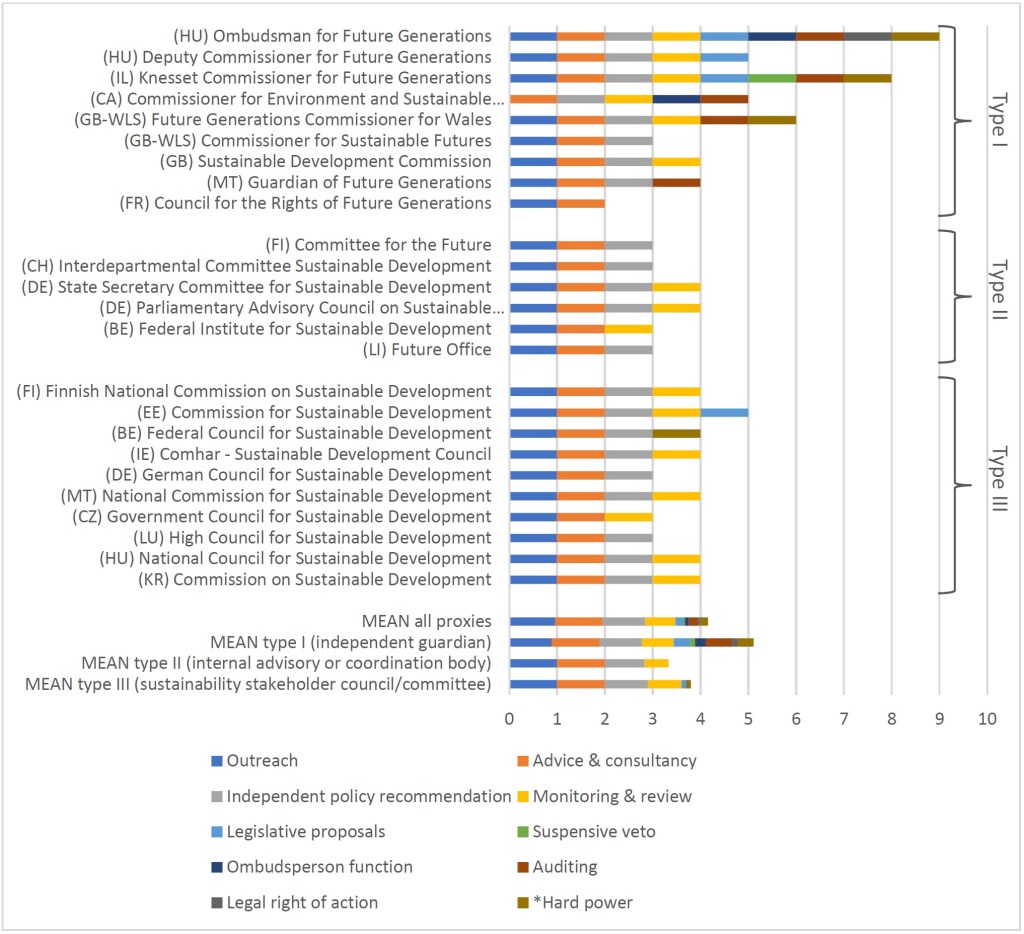
Type I proxies – the independent guardians – typically comprise experts who are not part of government or parliament. This allows them to consider the needs of future generations from a professional point of view with minimal political interference. These proxies often have robust legal foundations and wield specific political instruments usually not found in other proxy types, such, legal rights of action, a suspensive veto, ombudsperson functions, legislative proposals, and auditing, including independent investigation rights. Type I includes all the strongest, but also some of the weakest proxies examined in this study. The strongest ones can not only voice the interests of future generations, but can also make sure they are heard by parliament or government. However, the survival rate of type I proxies is rather low.

Type II proxies – the political or administrative advisory or coordination bodies – are, to a certain extent, the counter-model to type I. They are not independent, but internal parts of the political system, comprising either Members of Parliament or members of the governmental departments. Operating on a predominantly weak legal footing, they provide internal advisory, coordination, and sometimes monitoring services to enhance political decision-making from within, with a view toward benefitting future generations. They only have limited political instruments at their disposal and can access only few stages of the policy cycle, which makes them heavily reliant on good working relationships with other parts of parliament and government.

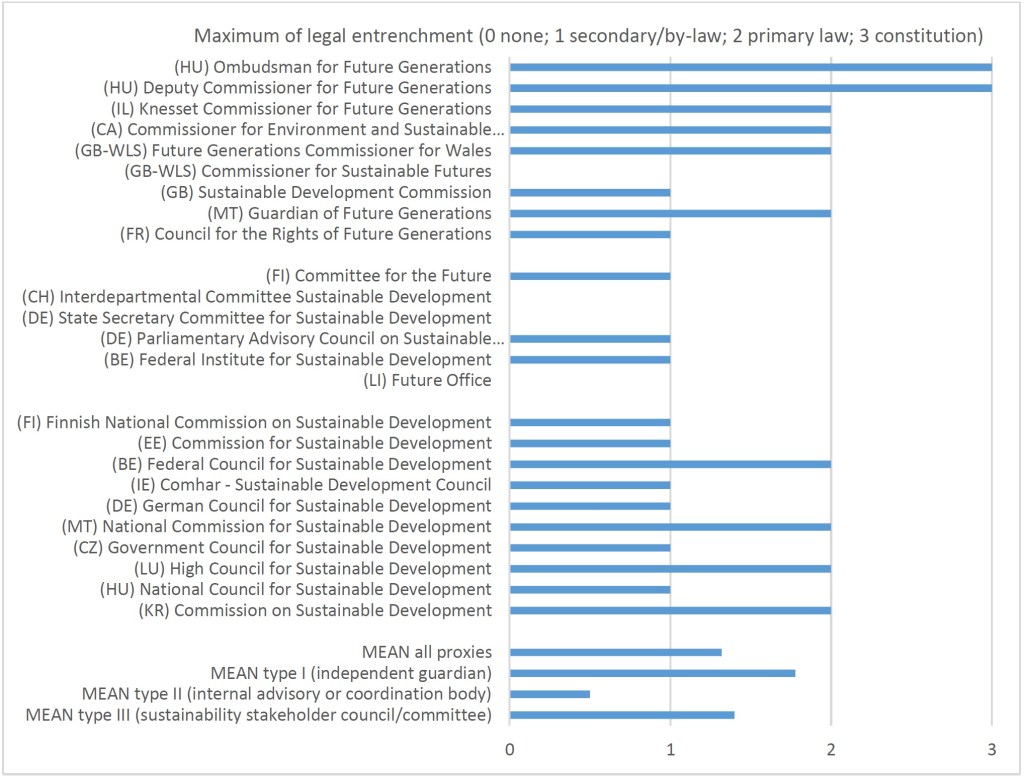
Type III proxies – the sustainability stakeholder councils or committees – are designated parts of the sustainability governance architecture of their host countries. Embracing the principles of functional representation and participation, members are appointed from different sectors of society to broaden societal outreach, provide general advice and specific policy recommendations to the government, and oftentimes monitor and review sustainability-related developments. While they lack particularly strong or weak formal capacities to influence political decision-making, they show the highest survival rate among the three types, possibly attributable to their integration across multiple sectors.

Design features

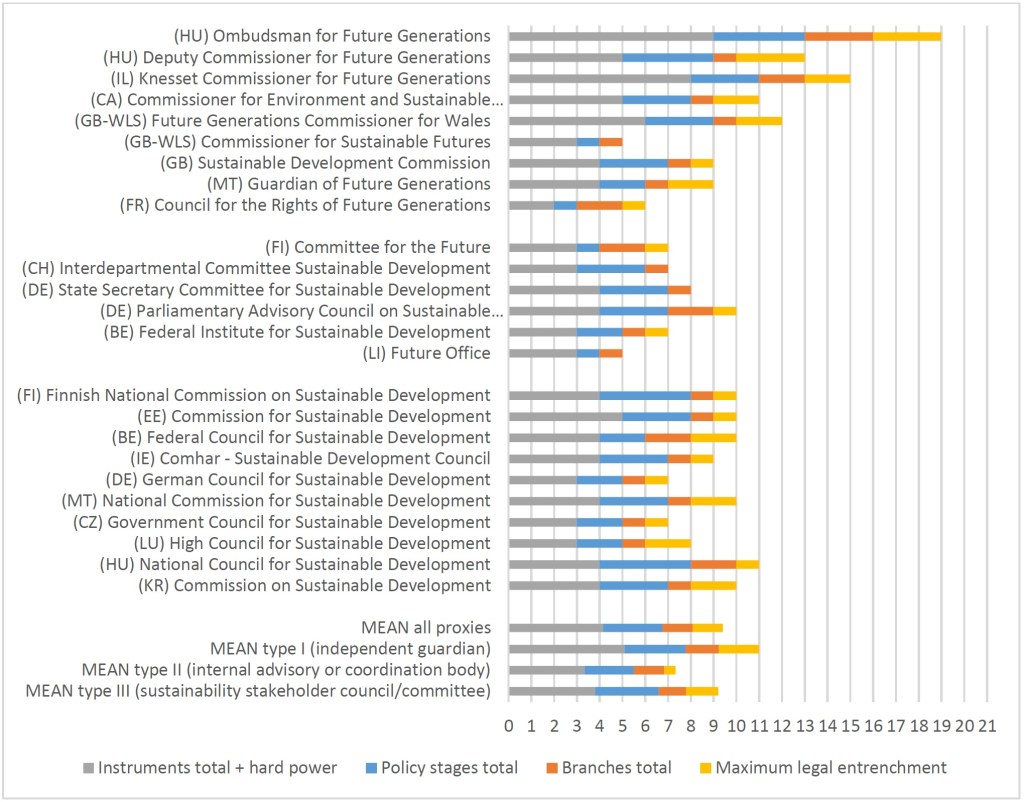
I assessed each proxy to determine the legal basis upon which it was established, the political instruments it was granted, and the branches of government and stages of the policy cycle it could engage with through these instruments. This figure shows the distribution of political instruments across proxies and types. Proxies were created with these instruments to allow them to monitor and influence political decision-making and reach out to society. To learn more about proxies’ access to branches of government and phases of the policy cycle, as well as their legal bases and total formal capacity to influence political decision-making, please scroll through the slideshow.
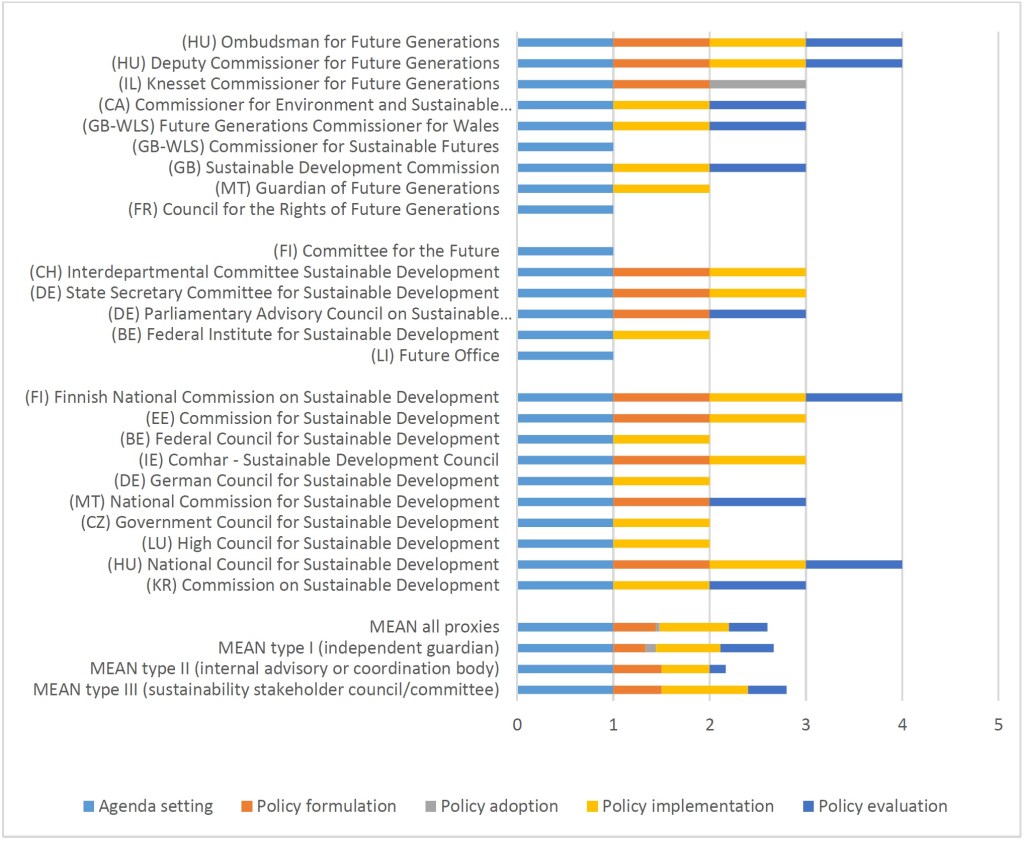
Political instruments | Access to stages of the policy cycle | Access to branches of government | Legal basis | Total formal capacity to influence political decision-making

A multifaceted landscape of institutionalized voices of future generations

In general, the diverse and dynamic array of proxies, although relatively small in number, provides manifold examples of institutional innovations illustrating how the interests of future generations can be considered in political decision-making. However, while some of these proxies can act as watchdogs with teeth when ignored, many seem to represent rather cosmetic than far-reaching reforms of the democratic decision-making process. Therefore, it is important not to place excessive expectations on these proxies in terms of effecting significant policy changes to the benefit of future generations. For more detailed and inspirational results, download the full study here.

Reference
Rose, Michael (2024): Institutional Proxy Representatives of Future Generations: A Comparative Analysis of Types and Design Features, in: Politics and Governance 12, Art. 7746 (21 pages). DOI: 10.17645/pag.7745

Citizens’ Councils for Promoting the Global Common Good

By Okka Lou Mathis

Prioritise climate protection, promote sustainable food production, increase funds for development cooperation, and create a sustainability ministry: These are just four of the 32 proposals from the citizens’ council on “Germany’s Role in the World”, consisting of 154 randomly selected citizens. The Bundestag will receive the final report on 19 March. The citizens’ council is an instrument of innovative citizen participation that has been used in many countries and at various political levels.

Citizens’ councils promise to reduce disenchantment with politics and to promote courageous solutions to socially controversial issues. The trick is that certain people come together by lot, ideally representing the socio-economic composition of society, in a so-called “mini-public”. The council is therefore much more inclusive and diverse than, for example, the Bundestag. Moreover, the councillors have neither voters, nor a party line, or lobby interests breathing down their necks. The idea is that this allows them to discuss political issues more impartially and at eye level. In addition to learning together, an appreciative, personal and yet fact-oriented exchange of experiences and views can take place according to the principle of “deliberation”: In the end, the best argument for the common good should actually be convincing, not just the loudest voice or the best-organised interest. For this reason alone, citizens’ councils are a useful addition to our democracy. In concrete terms, citizens’ councils can provide valuable impulses in terms of content, as the political recommendations on sustainability from the citizens’ council “Germany’s Role in the World” show.

The citizens examined this broad topic from five perspectives in working groups: sustainable development, peace and security, democracy and the rule of law, economy and trade, and the EU. The topics were selected in advance through a participatory process, and it is gratifying that sustainable development was considered very important. A small drop of bitterness, however, is that sustainable development was not, by its very nature, considered as a cross-cutting basic principle everywhere. Be that as it may, both the agreed guidelines and the concrete recommendations of the sustainable development group showed that the randomly chosen citizens were serious about wanting to anchor sustainability as an overarching guiding principle in German politics. For example, at their final meeting on 20 February, they agreed that Germany should “promote sustainability, climate protection, the right to clean water and the fight against world hunger as a global cross-sectional task (…) and place them at the centre of its political action so that future generations can also live well”. They proposed “enshrining sustainability in the Basic Law” and the “establishment of a sustainability ministry that coordinates, controls and monitors other ministries and ensures transparency”. They also found clear words for prioritising climate protection and for Germany to show “courage to embrace a reorientation towards the common good and end the continuous growth paradigm”. In addition, funds for “development aid” should be increased to 2% of gross national income (currently the rate is 0.6%). In addition, food production should become sustainable worldwide – “even if food prices in Germany rise as a result.”

If we think of the international agreements such as the Paris Climate Agreement and the 2030 Agenda for Sustainable Development, sustainability and the reduction of greenhouse gases are central and overarching political goals, and are not exactly new. What is new and encouraging, however, is that the international community’s existing goals, and their consequences for us in Germany seem to enjoy support among the general population, at least when citizens are given the opportunity to discuss them in an informed way. This could increase both the pressure on politicians for the ambitious implementation of these goals and the social legitimacy of sustainability measures in Germany. Despite all the euphoria, however, questions remain about the citizens’ council as an instrument, for example how to strengthen its political weight and how to attract broader public attention to the discussions and conclusions.

The citizens’ council “Germany’s Role in the World” shows the instrument’s potential for searching for solutions oriented towards the common good – both at national and global level. This makes the format directly relevant for international (development) cooperation, because the global common good is the very rationale behind the climate and sustainability agendas. The institutionalisation of citizens’ councils in Germany, especially on sustainability issues, would therefore be a promising way of exerting pressure for the implementation of these international targets. Incidentally, this is also a recommendation of the panel itself: “Germany should (…) use and account for citizen-based, political forums (e.g., citizens’ assemblies) on a permanent basis”. The next citizens’ council that could work for the global common good is already in the starting blocks – the topic: climate.

This post first appeared as The Current Column (2021), Deutsches Institut für Entwicklungspolitik / German Development Institute (DIE) on 18 March 2021.

Workshop Invitation: Democracy & Intergenerational Justice – Overcoming Harmful Short-termism Through New Institutions? (8–9 September 2020)

By Michael Rose

Sustainable development requires legitimate and effective governance for the long-term that somehow considers the needs of future generations. As part of the MANCEPT Workshops 2020, an annual conference in political theory at the University of Manchester (this time online), we co-organise a two-day panel to discuss the relationship between democracy and intergenerational justice and the opportunities and challenges of institutional reform.

Date: 8–9 September 2020, from 9 to 18:30 hrs (British Summer Time UTC+1), online

We welcome everyone who is interested in the topic! There is no fee for non-presenters, just send me an e-mail to get the Zoom login data. Let me know if you’d be willing to volunteer as a discussant (not required).

On Tuesday, Axel Gosseries will give a keynote speech “On Why We Should Not Expect Too Much from Intergenerational Legitimacy“ (11:3012:30).

On Wednesday, Simon Caney will deliver a keynote speech on “The Challenges of Governing for the Long-Term: Why the Problem is Deep” (11:0012:00).

Workshop Description

Democracies are commonly diagnosed with a harmful short-sightedness which makes it difficult to recognise and deal with long-term risks and challenges. This bias towards the present arises out of many institutional, cultural, and anthropological factors, among them the election cycle, the influence of special interest groups and the ineptitude of humans to deal with ‘creeping problems.’ In light of this, democracies seem ill-equipped to deal with challenges such as the climate crisis, artificial intelligence or microbial resistance. Thus, the ability of the living generation to take the interests of future people into account and to fulfil its obligations to future people is hampered.

Consequently, several countries have taken measures to facilitate long-term oriented decision-making, e.g. by establishing commissioners for future generations (Hungary, since 2008; Israel, 2001-06; Wales, since 2016) or a parliamentary committee for the future (Finland, since 1993), some of them having considerable capabilities for influence. Furthermore, scholars discuss a wide range of proposals for new future-oriented institutions (F-Institutions). These include the representation of future generations in parliament, ombudspersons for the future, regulatory impact assessments, advisory councils, deliberative mini-publics as well as the enfranchisement of the young, the disenfranchisement of the elderly and many more.

Despite the growing range of proposals for F-Institutions, questions regarding their justification and legitimacy, design, and implementation deserve further discussion. Intergenerational equity, democratic legitimacy, and generational sovereignty all exert their normative pull on the democratic system and consequently on the design of F-Institutions. For example, the ability of each generation to govern itself collectively seems incompatible with the idea of institutionally binding the currently living to ensure that they meet their obligations of intergenerational justice. Further, honouring obligations of intergenerational justice may suggest installing F-Institutions with extensive influence on the political decision-making process, while a concern for democratic legitimacy might foreclose many proposals for F-Institutions.

In sum, this workshop aims to bring together moral, political, and legal theorists and practitioners interested in democracy, intergenerational justice, long-term decision-making and short-termism to discuss the various tensions associated with these concepts on both the theoretical and empirical levels.

Participatory and collaborative environmental governance – just symbolic exercises to sustain unsustainability?

By Jens Newig

No matter if it’s about siting new landlines, declaring protected areas or developing water management plans: Citizen panels, stakeholder roundtables and deliberative decision-making have become commonplace in Western democracies. While great hopes have been placed in such participatory and collaborative forms of governance to advance environmental sustainability, the debate is now more nuanced and partly skeptical as concerns both their democratic and their sustainability-oriented benefits. Ingolfur Blühdorn and Michael Deflorian from WU Vienna add an interesting facet to this debate, building strongly on Ingolfur Blühdorn’s earlier work on simulative politics and democracy. Their thought-provoking article entitled “The Collaborative Management of Sustained Unsustainability: On the Performance of Participatory Forms of Environmental Governance” was published just two weeks ago in Sustainability.

What makes this an interesting read is its broader sociological perspective. Rather than asking how governance does or should function to achieve normative goals, the article investigates why participatory and collaborative forms of governance are proliferating and which societal functions are served through these. The authors start out by arguing that collaborative and participatory forms of governance are neither (1) particularly democratic nor (2) likely to be effective in the sense of their transformative potential towards sustainability. This, they argue is because (1) collaborative and participatory forms of governance are typically coopting citizens or selectively empowering only some actors who do not have a clear democratic mandate, and (2) because “their proliferation has, as yet, not taken modern consumer societies much closer to the great socio-ecological transformation”. This, the authors speculate, is “perhaps because the prevailing forms of decentralized and collaborative governance are explicitly designed not to disrupt the established order and are, therefore, structurally unable to deliver the kind of change that scientists and environmental movements demand.” If this is so, then why are collaborative and participatory decision-making processes becoming so prevalent?

The key to understanding this apparent puzzle, the authors argue, lies in the performative aspect of governance. Referring to the title of our 2018 paper on conceptualizing the “performance of participatory and collaborative governance”, the authors re-interpret the notion of ‘performance’. In a nutshell, they distinguish

  • performance as delivery of outputs – both in a “democratic” and in a substantive (“systemic”) sense – from
  • performance as theatrical display, enactment or illusion in the sense of symbolic or simulative politics.

It is this second perspective that the article focuses on, proposing “that these new modes of environmental governance have become so prominent because they actually correspond very closely to the particular dilemmas, preferences, and needs of contemporary consumer societies—notably the desire to sustain particular lifestyles and understandings of freedom and self-realization, which are known to be socially and ecologically destructive (unsustainable)”. Hence, new modes of environmental governance, “if assessed from the perspective of these contemporary dilemmas, preferences, and needs, they do actually perform exceptionally well. More specifically, they provide contemporary consumer societies with a practical policy mechanism that helps them to reconcile the widely perceived seriousness and urgency of socio-environmental problems with their ever more visible inability and unwillingness to deviate from their established societal order, patterns of self-realization and logic of development.” Put simply, while we cannot achieve sustainability and at the same time continue the established logic of consumption, participatory governance helps us to at least symbolically resolve this apparent contradiction. ‘Symbolic’ stems from the Greek term symballein, meaning to ‘throw together’ – here otherwise irreconcilable aims (I’ve written earlier about symbolic politics and legislation, as it happens in a special issue edited by Ingolfur Blühdorn). Hence, ‘performing’ collaborative governance gives us the feeling of teaming up for sustainability, while at the same time we do not give up on our unsustainable lifestyles. As a consequence, these collaborative practices contribute to stabilizing (rather than transforming) current systems of unsustainability – thus the argument of the authors.

While I find these lines of arguments illuminating, my main point of criticism concerns the lacking empirical grounding. The authors illustrate their points by three empirical cases, but these of course cannot be representative. We should be aware, therefore, that the performative functions identified here may apply to some cases of participatory and collaborative governance, but not to others.

Assuming we do strive for environmental sustainability, and assuming further that governance (by whatever mode) can play a vital, if not indispensable role in this – what insights do we gain from this article? In terms of normative guidance, this paper may leave us with a fatalistic impression that not much can actually be done, because – and so long as – societies embrace the “notions of freedom, self-determination, self-realization”, which are “firmly based on the principle of sustained unsustainability”. Having said that, I see three productive lessons we may take from the article:

  • First, the paper is enlightening for all those of us who either adhere to rationalist and instrumentalist models of decision-making, or who see decision-making through the lens of power-play (in which big business tends to ‘win’). Having read this paper, one can no longer claim not to have heard of the potential dangers of participatory and collaborative governance – not just because it may be ineffective but also because in a subtle, hidden, yet striking way it may serve to obscure its symbolic functions which result in sustaining unsustainability.
  • Second, these insights by no means imply an empirically grounded verdict! Despite its three examples, this is not an empirical paper. In fact, the jury is still out on how participatory and collaborative environmental governance actually delivers (to avoid the term ‘performs’) in both a democratic and a sustainability-oriented sense. What is required, more than ever, is solid empirical evidence of which modes of governance ‘deliver’ und under what circumstances.
  • Third, from a governance perspective, it is one thing to be aware about the potential deficiencies and misleading hopes of participation; it is another to ask: What is the alternative? Should we go “back” to strong state-based decision-making? Is there just too much governance and too little government? Arguably, we not only don’t know enough about the delivery of participatory and collaborative governance, but also we lack robust evidence on the role of expert-led decisions, the role of administrative capacities and of elite-networks in shaping decisions for environmental sustainability.

All in all, I highly recommend this enlightening article – not least for use in teaching sustainability governance courses, confronting students with sobering insights on the functions of participatory and collaborative governance, and triggering discussions about ways to effectively govern towards sustainability – including or not collaborative forms.

New doctoral programme “Democracy under Stress” – 7 PhD positions

Leuphana’s Center for the Study of Democracy has been awarded a major grant for funding a total of 14 PhD scholars. The first 7 scholarships are advertised now.

The doc­to­ral pro­gram in­ves­ti­ga­tes how the new po­li­ti­cal, eco­no­mic, eco­lo­gi­cal, and cultural chal­len­ges (‘stress fac­tors’) that mo­dern de­mo­cra­cies en­coun­ter are per­cei­ved, dealt with, and sol­ved in view of the exis­ting ten­si­on bet­ween po­li­ti­cal le­gi­ti­ma­cy and re­stric­ted per­for­mance. It will fur­ther look into the im­pli­ca­ti­ons that dif­fe­rent mo­des of pro­blem-hand­ling have for the ‘sur­vi­val chan­ces’ of de­mo­cra­cy. This two­fold re­se­arch agen­da will be ana­ly­zed in three fiel­ds of stu­dy that re­pre­sent the core func­tions of de­mo­cra­cies: par­ti­ci­pa­ti­on, re­pre­sen­ta­ti­on, and in­clu­si­on.

The first field of stu­dy is con­cer­ned with how ci­ti­zens in de­mo­cra­tic so­cie­ties per­cei­ve cur­rent so­cie­tal – e.g. environmental or sustainability-related – chal­len­ges in light of in­cre­a­sing ’eman­ci­pa­ti­ve’ va­lue ori­en­ta­ti­ons and how the­se per­cep­ti­ons are trans­la­ted into po­li­ti­cal be­ha­viour (participatory democracy).

In the frame­work of the se­cond field of stu­dy, the re­pre­sen­ta­ti­ve ca­pa­ci­ty of po­li­ti­cal in­ter­me­di­a­ry or­ga­niza­t­i­ons as well as po­li­ti­cal in­sti­tu­ti­ons wi­t­hin and outs­ide the na­ti­on sta­te will be ana­ly­zed (representative democracy).

By me­ans of selec­ted po­li­cy fiel­ds (e. g. en­vi­ron­men­tal, cli­ma­te, sci­ence and me­dia po­li­cy) the third field of stu­dy looks into the is­sue of how new forms of po­li­ti­cal par­ti­ci­pa­ti­on in­ter­act with tra­di­tio­nal in­sti­tu­ti­ons, ac­tors, and pro­ces­ses of re­pre­sen­ta­ti­ve de­mo­cra­cy (inclusive democracy).

Deadline for submission of applications is 12 June, 2016.

For more information, please see http://www.leuphana.de/en/research-centers/zdemo-english/doctoral-program-democracy-under-stress.html