AI Tools in Sustainability Research: Insights from Our Team Retreat

At our recent research retreat, we shared our experiences of AI tools for literature search, writing, and analysis. Since we are now reporting on AI’s usefulness as a ‘research assistant’, we also used ChatGPT to help draft this post— making it a practical experiment in itself!

🔍 Smarter Literature Searches: Elicit & Consensus

We’ve used these AI-powered search engines to discover academic papers.

  • Elicit delivers structured insights, acting like a mini meta-analysis (and very recently even offering systematic reviews in paid versions).
  • Consensus provides a broader mix of sources, including non-academic content.
  • Our observation: They return different results for the same query, so cross-checking is valuable. We’re also still testing how Elicit performs when conducting systematic reviews.

🎨 Visualizing Ideas: Napkin

Napkin turns text into quick conceptual diagrams—perfect for research presentations or proposal sketches. We all enjoyed playing with it, and would recommend to just give its free version a go.

🕸️ Mapping Research: Research Rabbit

This tool creates citation networks, helping to identify key papers and connections. However, it leans on older publications, so it’s best for field overviews rather than cutting-edge research. You can tailor it a bit more when uploading your own collection and asking it to add suggestions for similar publications. However, we found the interface and visualization of the citation networks a little overwhelming at first.

🤖 ChatGPT & Other AI Assistants

ChatGPT remains a go-to tool, now with improved accuracy. Key uses include:

  • Summarizing and analyzing uploaded papers.
  • Generating feedback in a peer review style.
  • Assisting with writing, though data privacy remains a concern.

Other notable tools include Perplexity, DeepSeek, and Aleph Alpha, although we have not used those extensively in our research

✍️ Writing Support: DeepL Write

Great for refining academic writing and maintaining consistent terminology, especially in multilingual work.

🎙️ Transcription Aids: Otter, Firefly & Dragon NaturallySpeaking

These AI-powered tools help transcribe interviews but still struggle with accents and poor audio quality. If interviewees agree, they can be a great time saver.

⚠️ Data Protection & Regulatory Uncertainty

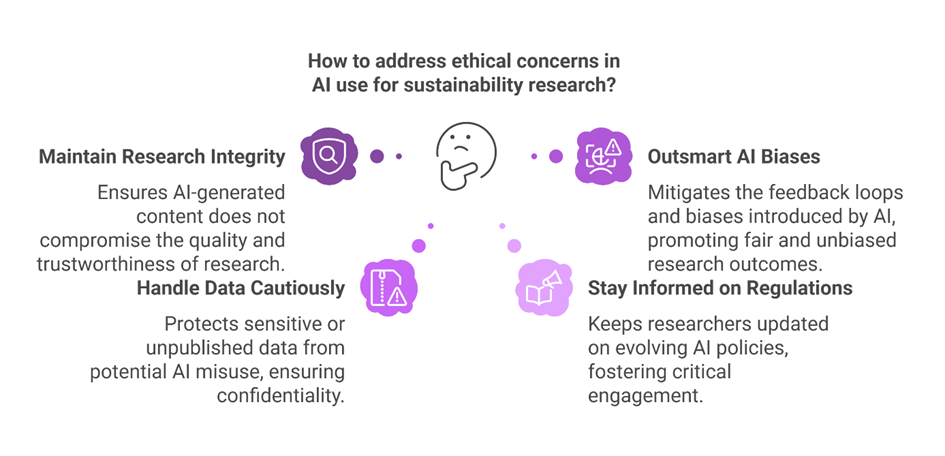
A major challenge remains: university regulations on AI tools vary, creating uncertainty for researchers and students who collaborate across institutions. Here, we’ve used Napkin to outline our concerns and potential solutions when using AI tools. What do you think of the graphics?
Final Thoughts

AI isn’t a magic fix, but it can be a powerful research ally when used thoughtfully. There are so many social media accounts that introduce a variety of AI – we’ve decided to test a few of those in the coming months, so stay tuned for more discussions on AI and its usefulness for research.

What AI tools have you found useful in (sustainability) research? What camp are you on: team yay or nay AI? Share your experiences and thoughts in the comments.
New Collaborative Project on the Sustainability Governance of Global Value Chains

By Jens Newig

Updated on 4 July 2024.

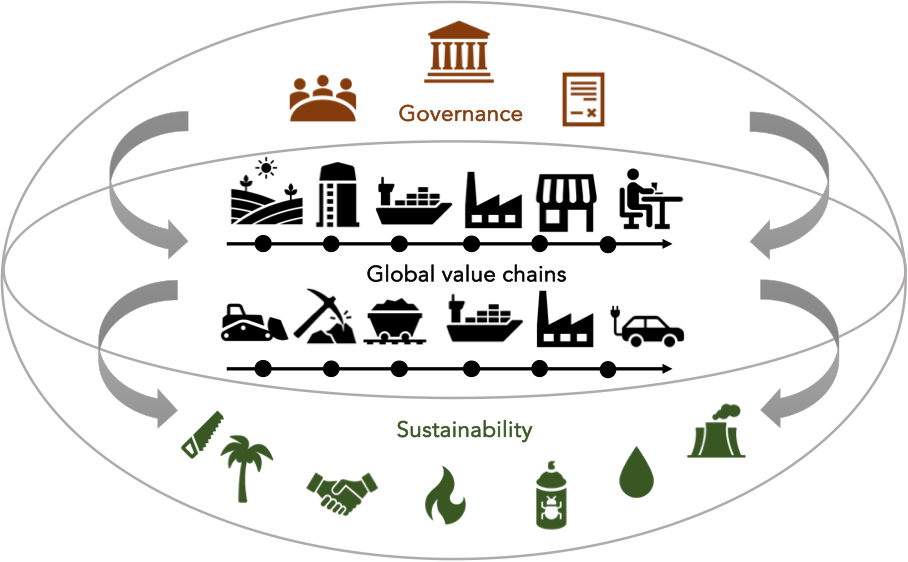
The global demand for raw materials and agricultural products has led to unsustainable working conditions and environmental impacts, especially in countries of the Global South. Efforts to address these issues have largely relied on voluntary certification and auditing by businesses, but since the mid-2010s, countries have implemented binding regulations such as France’s 2017 Loi de Vigilance, Germany’s 2023 Supply Chain Due Diligence Act, and the EU’s Corporate Sustainability Due Diligence Directive, with their effects still largely unexplored.

A new collaborative project, funded by the VolkswagenFoundation and the Lower Saxony Ministry of Science and Culture, will explore effects, potentials, and limitations of sustainability governance in global value chains (GVC). Leuphana University Lüneburg (lead) and Osnabrück University (co-lead) are collaborating with Oldenburg University and the German Institute for Global and Area Studies (GIGA).

Existing private and public approaches to the sustainability governance of GVCs face significant challenges. The geographic distance of many GVCs often leads to a lack of knowledge among Global North actors regarding the socio-economic, cultural, and ecological impacts at production sites in the Global South. Additionally, current information management systems fail to provide adequate data for making supply chains more sustainable, and the concept of “telecoupling” highlights the complexity of adapting international regulations to local conditions. Furthermore, GVCs are characterized by divergent interests and power asymmetries, making transparency and traceability essential yet difficult to achieve. Compliance with laws and standards remains challenging, particularly in regions with weak state capacities, necessitating monitoring, verification, sanctions, and capacity-building measures.

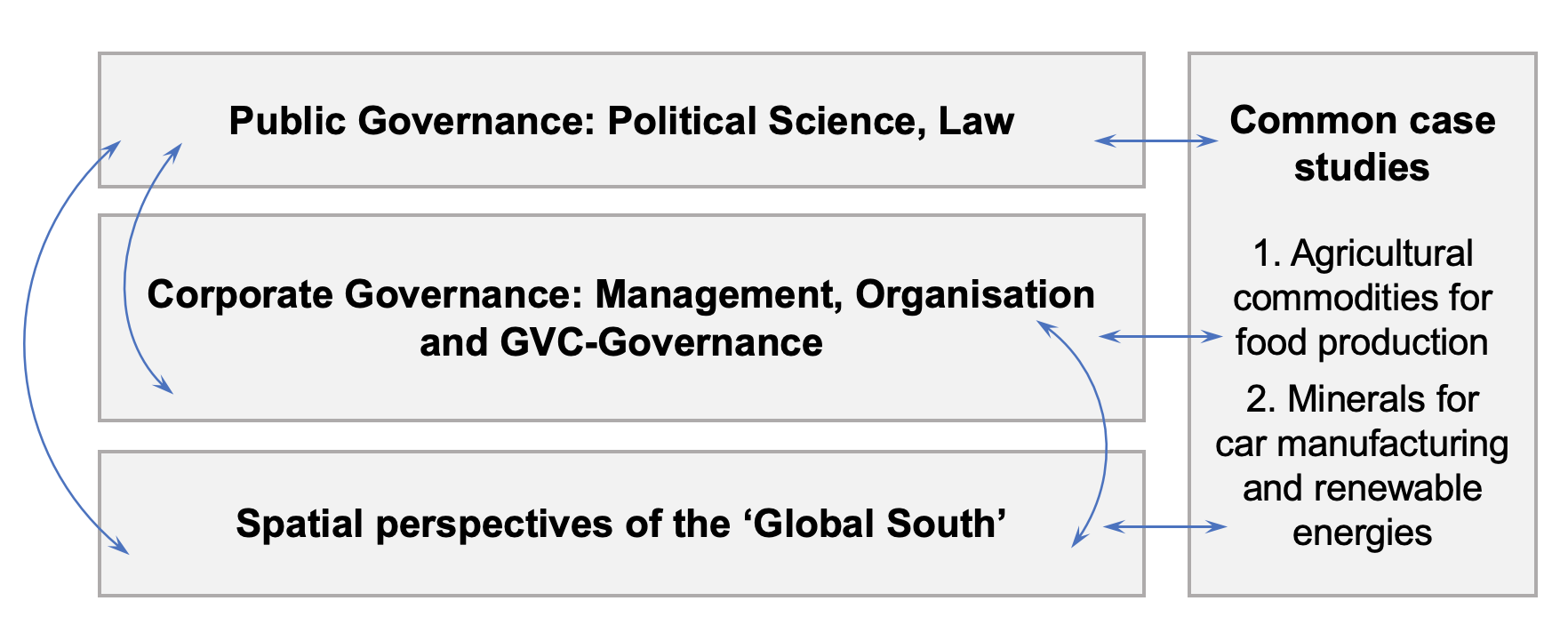
To explore these complex issues, the collaborative project takes a multi-perspective approach encompassing public governance (political and legal aspects), corporate governance (company networks and their practices), and regional perspectives (focusing on the Global South). The project will utilize empirical case studies in sectors crucial to Lower Saxony, such as agricultural raw materials for food production and minerals for automotive manufacturing and renewable energy production.

Key features of the research cluster include:

  1. Interdisciplinary integration of political, legal, economic, socio-technical, and geographical perspectives.
  2. Integration of perspectives from both the Global North and South.
  3. An empirical multi-sector comparison of GVCs relevant to Lower Saxony.

This comprehensive approach seeks to promote a deep understanding of how public regulations, corporate sustainability management, and technological solutions can drive the desired transformations along GVCs, ultimately contributing to sustainable global development.

In the months to come, two post-doc positions and nine PhD positions will be advertised across the collaborative project.