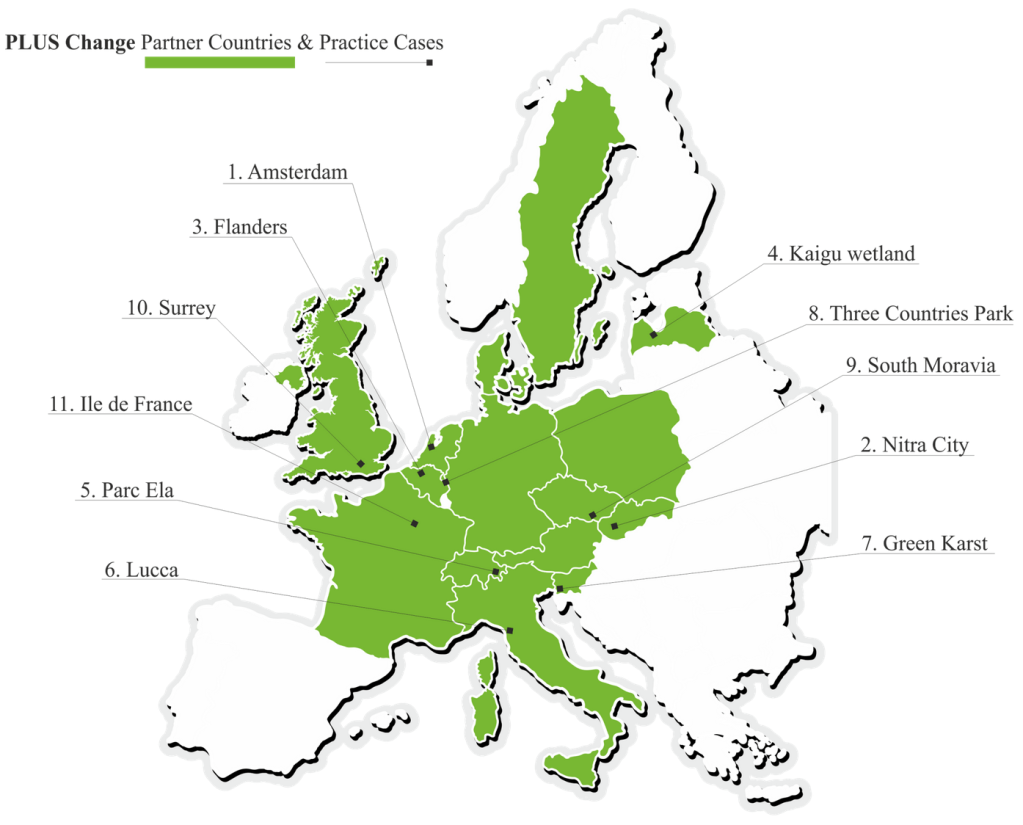
Governance systems are facing challenges to foster land-use strategies that support climate protection, social well-being and biodiversity conservation. The new EU-funded project “PLUS Change” involves 23 partner organizations across the European Union to provide robust evidence on and improve land-use decision-making for addressing climate change and biodiversity conservation. PLUS Change is co-ordinated by the Czech Globe research institute (see here for their introduction to the project). Using a transdisciplinary research approach, the project consortium is working with 11 planning authorities and regional development agencies in twelve case regions to firmly ground our research in the realities of different geographical, historical, cultural and political contexts and hence to produce policy-relevant knowledge on governing land-use towards sustainability.
To do so, the project will (1) bridge across biodiversity and climate, recognising them as problems that share many of the same underlying drivers, and must be solved together; (2) bridge between individual behaviour changes of citizens and broader systems-wide changes in decision-making and policy at levels from local to national to EU; and (3) bridge between different areas of expertise to create a truly transdisciplinary project that includes social sciences, land use modelers and practitioners of land use planning.
The scientific partners in PLUS Change will work on land-use modelling, produce a planning toolkit and test participatory methods in the case regions.
Our research group will use meta-analytical tools to synthesize evidence on how governance and policy impact sustainable land-use change. We aim to identify what governance approaches and interventions (evidence-based? participatory? collaborative? scale-adapted? etc.) have worked in what contexts to achieve a more sustainable land-use. Building on these results, in-depth empirical research (interviews, document analysis) will be conducted in 12 local practice cases in various countries across Europe. We will develop a rich understanding of the historical development of land use, contentious land use issues and conflicts, and the role of policy, tenure and governance arrangements in shaping land use change.
By Johanna Coenen, Gabi Sonderegger, Jens Newig, Patrick Meyfroidt, Edward Challies, Simon L. Bager, Louise M. Busck-Lumholt, Esteve Corbera, Cecilie Friis, Anna Frohn Pedersen, Perrine C.S.J. Laroche, Claudia Parra Paitan, Siyu Qin, Nicolas Roux, Julie G. Zaehringer
In today’s interconnected world, local sustainability issues such as deforestation, biodiversity loss, agri-chemical pollution and food insecurity are increasingly shaped by global commodity flows and the actions of distant actors. The demand for commodities such as soy, palm oil, cocoa, rubber and meat can have adverse social and environmental consequences in the production regions that are often geographically distant from the consumption sites. Such sustainability challenges often transcend traditional political boundaries, posing difficulties in designing governance institutions that adequately fit their scale. Where governance institutions fail to align with the scale of the problems they are meant to address, we encounter issues referred to as “problems of fit”, “mismatches”, or “misfits”. The governance of global commodity flows is particularly beset with such problems of fit.
In our recent article, published in Ecology and Society, we explore the spatial dimension of governance fit concerning global commodity flows. In doing so, we synthesize some key findings of the COUPLED project. We shed light on two key types of governance mismatches: boundary and resolution mismatches (Table 1).
Table 1. Boundary and resolution mismatches in the governance of telecoupled social-ecological systems.
Boundary mismatch
Resolution mismatch
Definition
Governance institutions neglect social-ecological problems that transcend established administrative or jurisdictional boundaries
Governance institutions have too coarse a spatial resolution than is suitable to address the social-ecological problems at hand
Underlying problem
Lack of governance extent
Lack of governance precision
Mechanism
Spillover
Leakage
Panacea trap
Description
Governance institutions do not govern a social-ecological problem that expands beyond their administrative or jurisdictional boundaries
Governance institutions address a social-ecological problem but create leakage(s), i.e., counterproductive effects outside the targeted area or domain of the intervention
Governance institutions are not specific enough to be effectively implemented and enforced
We present empirical examples of the different types of mismatches from both public and private governance perspectives in this publication. We also graphically illustrate the different mismatches. For example, Figure 1 displays boundary mismatches.
Figure 1. Boundary mismatches. Governance institutions neglect social-ecological problems that transcend established jurisdictional boundaries due to spillovers (A) or leakages (B).
Furthermore, we examine three approaches to address mismatches, namely due diligence laws and policies, landscape and jurisdictional approaches to supply chain governance, and environmental provisions in trade agreements. We show that any attempt to resolve boundary or resolution mismatches comes with the risk of creating new mismatches. We find that no single governance approach can address all mismatches, emphasizing the need for the alignment of multiple governance approaches to effectively govern global commodity flows.
In this blog post I reflect on some lessons learned of writing a manuscript with 14 co-authors, submitted for publication in a peer-reviewed journal. The paper aims to synthesize the results of an interdisciplinary research project, involving 15 individual PhD projects based at 8 different European universities. Here I share my experiences of leading such a collaborative endeavour. This blogpost is targeted at any (potential) lead author, but it can also be insightful to co-authors because it highlights common challenges when working and writing in teams.
Challenge 1: Assume leadership.
Most obviously, the lead author is expected to assume leadership. However, it is not always clear what this means in practices.
Tip 1.1. Choose an author management strategy.
As a first step, you should decide which author management strategy you wish to use. Do you follow the approach of the “lone wolf”, “dynamic duo”, “board of directors”, “roundtable” or “organized chaos” (see Appendix below)? Jointly reflecting on different modes of collaboration in interdisciplinary research teams can help to clarify roles and responsibilities, secure firm commitments from co-authors and prevent that co-authors hold onto preconceived expectations about the lead authors’ role. Even though it may be desirable to create a leadership collective as it can help to cultivate a particularly caring and inclusive academic culture, individual leadership is still the predominant modus operandi in scientific collaborations. Note that the authorship management strategy can change in the course of the writing process.
Tip 1.2. Discuss concrete proposals rather than open questions.
If you ask 14 authors how to approach or resolve a given issue, you may receive 14 different answers. If these answers are not compatible with one another, you can be left with more questions than answers. Rather than posing open questions, it can be more efficient to discuss concrete suggestions and ideas with co-authors. For example, I found it useful to always prepare a few presentation slides with the main ideas and remaining questions before meetings. Even if your ideas seem very preliminary, they provide a basis for discussion and help you steer the process.
Tip 1.3. Be prepared to make (final) decisions and communicate your decision-making authority with your co-authors.
Sometimes you find yourself in a deadlock where two different co-authors make contrary suggestions. For example, co-author A wishes to start the introduction with the core concept, whereas co-author B suggests to start with an elaboration of the real-world problem. Accommodating both suggestions may not be feasible. Acknowledge that you, as a lead author, are not able to accommodate all co-authors’ views and suggestions to the same extent and that you are entitled and expected to make decisions. Several senior researchers in our team encouraged me to assume this decision-making authority. Their affirmation of my lead role was certainly important for leading the process with more confidence.
Tip 1.4. Discuss the envisioned audience of the paper.
In interdisciplinary team of authors, who usually target slightly different audiences, it is important to discuss the target audience of the joint paper (and potential journal for submission) in order to align everyone’s expectations.
Tip 1.5. Make sure that you always feel a clear sense of ownership of the paper.
Even though a co-authored paper presents joint work, it is important that you always feel responsible for both the success and failure of the study. As much as I felt that this piece of work was “our paper”, I considered it to be “my paper” because I not only provided the main intellectual input, but also made sure that I could fully identify with every single argument that was developed. There is the risk that co-authors change the storyline of the paper according to their individual research interests and expertise, which you need to recognize, potentially discuss and carefully adapt to ensure that the paper speaks with one voice despite many different perspectives that informed the writing.
Challenge 2: Determine co-authorship
Tip 2.1. Reflect on the criteria for authorship.
Writing collaborative papers in the realm of larger research projects poses the question who becomes a co-author. It may be desirable to write a paper with all researchers who are involved in the research project because a presumably strong and long list of authors may raise the scientific credibility of the study and demonstrate the interdisciplinarity and inclusiveness of the research project. However, the more authors are involved, the more challenging it gets to ensure that all authors make a substantial, direct and intellectual contribution to the study, which is a widely used criterion for authorship (see e.g. guidelines for safeguarding good research practices by the German Research Foundation or the commonly used ICMJE guidelines). For our research project, for example, all members of the project were invited to two synthesis workshops (as further discussed below). While we offered everyone the possibility to become a co-author, we clarified that the mere participation in the workshop was not sufficient to qualify for co-authorship. Co-authors were expected to contribute towards developing, drafting and revising the manuscript; and asked to give final approval before journal submission. Discussing the criteria for authorship early on can help to prevent issues around ghost, guest, orphan or forged authorship.
Tip 2.2. Consider using an authorship agreement.
When you start collaborating, it is important to clarify some fundamental questions: What inputs and how much commitment do you expect from co-authors? How much guidance and instructions do you provide to co-authors? How much time are co-authors expected to attribute to this joint work? Especially as a junior researcher it can be uncomfortable to discuss this topic with senior researchers as there are power differentials. If you wish to formalize your modes of collaboration, you can use an authorship agreement (see example).
Tip 2.3. Keep track of the individual contributions.
Even if you decide not to fill an authorship agreement from the beginning of your collaboration, it is useful to record the individual contributions transparently. For example, set up a shared document with bullet points or a table, similar to the example of the authorship agreement provided above, and keep track of the individual contributions.
Tip 2.4.: Develop a strategy how to harmonize different writing styles.
If several people write the final manuscript, you need to find ways how to harmonize different writing styles. In our case, co-authors sent me bullet points or text snippets that I adapted and incorporated into the full manuscript. Other approaches to the writing process are of course possible. In any case, it is useful to briefly discuss your approach with the team.
Challenge 3: Manage time.
Tip 3.1. Develop a time schedule and discuss it with the team.
Collaborative paper projects usually take several months or even years. Thus, it is important to identify particular tasks and keep track of the progress made. For example, you can use a Gantt chart to maintain an overview. Add milestones and deadlines and consider when your co-authors are on holidays or not available due to other commitments like conferences or fieldwork.
Tip 3.2. Schedule regular meetings/jour fixes.
It may be difficult to find time for meetings with all authors or a smaller group of authors. Therefore, it is useful to plan regular meetings from the beginning. For example, schedule bi-weekly or monthly meetings for the expected duration of the collaboration. Even if some meetings may seem superfluous because not much progress has been made, briefly discussing any difficulties and the status quo of the paper can be useful to overcome a deadlock and ensures that co-authors remain committed to the joint study. Additional ad-hoc meetings can be scheduled if needed.
Tip 3.3. Always communicate the next steps.
Most, if not all, co-authors work on other projects and tasks next to your joint work. Thus, it is highly important to communicate whether you expect any inputs, and if so, from whom and when. You will more likely receive useful inputs from co-authors if you design small work packages, provide clear instructions and indicate tentative internal deadlines.
Challenge 4: Organize a workshop.
Organizing a workshop can help to create a shared vision of the paper. For our joint paper, we organized two workshops – one online and one in person – which helped to recognize diverging perspectives, develop new ideas, set the focus, and create a sense of shared responsibility for the progress of the study.
Tip 4.1. Communicate the agenda and aims of the workshop in advance.
First, all co-authors should be informed about the agenda and aims of the workshop – either a few days before the workshop or at the beginning. By clearly formulating the goals and desired outputs, you increase the chances of yielding actionable and substantial results.
Tip 4.2. Let others be the note-taker, facilitator and rapporteur during the workshop.
Organizing a workshop and preparing the materials can be time-consuming and intellectually-demanding. Although you may organize the workshop collaboratively, it will require time and energy to decide on the content and program of the workshop. Additionally, you may be overwhelmed by the co-authors’ feedback and inputs you receive during the workshop. Thus, it can be useful to ask other participants to help with taking notes, facilitating the discussion or acting as a rapporteur at the end of the workshop. If you do not assume all these roles yourself, you can better focus on the content-related ideas and challenging questions that will arise during the workshop.
Tip 4.3. Not only discuss the content of the paper, but also the work process.
At our workshops, we focused mainly on the content of the paper, trying to find the common denominator and advancing the main argument. However, it would have been beneficial if we had also discussed the work process. Exchanging about the co-authors’ expectations, commitments, roles and responsibilities can help clarifying the expected work flow and workload. Discussing our experiences from other collaborative studies with interdisciplinary author teams could have contributed to learning from best practices.
Challenge 5: Handle feedback
Tip 5.1.: Give clear instructions on what feedback to expect.
When a full paper draft is ready, co-authors will be involved in revising and editing the manuscript. If you give clear instructions on what feedback you expect, you will receive more targeted suggestions for improvements. For example, ask your co-authors for concrete edits (using track changes) rather than general comments on the text. Additionally, you can set the focus of the internal revisions. For instance, in the final rounds of revisions I indicated that we do not need additional illustrative examples or explanations because we already reached the word count. Rather, I asked the co-authors to focus on revising and modifying the existing text in order to avoid that co-authors add too many additional arguments and examples that we could not accommodate in the manuscript.
Tip 5.2. Learn to dismiss co-authors’ suggestions.
My co-authors’ comments and suggestions for improvements were excellent. However, it was not feasible to integrate all the feedback of our interdisciplinary research team for two main reasons. First, the word count is limited. Second, the paper needs to have a common thread and cannot do justice to all perspectives. Thus, we had to disregard some aspects. It was important to communicate from the beginning that the paper cannot accommodate all perspectives equally. I had to learn to dismiss some suggestions for change, despite highly appreciating co-authors’ inputs and valuing diverse perspectives. At the beginning, I felt obliged to incorporate all suggestions for improvements, but I learned over time that dismissing some suggestions was occasionally necessary and justified in order to keep the work manageable.
In sum…
It has been an extremely enriching experience of leading this work and I very much appreciated the opportunity, privilege and challenge of assuming this task. Of course, not all steps were easy, but I would not want to miss this experience – irrespective of the outcome of the pending review process of our paper. Not only the trustful, respectful and supportive relationships within the team, but also the co-authors’ positive feedback and affirmation of our work offset moments of insecurity and frustration. Good leadership benefits vastly from good teamwork to which all co-authors can contribute. Most importantly, take care of yourself and others during the joint project because you can only sustain your work in the long-term if you respect your own limits, and openly and carefully engage with the divergent needs, expectations and interests of others.
Acknowledgement: I thank Jens Newig for his useful comments and edits of the draft of this blog post.
“The lead author manages the manuscript tasks, does much of the work on parts of the manuscript, but engages coauthors for for feedback and brainstorming once materials have been prepared, and is open to revising and altering the approach taken. […] Because the lead author is taking on more of the individual tasks, the group size should be smaller, and the authorship table should be used heavily to maintain appropriate coauthor contributions.” (p. 9)
Dynamic duo
“Two clearly defined co-leads manage the manuscript tasks equally and are listed as co-leads in the manuscript author list. […] The same issues of engagement with and feedback from the rest of the coauthors that were raised for the lone wolf approach apply here. This strategy has advantages such as of having two people to keep momentum going on a manuscript when busy periods hit, having individuals who can learn from each other by working together on all aspects of a manuscript closely, and taking advantage of different strengths of individuals.” (p. 9)
Board of directors
“A small group (3–5) of coauthors, including the lead author, manage the manuscript tasks by dividing up tasks, and working closely together on the vision for the manuscript. This group interacts frequently to develop the manuscript, tasks are delegated among group members, and then the group engages with other coauthors for feedback and is open to revising based on that feedback. This strategy shares many of the advantages of the dynamic duo, but may be better for collaborations that would benefit from a larger or more diverse leadership group.” (p. 9)
Round table
“A group of coauthors that follow a flat or distributed leadership model in which all authors jointly participate in managing the manuscript tasks, in particular related to major decision-making. The role of the first author in this case is to coordinate and keep track of all of the different efforts and monitor the timeline for completion of tasks. This management strategy may be the most unusual for science teams, but can be effective with the right manuscript. For example, manuscripts that have several large tasks that can be completed individually may benefit from this strategy.” (p. 9)
Organized chaos
“In this management strategy, the lead author(s) manages the manuscript tasks, but the overall structure to the workflow differs significantly from the first four strategies. The strategy is best suited for manuscripts that include everyone on the project (and sometimes more) as coauthors, often for less common manuscript types, such as data papers or project synthesis papers. Because there are many more tasks than a traditional manuscript, it is often more efficient for the lead author to delegate and coordinate tasks independently rather than collaboratively.” (pp. 9-10)
Oliver, S. K., Fergus, C. E., Skaff, N. K., Wagner, T., Tan, P. N., Cheruvelil, K. S., & Soranno, P. A. (2018). Strategies for effective collaborative manuscript development in interdisciplinary science teams. Ecosphere, 9(4). https://doi.org/10.1002/ecs2.2206
By Johanna Coenen, Jens Newig, Patrick Meyfroidt, Simon Bager and Edward Challies
In the past months, we have tried to solve a case of plagiarism, but without success. The process has brought the sobering revelation that plagiarism is deliberately ignored in a high-ranking journal like the Journal of Cleaner Production, which is published by Elsevier.
We contacted the Editors of JCLP and asked them to review this issue. After sending several reminders, we received a response in October, saying: “Our similarity check report shows that only 1% of similarity rate for these two articles. Therefore, we do not think there is possible plagiarism for the JCLP paper. However, there is indeed inappropriate citation, we will contact the authors and make a correction accordingly” [E-mail October 21, 2021].
Yet, the journal editors took no actions. We sent a reminder e-mail and received the following response in December: “After our editorial team’s internal discussion, we do not think there is any potential plagiarism regarding the article […]. “Although the JCLP article clearly uses the EPG paragraph (order and references), the JCLP paper is not using “their ideas or results,””.” [E-mail from December 10, 2021]
Indeed, a similarity rate of 1% seems very little. However, our text has only partly been copied literally, and partly been paraphrased, which is more difficult to detect with a plagiarism software than longer passages of literal copying. The problem is that the entire paragraph is organized around exactly the same references, in the same order, to make the same points (and still takes over parts verbatim). In other words, what is plagiarized here is only partly the specific words; it is the intellectual content that is expressed in organizing these thoughts and in identifying, compiling, organizing and synthesizing these references. Any reader will acknowledge that it is entirely impossible that independently, these authors came up with exactly the same list of works compiled in the same order to make the same points. It is thus indisputable that these authors drew inspiration from our paper without citation.
Elsevier’s policies explicitly recognize that even paraphrasing is a form of plagiarism: “Copying may take place without reproducing the exact words used in the original work, i.e. without literal or substantial copying. This type of copying is known as paraphrasing, and it can be the most difficult type of plagiarism to detect (…)”.1
We responded to the Editors of JCLP by seriously questioning their position and inaction. We requested that the authors should add an appropriate citation to our article, such as “This paragraph is drawn from Coenen et al. (2021)” or similar. We never requested a retraction of the article, but merely an Erratum to simply acknowledge our work from which these authors drew. However, we did not receive a response.
As a next step, we contacted the authors, presented them this comparison and asked them to issue an Erratum in order to include an appropriate citation. The authors apologized, announced that they would cite us in their next publication (we note that this announcement has, in our view, no relevance to the matter in question here), but did not take any actions in the present case.
As a last step, we sent a complaint to Elsevier. We presented our case, asked them to review the issue and pointed to what in our view is an irresponsible journal editorship at JCLP. The case was forwarded to the editorial manager of JCLP. Then, we received a response from the JCLP editorial team, saying that “Upon a second check, the editorial team still don’t find real plagia-rism issue even according to the strictest ethical standard.”. They went on and explained: “To illustrate the editors’ point of view, the editorial team have checked your EPG paper. We also could find the same issues in it, which recorded 25% similarity. Being strict, even if you cite the source, you cannot use the same text.” [E-mail from February 28, 2022]. They added a hardly readable compilation of screenshots which shows text segments with a high degree of similarity with our article. This plagiarism assessment revealed similarities between our EPG article and short phrases of sources that we cite, the entry of the very same paper on ResearchGate (which explains the high degree of similarity), and even another sentence that the authors of the aforementioned plagiarized text segment have seemingly taken from our article.
We suddenly found ourselves in the position of needing to defend our own article. Any scientific article is based on previous literature and rephrases existing studies to some extent. Thus, finding some degree of similarity is neither surprising, nor problematic when appropriate citation is used. The mentions of similarity/plagiarism that the JCLP editorial team identified on our article in EPG are single sentences that directly cite the paper to which they refer. As the compilation shows, several works pick the same point from specific papers, and use the formulation of the original authors to remain as true as possible to their originally-intended meaning. With adequate citation that just follows this sentence, this is not plagiarism.
On top of this, the JCLP editorial team accused us of “a substantial amount of self-plagiarism” [E-mail from February 28, 2022], which is clearly unjustified, as the texts they identified do not refer to different works, but simply the upload of the same paper on ResearchGate and our own blog post discussing it.
What started out as a genuine attempt to correct an omission has become an eye-opening and worrying experience about research ethics and publishing practices. The apparent reluctancy to take actions against plagiarism undermines the credibility of the journal and, most importantly, its scientific integrity. We are unfortunately not the only researchers who report about editors’ deliberate ignorance of plagiarism. David A. Sanders highlighted in a related blogpost: “By not taking firm action on articles that contain plagiarized text, editors are encouraging misconduct”.2 We hope that publicizing our case contributes towards raising awareness about violations of good research practices and responsible journal management.
We are proud and happy to announce the launch of ParticipationCaseScout: a new web-based tool to explore and analyse a database of public environmental decision processes, with a focus on participatory and collaborative governance in Western democratic states (project ‘EDGE’).
With the goal of integrating and cumulating fragmented case-based knowledge, ‘EDGE’ has produced a database of 305 coded cases of public environmental governance, mainly to test the relationship between different forms of participatory and collaborative decision-making and environmental outcomes (for results, see e.g. Jager et al. 2020 and Newig et al. 2019). Funded by the European Research Council (ERC), ‘EDGE’ was led by Jens Newig, with Ed Challies, Nicolas Jager and Elisa Kochskämper as collaborators. The map below shows all locations of ‘EDGE’ cases.
To facilitate knowledge transfer, we developed the idea for ParticipationCaseScout in two undergraduate research seminars at Leuphana University Lüneburg in 2019 and 2020. When students were conducting expert interviews, they learned that professionals in public administration and consulting would appreciate a web-based tool that allows them to browse case studies in settings similar to their own work.
After two years of work, ParticipationCaseScout (available in English and German) not only serves to browse, explore and compare existing case studies (with many options for searching and filtering). It also allows to calculate governance-related ‘success’ factors for achieving desired environmental or social outcomes via specifically tailored regression analyses.
We are grateful to our many collaborators: our student assistants, Marlene Rimmert, Anita Vollmer, Inga Melchior and Lana Wesemann; the participants of the two undergraduate seminars; the many experts in public administration and consulting who commented on earlier versions of ParticipationCaseScout and to Mathias Jesussek from DataTab for technical implementation of the interactive tool.
We hope that ParticipationCaseScout will inspire practitioners in the evidence-informed design of participatory decision-making processes, and provide researchers an easy access to a cumulative knowledge base for further comparative inquiry – qualitative and quantitative.
For an Innovative Session on 9 September 2021 at the upcoming Earth System Governance Conference (Bratislava / vitual, 7-10 September), we are looking for junior and senior scholars who would like to give short inputs of 5-7 minutes on different aspects of knowledge cumulation in earth system governance research. Inputs may cover topics such as
epistemic prerequisites and limits of knowledge cumulation;
methods of knowledge cumulation;
experiences and best practice examples of knowledge cumulation;
policy makers’ perspectives on knowledge cumulation as evidence production;
open science for knowledge cumulation;
forward-looking perspectives of how to improve knowledge cumulation.
The virtual innovative session will take place on September 9 from 10.30 to 12.00 Central European Time. If you are interested to contribute a short presentation, please send us your abstract (around 250 words) by July 25 (e-mail to newig@uni.leuphana.de and rose@uni.leuphana.de). We will inform you about acceptance in early August.
The innovative session seeks to bring together researchers from the ESG community – and the wider field of environmental governance – who share a common interest in the debate on knowledge cumulation, its prospects, opportunities, current diagnoses, limits and pitfalls, as well as in building institutions that facilitate a more “cumulative research culture” without compromising epistemic diversity.
While this session is linked to an emerging ESG Task Force on Knowledge Cumulation, everyone is invited to participate regardless of your interest in taking part in the Taskforce. (The Taskforce will be launched at the ESG Conference on September 10, at 1.30 p.m. – virtual. Please et us know if you would like to join, independently of the Innovative Session.)
More details on the Innovative Session can be found in this document.
We look forward to receiving interesting proposals!
Communicating our research results to fellow scientists, but also policy makers, practitioners, journalists and the general public, is a core task in science. It is particularly important if we aim to facilitate evidence-based decision-making and aspire to have a real-world impact with our research.
Visualizations play a powerful role in science communication. They help to attract attention, summarize data and make information easily accessible (see also this blog post and recent publication about telecoupling visualizations). Animated and interactive visuals in particular can be highly appealing and effective means for communicating results via websites, blog posts, social media posts and conference presentations. Yet, many scientists seem to lack the time and/or technical capacities to generate appealing visuals that speak to their target audience.
In recent years, a range of visualizations tools has been developed that aim to facilitate the transformation of data into attractive visuals. Often, they are simple to use and do not require sophisticated data visualization skills. In the table below, we present a selection of such visualization tools, which may help us to translate our research results into beautiful visuals.
To use ArcGIS StoryMaps, you need full access to the Essential Apps Bundle by purchasing an ArcGIS Creator or GIS Professional user type.Many universities and organizations are already using ArcGIS, so you may be able to get access to ArcGIS via the organization or university you work for.
Clickhereto find an example of a network graph which shows the interlinkages between climate initiatives and the Sustainable Development Goals (created with kumu.io).
This post first appeared at coupled-itn.eu on April 21, 2021.
In various projects, we come across the challenge of assessing the ‘success’ of environmental policy and governance. Regularly, we find three main aspects mentioned: effectiveness, legitimacy, and justice (alongside other, mostly related factors such as efficiency, equity, transparency, and accountability). But how can we succinctly define these evaluative criteria? Here’s our attempt, which we have already applied in one project (GOVERNECT). Our definitions are inspired by works of Adger et al. (2003); Fung (2006), and Hogl et al. (2012).
Figure 1: (At least) three dimensions of environmental governance ‘success’?
Environmental effectiveness: Strictly speaking, effectiveness of policy/governance refers to the extent to which a given goal is reached. More specifically, environmental effectiveness refers to the extent to which a policy is likely to achieve environmental improvements in the sense of sustainable use of resources, protection of ecosystems and human health, and prevention of environmental degradation. Aspects of efficiency, delivery, implementation, goal attainment, or improving environmental conditions may all contribute to effectiveness.
Legitimacy: Justified authority. Key questions are: a) Is the policy/governance instrument (likely to be) accepted by the constituency and/or addressees? b) Has it been produced through a fair, transparent process, involving the relevant stakeholder groups and affected parties (procedural fairness) – or is there an imbalanced representation of actor groups and ‘illegitimate’ influence? Legitimacy is culturally specific and may, but need not, be linked to democracy. Note that output-oriented legitimacy is often closely related to (environmental) effectiveness in the sense that a policy may be seen as legitimate if it delivers intended outcomes.
Justice: Environmental justice as a principle embodies the idea that no person or group is systematically deprived or disadvantaged in the distribution of protection from environmental and health risks, or the enjoyment of environmental quality. Furthermore, environmental justice relates to whether people are given due recognition and treated fairly in public environmental decision-making (an aspect which overlaps with legitimacy). Key questions are: Is the policy/governance instrument likely to create/exacerbate or reduce inequalities or inequity among stakeholders / affected populations – e.g. through spatially or temporally uneven impacts of environmental change, access to resources, or other consequences of the policy/governance instrument?
So, the ‘success’ (or lack thereof) of environmental governance processes may be seen as a three-dimensional concept. There may of course be trade-offs between these dimensions. For example, a process that delivers a high level of environmental protection may be considered a failure by stakeholders who attach a lot of importance to justice, if that process was less than fair. Others, who weigh environmental effectiveness relatively highly, may consider it a success.
To complicate things further, these three dimensions or criteria are not independent, but rather overlapping and related (as mentioned above), so they interconnect in a way that is more complex than depicted in Figure 1. Our contention, though, is that it may be more fruitful to assess environmental governance processes according to these criteria, than to pursue any single definition of ‘success’ for the evaluation of governance processes.
We’d be happy for any comments or discussion on these definitional attempts!
Cited literature
Adger, W.N., K. Brown, J. Fairbrass, A. Jordan, J. Paavola, S. Rosendo and G. Seyfang (2003) ‘Governance for sustainability: Towards a ‘thick’ analysis of environmental decisionmaking.’ Environment and Planning A 35 (6): 1095-110.
Fung, A. (2006) ‘Varieties of Participation in Complex Governance.’ Public Administration Review 66 (Special Issue): 66-75.
Hogl, K., E. Kvarda, R. Nordbeck and M. Pregernig (2012) Legitimacy and effectiveness of environmental governance – concepts and perspectives, in Environmental Governance. The Challenge of Legitimacy and Effectiveness, eds. K. Hogl, E. Kvarda, R. Nordbeck and M. Pregernig. Cheltenham: Edward Elgar: 1-26.
Prioritise climate protection, promote sustainable food production, increase funds for development cooperation, and create a sustainability ministry: These are just four of the 32 proposals from the citizens’ council on “Germany’s Role in the World”, consisting of 154 randomly selected citizens. The Bundestag will receive the final report on 19 March. The citizens’ council is an instrument of innovative citizen participation that has been used in many countries and at various political levels.
Citizens’ councils promise to reduce disenchantment with politics and to promote courageous solutions to socially controversial issues. The trick is that certain people come together by lot, ideally representing the socio-economic composition of society, in a so-called “mini-public”. The council is therefore much more inclusive and diverse than, for example, the Bundestag. Moreover, the councillors have neither voters, nor a party line, or lobby interests breathing down their necks. The idea is that this allows them to discuss political issues more impartially and at eye level. In addition to learning together, an appreciative, personal and yet fact-oriented exchange of experiences and views can take place according to the principle of “deliberation”: In the end, the best argument for the common good should actually be convincing, not just the loudest voice or the best-organised interest. For this reason alone, citizens’ councils are a useful addition to our democracy. In concrete terms, citizens’ councils can provide valuable impulses in terms of content, as the political recommendations on sustainability from the citizens’ council “Germany’s Role in the World” show.
The citizens examined this broad topic from five perspectives in working groups: sustainable development, peace and security, democracy and the rule of law, economy and trade, and the EU. The topics were selected in advance through a participatory process, and it is gratifying that sustainable development was considered very important. A small drop of bitterness, however, is that sustainable development was not, by its very nature, considered as a cross-cutting basic principle everywhere. Be that as it may, both the agreed guidelines and the concrete recommendations of the sustainable development group showed that the randomly chosen citizens were serious about wanting to anchor sustainability as an overarching guiding principle in German politics. For example, at their final meeting on 20 February, they agreed that Germany should “promote sustainability, climate protection, the right to clean water and the fight against world hunger as a global cross-sectional task (…) and place them at the centre of its political action so that future generations can also live well”. They proposed “enshrining sustainability in the Basic Law” and the “establishment of a sustainability ministry that coordinates, controls and monitors other ministries and ensures transparency”. They also found clear words for prioritising climate protection and for Germany to show “courage to embrace a reorientation towards the common good and end the continuous growth paradigm”. In addition, funds for “development aid” should be increased to 2% of gross national income (currently the rate is 0.6%). In addition, food production should become sustainable worldwide – “even if food prices in Germany rise as a result.”
If we think of the international agreements such as the Paris Climate Agreement and the 2030 Agenda for Sustainable Development, sustainability and the reduction of greenhouse gases are central and overarching political goals, and are not exactly new. What is new and encouraging, however, is that the international community’s existing goals, and their consequences for us in Germany seem to enjoy support among the general population, at least when citizens are given the opportunity to discuss them in an informed way. This could increase both the pressure on politicians for the ambitious implementation of these goals and the social legitimacy of sustainability measures in Germany. Despite all the euphoria, however, questions remain about the citizens’ council as an instrument, for example how to strengthen its political weight and how to attract broader public attention to the discussions and conclusions.
The citizens’ council “Germany’s Role in the World” shows the instrument’s potential for searching for solutions oriented towards the common good – both at national and global level. This makes the format directly relevant for international (development) cooperation, because the global common good is the very rationale behind the climate and sustainability agendas. The institutionalisation of citizens’ councils in Germany, especially on sustainability issues, would therefore be a promising way of exerting pressure for the implementation of these international targets. Incidentally, this is also a recommendation of the panel itself: “Germany should (…) use and account for citizen-based, political forums (e.g., citizens’ assemblies) on a permanent basis”. The next citizens’ council that could work for the global common good is already in the starting blocks – the topic: climate.
This post first appeared as The Current Column (2021), Deutsches Institut für Entwicklungspolitik / German Development Institute (DIE) on 18 March 2021.
This is a story about a publication process that went very wrong but eventually came to a happy end – but only after a considerable amount of time and loss of hair out of despair. I tell this story so that other authors who may find themselves in a similar situation can draw on the experiences my co-authors and I have had here, and hopefully also get their paper published against all odds. This account could be particularly interesting for PhD students because this story is about one of my PhD papers. And that was also part of the problem. What is more, there is also a fun element to this story – as one of the co-authors of this paper frequently stated, this whole process would have been quite a slapstick comedy if it had not been so serious.
It all started with the submission of the last paper of my cumulative dissertation. Until then, I had been quite lucky with the publication of all the other papers in my dissertation. Publication had been very swift with reasonable review times and limited requests for changes. Thus, I also had high hopes for this paper when I submitted it to a journal shortly before handing in my complete dissertation. While waiting for the reviewers’ response, I defended my dissertation and was now eager to publish it.
Before doing so, I informed the journal where I had submitted the paper of my intention to publish the original manuscript non-commercially as part of my dissertation. I also asked if there were any copyright issues. The first answer was that it should not be a problem to include the manuscript in my dissertation. I also pointed out that my thesis would be freely accessible online through library web catalogues. Thus, the journal stated that it would be fine to reprint the manuscript in my dissertation, but only after final acceptance of the paper. However, when I received this final statement after a few weeks, I had already submitted my dissertation. After all, the initial response from the journal was that there would not be a problem.
Not long after, the paper came back with rather favourable reviews from three reviewers. My co-authors and I revised the manuscript and sent it back … and were almost immediately told that the paper had to be rejected because of its high similarity to existing publications.
At first, we were puzzled. In searching for the cause of this problem, the journal was not very helpful, as they were reluctant to share the plagiarism check report with us. Nevertheless, we figured out that it was indeed the original manuscript in my PhD thesis that had caused the plagiarism alert. Was I stuck in a Catch-22?
Admittedly, not having waited for the journal’s final decision on the publication of the paper in my thesis was my mistake. Thus, we apologized and explained why the manuscript had already been published. The editor of the journal then informed us that they “prefer publishing original texts, which are not copy-paste products from the web. On the other hand, excerpts from reports, thesis works, etc. are acceptable provided the copy owner will not accuse the publisher for plagiarism.” He also asked us to “resubmit the version [we] would like publishing as a new manuscript”.
Relieved, we resubmitted the revised manuscript, assuming that this would be a mere technicality. But after some time, we learned that the manuscript had been sent out again for review (which, of course, we had not expected, given that it had already been reviewed and revised once before and that the reason for resubmission had nothing to do with the quality of its content). We were asked for minor revisions, revised the paper, sent it back and… were told again (!) that our paper had been rejected because of suspected plagiarism.
We explained everything to the editor of the journal again, and after some back and forth, he informed us that he „finally proposed accepting the text as it stands.” We were very happy, but after the experiences we had had up to that point, we did not truly believe what we were reading.
And rightly so: nothing happened for weeks. Upon enquiry on our part, the editor first claimed that he had understood that we wanted to revise and resubmit the manuscript (no one had ever even mentioned this). Then he claimed technical difficulties as the cause of the delay in publication and promised to look into it. Yet again, the only thing we heard back about the manuscript was extended silence.
I was beginning to despair because a meaningful conversation and conflict resolution with the editorial office seemed impossible. Thus, I tried a higher level and made a request through the publisher’s author support, which, however, could not have been less helpful: My request was redirected to the journal itself. And the journal’s response was – you guessed it – that our manuscript was rejected, without further explanation. I challenged this decision again, but I never received a reply.
By this time, about two years had passed since the manuscript was first submitted and, not for the first time, I was on the verge of giving up. In addition to the confusion and unreliability in communication with the editorial office, there were other issues. For instance, after submission the paper kept sitting on the editor’s desk for months before it was passed on to the reviewers (almost three months after the first submission, five months after the second submission). Also, both times the paper was forwarded only after additional request from our side. And often, the editor only answered requests from the co-authoring senior researcher, while requests from my side remained unanswered.
Yet, there was one last hope. Rather by chance, I had come across the publisher’s ethics reporting contact where you could raise concerns about editorial or publishing matters (and that was lucky enough, because this contact is really hard to find). So, as a last resort, I wrote up the whole story and sent it to this ethics contact, along with copies of all email correspondence, alleging unethical behaviour on the part of the journal.
On the same day (!) I was contacted by an associate publisher who promised to discuss the matter with the editor concerned. Only about ten days later, I was informed that “[t]he content of the article is good for publication and the only reason to reject the paper was the overlap with the thesis. As the thesis contains unpublished work, this should not be considered prior publication. For this reason, the rejection decision will be rescinded.” The only condition was that I would have to include the citation of my dissertation in the manuscript and I should be contacted by the journal for this.
The journal stuck to its former modus operandi and never sent me a request for this minor edit. Thus, after a few weeks of waiting, I wrote again to the associate publisher. And then, truly and finally, our paper was officially accepted for publication, with no further requirements. Now that the manuscript was no longer in the hands of the journal but in the hands of the publisher, publication of the paper was surprisingly swift.
I am very relieved now that this odyssey has come to a happy end. And at the very least, it taught me some lessons: 1) Be very careful about publishing your PhD thesis if it contains papers that have not yet been published. 2) If there are problems that cannot be solved with the editorial office of a journal, get the publisher involved – but do not use the normal author support system for that. 3) Do not give up on a publication lightly, even if it encounters problems.
By the way, the paper concerned presents a case study meta-analysis on the success of collaboratives striving for a more sustainable agriculture and you can find it here.



 SUSTAINABILITY GOVERNANCE