“PLUS Change”: New EU-funded project on governing sustainable land use (and open PhD position)

By Jens Newig

Governance systems are facing challenges to foster land-use strategies that support climate protection, social well-being and biodiversity conservation. The new EU-funded project “PLUS Change” involves 23 partner organizations across the European Union to provide robust evidence on and improve land-use decision-making for addressing climate change and biodiversity conservation. PLUS Change is co-ordinated by the Czech Globe research institute (see here for their introduction to the project). Using a transdisciplinary research approach, the project consortium is working with 11 planning authorities and regional development agencies in twelve case regions to firmly ground our research in the realities of different geographical, historical, cultural and political contexts and hence to produce policy-relevant knowledge on governing land-use towards sustainability.
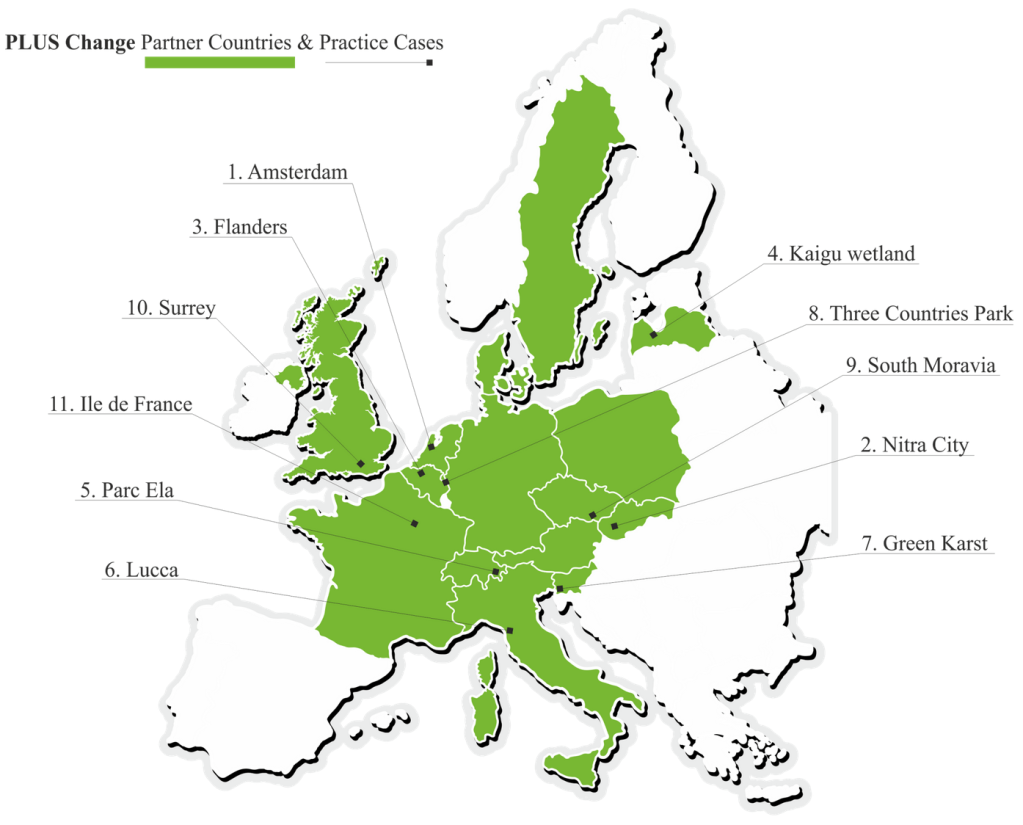
To do so, the project will (1) bridge across biodiversity and climate, recognising them as problems that share many of the same underlying drivers, and must be solved together; (2) bridge between individual behaviour changes of citizens and broader systems-wide changes in decision-making and policy at levels from local to national to EU; and (3) bridge between different areas of expertise to create a truly transdisciplinary project that includes social sciences, land use modelers and practitioners of land use planning.

The scientific partners in PLUS Change will work on land-use modelling, produce a planning toolkit and test participatory methods in the case regions.

Our research group will use meta-analytical tools to synthesize evidence on how governance and policy impact sustainable land-use change. We aim to identify what governance approaches and interventions (evidence-based? participatory? collaborative? scale-adapted? etc.) have worked in what contexts to achieve a more sustainable land-use. Building on these results, in-depth empirical research (interviews, document analysis) will be conducted in 12 local practice cases in various countries across Europe. We will develop a rich understanding of the historical development of land use, contentious land use issues and conflicts, and the role of policy, tenure and governance arrangements in shaping land use change.

Interested to join the Leuphana PLUS Change team as a PhD researcher? Shortly, we will advertise an open position at https://www.leuphana.de/en/university/open-positions/research-teaching.html.

Spatial mismatches impede the effective governance of global commodity flows

By Johanna Coenen, Gabi Sonderegger, Jens Newig, Patrick Meyfroidt, Edward Challies, Simon L. Bager, Louise M. Busck-Lumholt, Esteve Corbera, Cecilie Friis, Anna Frohn Pedersen, Perrine C.S.J. Laroche, Claudia Parra Paitan, Siyu Qin, Nicolas Roux, Julie G. Zaehringer 

In today’s interconnected world, local sustainability issues such as deforestation, biodiversity loss, agri-chemical pollution and food insecurity are increasingly shaped by global commodity flows and the actions of distant actors. The demand for commodities such as soy, palm oil, cocoa, rubber and meat can have adverse social and environmental consequences in the production regions that are often geographically distant from the consumption sites. Such sustainability challenges often transcend traditional political boundaries, posing difficulties in designing governance institutions that adequately fit their scale. Where governance institutions fail to align with the scale of the problems they are meant to address, we encounter issues referred to as “problems of fit”, “mismatches”, or “misfits”. The governance of global commodity flows is particularly beset with such problems of fit. 

In our recent article, published in Ecology and Society, we explore the spatial dimension of governance fit concerning global commodity flows. In doing so, we synthesize some key findings of the COUPLED project. We shed light on two key types of governance mismatches: boundary and resolution mismatches (Table 1). 

Table 1. Boundary and resolution mismatches in the governance of telecoupled social-ecological systems.

 Boundary mismatchResolution mismatch
DefinitionGovernance institutions neglect social-ecological problems that transcend established administrative or jurisdictional boundariesGovernance institutions have too coarse a spatial resolution than is suitable to address the social-ecological problems at hand
Underlying problemLack of governance extentLack of governance precision
MechanismSpilloverLeakagePanacea trap
DescriptionGovernance institutions do not govern a social-ecological problem that expands beyond their administrative or jurisdictional boundariesGovernance institutions address a social-ecological problem but create leakage(s), i.e., counterproductive effects outside the targeted area or domain of the interventionGovernance institutions are not specific enough to be effectively implemented and enforced

We present empirical examples of the different types of mismatches from both public and private governance perspectives in this publication. We also graphically illustrate the different mismatches. For example, Figure 1 displays boundary mismatches. 

Figure 1. Boundary mismatches. Governance institutions neglect social-ecological problems that transcend established jurisdictional boundaries due to spillovers (A) or leakages (B).


Furthermore, we examine three approaches to address mismatches, namely due diligence laws and policies, landscape and jurisdictional approaches to supply chain governance, and environmental provisions in trade agreements. We show that any attempt to resolve boundary or resolution mismatches comes with the risk of creating new mismatches. We find that no single governance approach can address all mismatches, emphasizing the need for the alignment of multiple governance approaches to effectively govern global commodity flows. 


Read the publication 

Coenen, J., Sonderegger, G., Newig, J., Meyfroidt, P., Challies, E., Bager, S., Busck-Lumholt, L. M., Corbera, E., Friis, C., Frohn Pedersen, A., Laroche, P. C. S. J., Parra Paitan, C., Qin, S., Roux, N., & Zaehringer, J. G. (2023). Towards spatial fit in the governance of global commodity flows. Ecology and Society, 28(2). 24.