The Independent Guardian, the Advisory/Coordination Body, and the Stakeholder Council

Three Types of Institutional Innovations Show How to Represent Future Generations in Political Decision-Making Today

By Michael Rose

The choices we make in politics today, whether regarding biodiversity loss, climate change, or social security systems, hold significant repercussions for the well-being of future (i.e., yet unborn) generations. The fact that future generations have no voice today may contribute to the governance failures prevalent in these realms and others. From a democratic perspective, the interests of all affected by political decisions should be considered in their formulation. Moreover, the guiding principle of sustainable development asks us to consider the needs of future generations alongside those of the present. But how could we give a voice to people who do not yet exist?

The German Bundestag hosts the Parliamentary Advisory Council on Sustainable Development, a member of the Network of Institutions for Future Generations (Photo: Robert Diam).

Several democracies have responded to this challenge by establishing specialized institutions. For instance, in 1993, the Finnish Parliament formed the Committee for the Future. Shortly thereafter, in 1995, Canada established the Commissioner for Environment and Sustainable Development. Both institutions remain active today. From 2001 to 2005, the Israeli Knesset had a Parliamentary Commissioner for Future Generations. Following suit, in 2008, the Hungarian Parliament introduced an Ombudsman for Future Generations, although this position was later downgraded by the Orbán Government in 2012. Notably, the Future Generations Commissioner for Wales stands out as a prominent example of how democracies evolve their institutional frameworks to consider future generations today.

Twenty-five institutions in 17 democracies

In my article “Institutional Proxy Representatives of Future Generations: A Comparative Analysis of Types and Design Features”, I formulated the notion of institutional proxy representation of future generations to provide a theoretical foundation for these institutional advancements. Furthermore, I applied this concept to build a comprehensive inventory of empirical instances of institutional proxy representation across democracies worldwide. Through this analysis, I identified 25 institutions for future generations – or “proxies” – in 17 democracies.

The proxies are grouped into three types, based on the rationale of selecting their members: The expertise-driven independent guardian (type I), the political or administrative advisory or coordination body (type II), and the sustainability stakeholder council or commission (type III). For each proxy (and proxy type), I assessed how it is designed, and how this translates into its formal capacity to influence political decision-making.

Three types

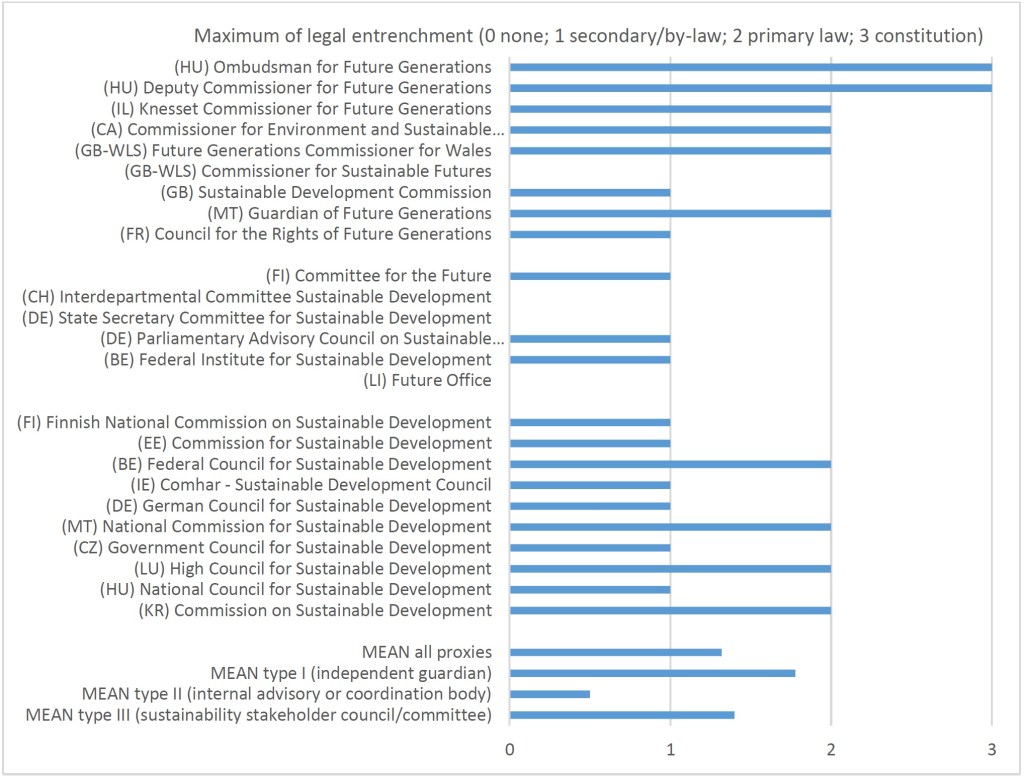
Type I proxies – the independent guardians – typically comprise experts who are not part of government or parliament. This allows them to consider the needs of future generations from a professional point of view with minimal political interference. These proxies often have robust legal foundations and wield specific political instruments usually not found in other proxy types, such, legal rights of action, a suspensive veto, ombudsperson functions, legislative proposals, and auditing, including independent investigation rights. Type I includes all the strongest, but also some of the weakest proxies examined in this study. The strongest ones can not only voice the interests of future generations, but can also make sure they are heard by parliament or government. However, the survival rate of type I proxies is rather low.

Type II proxies – the political or administrative advisory or coordination bodies – are, to a certain extent, the counter-model to type I. They are not independent, but internal parts of the political system, comprising either Members of Parliament or members of the governmental departments. Operating on a predominantly weak legal footing, they provide internal advisory, coordination, and sometimes monitoring services to enhance political decision-making from within, with a view toward benefitting future generations. They only have limited political instruments at their disposal and can access only few stages of the policy cycle, which makes them heavily reliant on good working relationships with other parts of parliament and government.

Type III proxies – the sustainability stakeholder councils or committees – are designated parts of the sustainability governance architecture of their host countries. Embracing the principles of functional representation and participation, members are appointed from different sectors of society to broaden societal outreach, provide general advice and specific policy recommendations to the government, and oftentimes monitor and review sustainability-related developments. While they lack particularly strong or weak formal capacities to influence political decision-making, they show the highest survival rate among the three types, possibly attributable to their integration across multiple sectors.

Design features

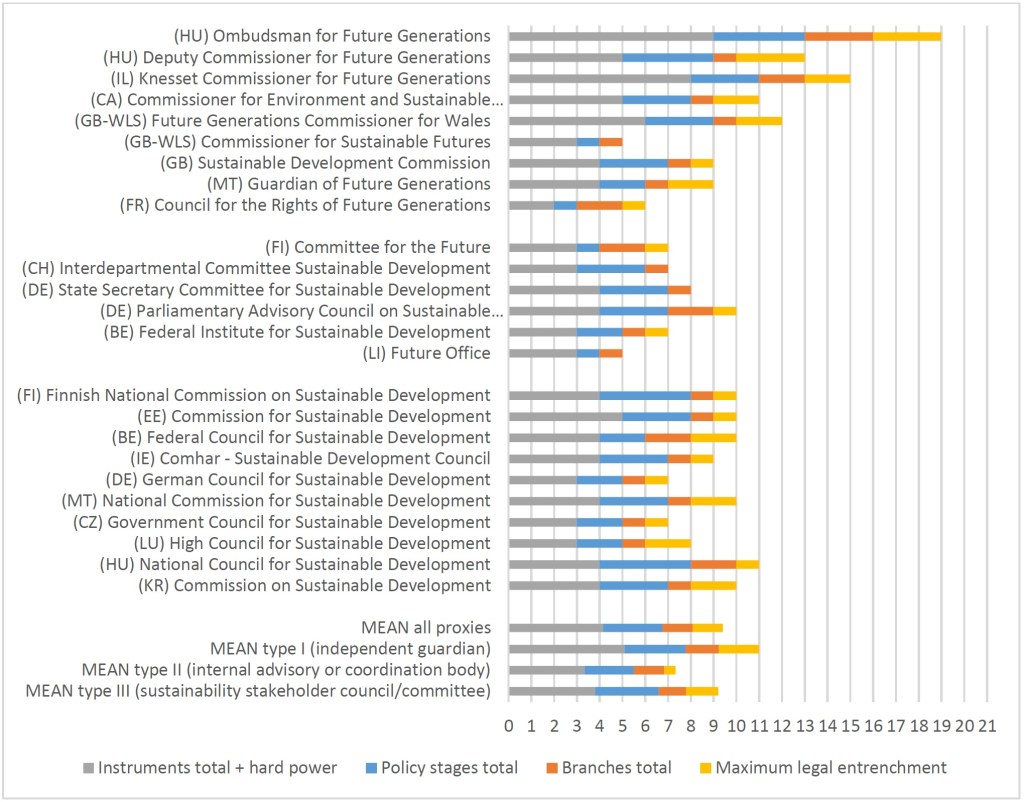
I assessed each proxy to determine the legal basis upon which it was established, the political instruments it was granted, and the branches of government and stages of the policy cycle it could engage with through these instruments. This figure shows the distribution of political instruments across proxies and types. Proxies were created with these instruments to allow them to monitor and influence political decision-making and reach out to society. To learn more about proxies’ access to branches of government and phases of the policy cycle, as well as their legal bases and total formal capacity to influence political decision-making, please scroll through the slideshow.
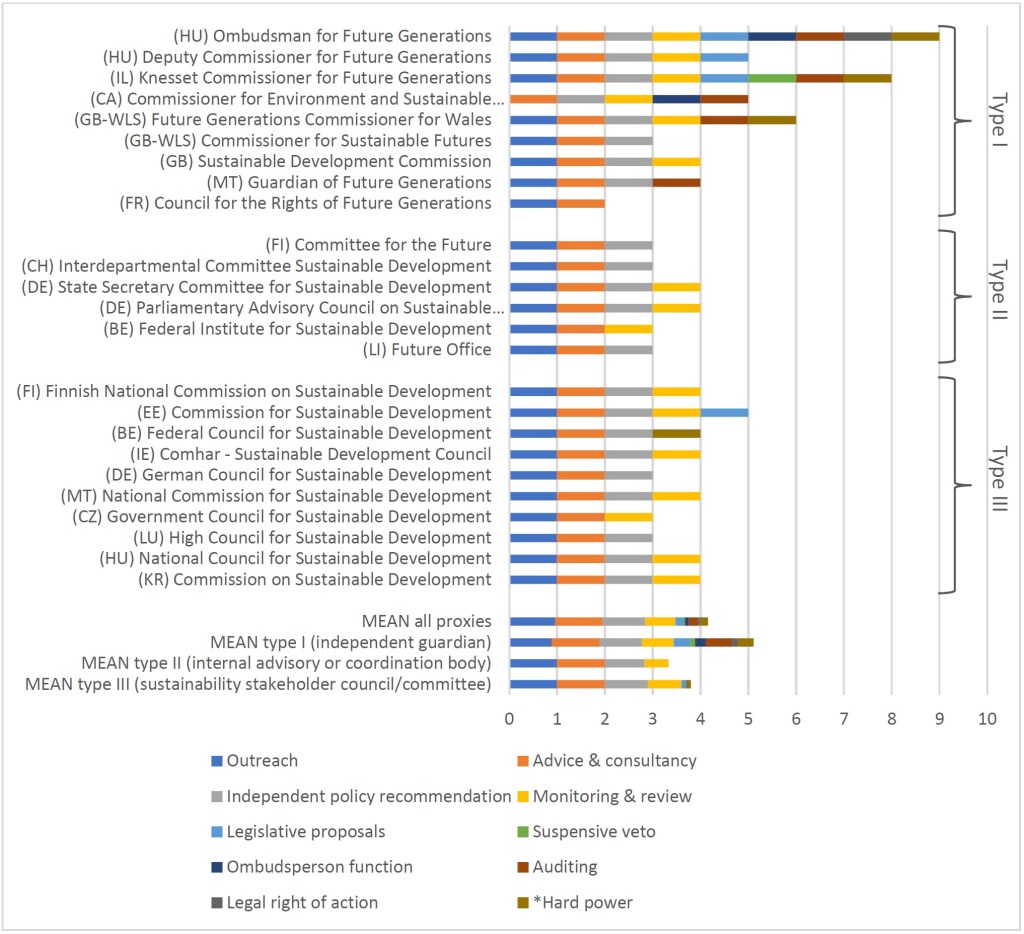
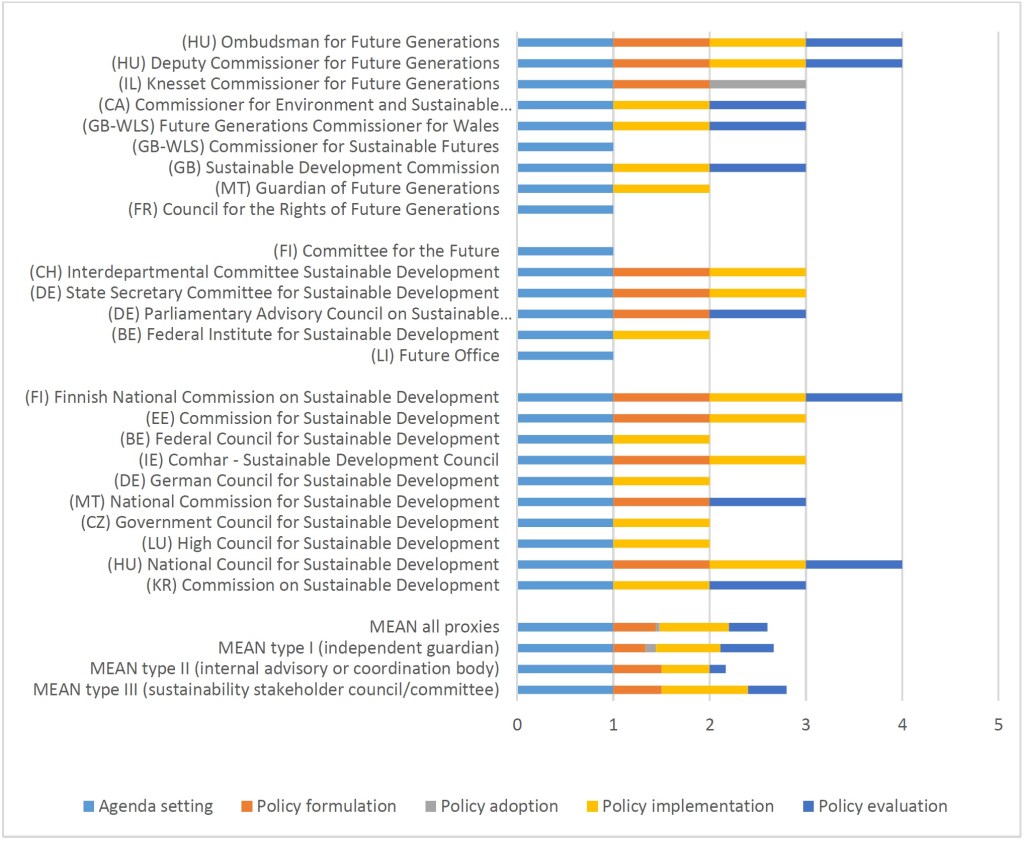
Political instruments | Access to stages of the policy cycle | Access to branches of government | Legal basis | Total formal capacity to influence political decision-making

A multifaceted landscape of institutionalized voices of future generations

In general, the diverse and dynamic array of proxies, although relatively small in number, provides manifold examples of institutional innovations illustrating how the interests of future generations can be considered in political decision-making. However, while some of these proxies can act as watchdogs with teeth when ignored, many seem to represent rather cosmetic than far-reaching reforms of the democratic decision-making process. Therefore, it is important not to place excessive expectations on these proxies in terms of effecting significant policy changes to the benefit of future generations. For more detailed and inspirational results, download the full study here.

Reference
Rose, Michael (2024): Institutional Proxy Representatives of Future Generations: A Comparative Analysis of Types and Design Features, in: Politics and Governance 12, Art. 7746 (21 pages). DOI: 10.17645/pag.7745

Workshop Invitation: Democracy & Intergenerational Justice – Overcoming Harmful Short-termism Through New Institutions? (8–9 September 2020)

By Michael Rose

Sustainable development requires legitimate and effective governance for the long-term that somehow considers the needs of future generations. As part of the MANCEPT Workshops 2020, an annual conference in political theory at the University of Manchester (this time online), we co-organise a two-day panel to discuss the relationship between democracy and intergenerational justice and the opportunities and challenges of institutional reform.

Date: 8–9 September 2020, from 9 to 18:30 hrs (British Summer Time UTC+1), online

We welcome everyone who is interested in the topic! There is no fee for non-presenters, just send me an e-mail to get the Zoom login data. Let me know if you’d be willing to volunteer as a discussant (not required).

On Tuesday, Axel Gosseries will give a keynote speech “On Why We Should Not Expect Too Much from Intergenerational Legitimacy“ (11:3012:30).

On Wednesday, Simon Caney will deliver a keynote speech on “The Challenges of Governing for the Long-Term: Why the Problem is Deep” (11:0012:00).

Workshop Description

Democracies are commonly diagnosed with a harmful short-sightedness which makes it difficult to recognise and deal with long-term risks and challenges. This bias towards the present arises out of many institutional, cultural, and anthropological factors, among them the election cycle, the influence of special interest groups and the ineptitude of humans to deal with ‘creeping problems.’ In light of this, democracies seem ill-equipped to deal with challenges such as the climate crisis, artificial intelligence or microbial resistance. Thus, the ability of the living generation to take the interests of future people into account and to fulfil its obligations to future people is hampered.

Consequently, several countries have taken measures to facilitate long-term oriented decision-making, e.g. by establishing commissioners for future generations (Hungary, since 2008; Israel, 2001-06; Wales, since 2016) or a parliamentary committee for the future (Finland, since 1993), some of them having considerable capabilities for influence. Furthermore, scholars discuss a wide range of proposals for new future-oriented institutions (F-Institutions). These include the representation of future generations in parliament, ombudspersons for the future, regulatory impact assessments, advisory councils, deliberative mini-publics as well as the enfranchisement of the young, the disenfranchisement of the elderly and many more.

Despite the growing range of proposals for F-Institutions, questions regarding their justification and legitimacy, design, and implementation deserve further discussion. Intergenerational equity, democratic legitimacy, and generational sovereignty all exert their normative pull on the democratic system and consequently on the design of F-Institutions. For example, the ability of each generation to govern itself collectively seems incompatible with the idea of institutionally binding the currently living to ensure that they meet their obligations of intergenerational justice. Further, honouring obligations of intergenerational justice may suggest installing F-Institutions with extensive influence on the political decision-making process, while a concern for democratic legitimacy might foreclose many proposals for F-Institutions.

In sum, this workshop aims to bring together moral, political, and legal theorists and practitioners interested in democracy, intergenerational justice, long-term decision-making and short-termism to discuss the various tensions associated with these concepts on both the theoretical and empirical levels.

Macro-Level Datasets for Sustainability Governance

By Michael Rose

Comparative politics scholars love macro data. To comparatively analyze all kinds of nation states and institutions, they build datasets on their characteristics. For example, there are several datasets and indices that help to assess and eventually measure democracies and autocracies worldwide, such as the Freedom House Index, Varieties of Democracy, The Economist’s Democracy Index, or the Polity Project. But data are systematically collected and made available to the research community far beyond democracy indices (see below).

In sustainability governance research, though, these kinds of databases are rarely used or developed. This is a pity, as comparative (macro) data could help to conduct mid- and large-n studies, account for important parts of context variance in comparative case studies, and thereby facilitate relating and cumulating knowledge.

The following list offers a selection of open access datasets used in political science that can be of great benefit for sustainability governance scholars. Feel free to post additional datasets in the comment section!

The Comparative Constitutions Project codes the world’s constitutions, including variables on the states’ polity (branches of government, formal institutions, election rules, federalism) and the constitutions’ issue areas, e.g. if and how the constitution refers to the environment and natural resources. Constitutional changes are tracked on a yearly basis (Elkins et al. 2019).

Polity IV accounts for democratic and authoritative regimes, including variables such as the central state authority, executive constraints, political participation, and transitions (Center for Systemic Peace 2019).

ParlGov provides data on parties, elections and cabinets for 37 western democracies (Döring and Manow 2019).

The Party Manifesto Project codes, inter alia, the party family of ecological parties and statements regarding environmental protection and sustainability in party manifestos (electoral programs) (Volkens et al. 2019).

World Values Survey and European Values Study include aggregatable information on the interviewee’s membership in environmental organizations, attitudes towards environmental care, participation in demonstrations for the environment, donating behavior towards ecological organizations, confidence in the environmental protection movement, and satisfaction with issues such as air quality, public transport, or water quality (Inglehart et al. 2019; European Value System Study Group et al. 2019).

The Sustainable Governance Indicators analyze the policy performance and governance capacities in EU and OECD countries. This includes environmental policies and outcomes (such as waste and GHG emissions), the participation in multilateral environmental agreements and evidence-based instruments such as sustainability checks (Bertelsmann Stiftung 2018; Schraad-Tischler et al. 2018).

The Environmental Performance Index analyses 24 performance indicators for 180 countries (Wendling et al. 2018).

And, of course, the statistics departments of international organizations such as the World Bank and the OECD provide many additional time-series data on key economic, social, environmental, government and development indicators (World Bank 2019; OECD 2019).

Moreover, in their Sustainable Development Report, the Bertelsmann Foundation and the Sustainable Development Solutions Network jointly track the SDG achievements of most of the world’s nations statistically (Sachs et al. 2019).

Cited literature

Bertelsmann Stiftung (2018): Sustainable Governance Indicators. Gütersloh. Available online at http://www.sgi-network.org.

Center for Systemic Peace (2019): Polity IV Project. Vienna (Virginia). Available online at https://www.systemicpeace.org/polityproject.html, checked on 8/14/2019.

Döring, Holger; Manow, Philip (2019): Parliaments and governments database (ParlGov). Information on parties, elections and cabinets in modern democracies. Available online at parlgov.org, checked on 8/13/2019.

Elkins, Zachary; Ginsburg, Tom; Melton, James (2019): Comparative Constitutions Project. Informing constitutional design. Available online at https://comparativeconstitutionsproject.org.

European Value System Study Group; Tilburg University; GESIS (2019): European Values Study. Tilburg, Mannheim. Available online at https://europeanvaluesstudy.eu, checked on 8/13/2019.

Inglehart, R.; Haerpfer, C.; Moreno, A.; Welzel, C.; Kizilova, K.; Diez-Medrano, J. et al. (2019): World Values Survey. Edited by JD Systems Institute. Madrid. Available online at http://www.worldvaluessurvey.org, checked on 8/13/2019.

OECD (2019): OECD.Stat. Paris. Available online at https://stats.oecd.org/.

Sachs, J.; Schmidt-Traub, G.; Kroll, C.; Lafortune, G.; Fuller, G. (2019): Sustainable Development Report 2019. Transformations to achieve the Sustainable Development Goals. Edited by Bertelsmann Stiftung, Sustainable Development Solutions Network (SDSN). New York. Available online at https://sustainabledevelopment.report.

Schraad-Tischler, Daniel; Schiller, Christof; Hellmann, Thorsten; Lopes, Elisabeth Faria (2018): Policy Performance and Governance Capacities in the OECD and EU. Sustainable Governance Indicators 2018. Edited by Bertelsmann Stiftung. Gütersloh. Available online at https://www.sgi-network.org/docs/2018/basics/SGI2018_Overview.pdf, checked on 8/2/2019.

Volkens, Andrea; Krause, Werner; Lehmann, Pola; Matthieß, Theres; Merz, Nicolas; Regel, Sven; Weßels, Bernhard (2019): The Manifesto Data Collection. Manifesto Project (MRG/CMP/MARPOR). Edited by Wissenschaftszentrum Berlin für Sozialforschung (WZB). Berlin. Available online at https://manifesto-project.wzb.eu, checked on 8/13/2019.

Wendling, Z. A.; Emerson, J. W.; Esty, D. C.; Levy, M. A.; Sherbinin, A. de; et al. (2018): 2018 Environmental Performance Index. Edited by Yale Center for Environmental Law and Policy. New Haven. Available online at https://epi.yale.edu.

World Bank (2019): World Bank Open Data. Free and open access to global development data. Available online at https://data.worldbank.org/.